
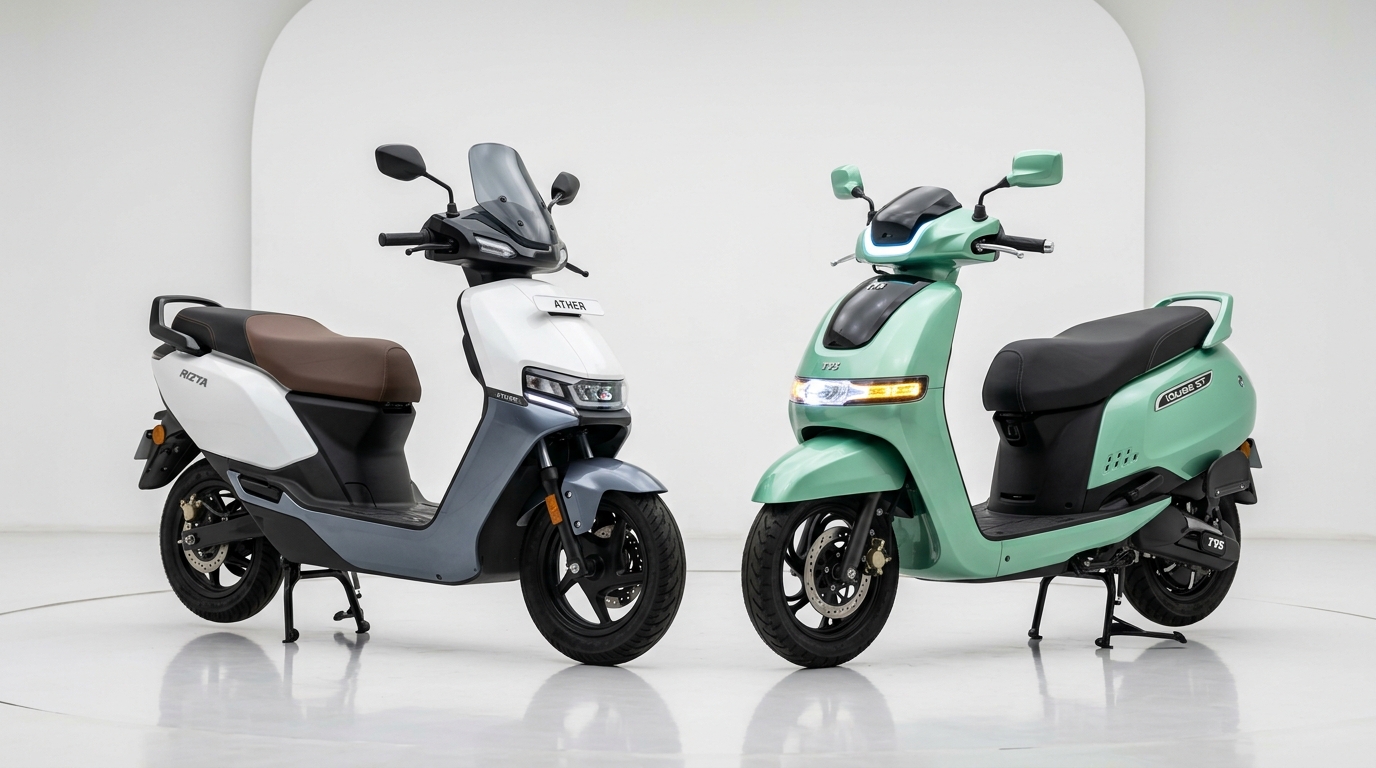
As urban family riders transition from combustion scooters to electric mobility, two models have emerged at the forefront of the practicality segment: the Ather Rizta and the TVS iQube. While early electric scooters prioritized sporty acceleration and aggressive ergonomics, these two focus squarely on everyday utility, pillion comfort, and predictable real-world range.
The decisive differentiator between the two is cargo capacity. Ather engineered the Rizta with a 34-liter under-seat compartment paired with an optional 22-liter front Frunk, providing a total of 56 liters of enclosed storage. In contrast, the TVS iQube features a 32-liter under-seat tub without a front trunk option. For internal combustion commuter benchmarks, explore our Suzuki Access 125 vs Honda Activa 125 comparison and our Bajaj Freedom 125 CNG real-world review.
On the battery front, the Rizta's 3.7 kWh pack delivers approximately 125 km of real TrueRange in mixed city riding, compared to 115 km on the TVS iQube 3.4 kWh variant. In suspension performance, TVS edges ahead with its dual rear hydraulic shock absorbers offering plusher bump absorption than Ather's firmer monoshock setup. Calculate your exact running cost savings against petrol using our EV finance calculator and check the latest industry news on our motorcycle news page.
Frequently Asked Questions (FAQs)
Which scooter has more boot space: Ather Rizta or TVS iQube? +
Ather Rizta offers 34 liters under the seat plus an optional 22-liter front Frunk, giving a total of 56 liters of cargo storage. TVS iQube offers 32 liters of under-seat storage without a front trunk.
What is the real-world range difference between Rizta and iQube? +
The Ather Rizta (3.7 kWh pack) delivers approximately 125 km of real TrueRange in city riding, while the standard TVS iQube (3.4 kWh pack) delivers around 115 km on a full charge.