TECHNICAL SPECIFICATIONS DASHBOARD
INDEPENDENT TECHNICAL REVIEW
With fuel prices skyrocketing across South Asia, commuting budgets have been severely squeezed. Commuters are facing a critical choice: should they buy a traditional 70cc/100cc petrol scooter or switch to an electric scooty? We break down the **real running costs over a 5-year ownership cycle**.
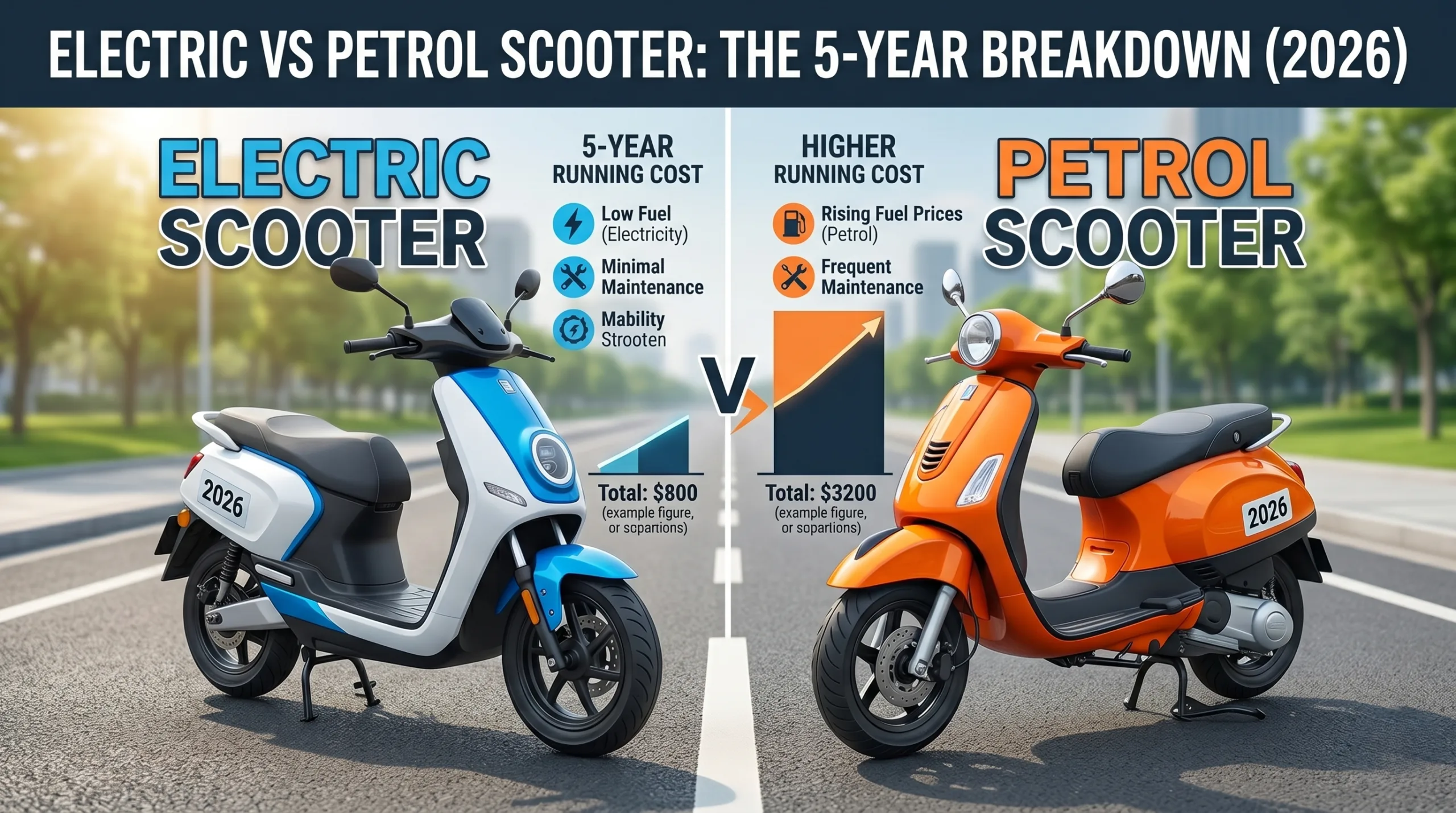
A standard petrol bike (like the Honda CD70) consumes roughly 1 liter of fuel every 40-50 km, costing about Rs. 5.00 to Rs. 6.00 per kilometer. On the other hand, an electric scooter consumes about 1.8 units of electricity per full charge (running 70-80 km), costing only Rs. 0.80 to Rs. 1.00 per kilometer. This creates an immediate **80% reduction in daily energy costs**.
Maintenance further highlights the divide. Petrol bikes require monthly engine oil changes, air filters, and spark plugs, costing roughly Rs. 6,000 to Rs. 8,000 annually. EVs eliminate the engine entirely. However, the EV owner must factor in **battery replacement costs** (approx. Rs. 40,000 for Graphene or Rs. 90,000 for Lithium) after 3 to 4 years of daily runs.
Running Cost & 1-Year Ownership Cost Analysis
We analyze the hard financial data: fuel or electricity cost per kilometer and the total 1-year cost of ownership (assuming a standard annual commute of 8,000 km, including regular tuning, taxes, and charging):
1. Running Cost per Kilometer
| Vehicle Model | Efficiency Rate | Real Cost per KM |
|---|---|---|
| EVCOSTOPX | Real-World Commute | Rs. 0.90 |
2. 1-Year Total Ownership Expenses (8,000 KM)
Comparative comparison: Electric Scooter (Rs. 0.90 per KM) vs Petrol Scooter (Rs. 5.50 per KM).
| Vehicle Model | Annual Run | Total Annual Cost |
|---|---|---|
| EVCOSTOPX | 8,000 km | Rs. 7,200 |
Owner's Voice & Longitudinal Commuter Feedback
"Switching to a Metro electric scooter saved my family budget. We travel 40 km daily, and our commuting expenses dropped from Rs. 7,000 a month to under Rs. 1,000." — Kamran Mughal, teacher, Karachi
Who is this for?
Perfect for daily urban commuters, delivery riders, and students traveling between 30 km to 70 km daily who want to maximize monthly cash savings. Avoid if you regularly drive over 100 km a day.
Pros & Cons Checklist
PROS / ADVANTAGES
- Saves up to Rs. 38,000 annually in pure fuel expenses
- Eliminates routine engine oil, filter, and tuning maintenance costs
- Quiet, zero-emission travel protects residential air quality
- Recovers the initial EV premium cost within 18 months of driving
CONS / LIMITATIONS
- Requires a large lump-sum battery replacement cost every 3–4 years
- Standard domestic charging takes 5 to 7 hours compared to instant fuel refills
- Lower resale value for older EV models compared to petrol commuters
FREQUENTLY ASKED QUESTIONS (FAQ)
RELATED RECOMMENDATIONS
Fuel vs Electricity: The Cost Per Kilometre Truth
The single most important number when comparing electric and petrol scooters is cost per kilometre. Everything else — range, speed, features — is secondary for a budget-conscious commuter. Let's break it down with 2026 real prices.
A petrol scooter at 45 km/l with petrol at Rs. 105/litre (Mumbai price, June 2026) costs Rs. 2.33/km in fuel alone. An electric scooter consuming 25 Wh/km with electricity at Rs. 8/unit costs Rs. 0.20/km. The ratio: petrol costs 11.6x more per kilometre than electricity. Over 10,000 km/year, that's Rs. 23,300 in petrol vs Rs. 2,000 in electricity — a Rs. 21,300/year saving.
Complete 5-Year Cost Comparison Model
| Cost Category | Petrol Scooter (Honda Activa 6G) | Electric Scooter (TVS iQube ST) |
|---|---|---|
| Ex-Showroom Price | Rs. 79,900 | Rs. 1,10,000 |
| Registration + Insurance (Y1) | Rs. 12,000 | Rs. 8,000 (green vehicle discount) |
| Annual Fuel/Electricity Cost | Rs. 23,300/year | Rs. 2,000/year |
| Annual Service Cost | Rs. 8,500/year | Rs. 1,800/year |
| Total 5-Year Running Cost | Rs. 1,59,000 | Rs. 19,000 |
| 5-Year Total Ownership Cost | Rs. 2,50,900 | Rs. 1,37,000 |
The electric scooter is Rs. 1,13,900 cheaper over 5 years despite costing Rs. 30,100 more at purchase. Break-even point occurs at approximately 18–24 months for a 10,000 km/year commuter.
Hidden Costs Most Comparisons Miss
For Petrol Scooters: Engine oil change every 2,000–3,000 km (Rs. 350–500 including labour); air filter replacement annually (Rs. 200–350); carburetor cleaning every 15,000 km (Rs. 800–1,200); spark plug replacement (Rs. 150–300); chain replacement every 20,000–30,000 km (Rs. 800–1,500); valve adjustment at 15,000 km intervals (Rs. 400–600). Total hidden annual cost: Rs. 3,500–5,000.
For Electric Scooters: Tyre wear is comparable. Brake pads last 30–40% longer due to regenerative braking. Battery check annually (usually free under warranty). Software updates are OTA — free. Hidden annual cost: Rs. 500–1,200 (mostly tyres). Zero engine maintenance — this is the biggest differentiator.
Depreciation & Resale Value Reality
Petrol scooter depreciation is well-understood: a Honda Activa loses approximately 15–20% of value in Year 1, then 10–15%/year thereafter. An Activa bought at Rs. 79,900 is worth approximately Rs. 45,000–55,000 after 3 years.
Electric scooter depreciation is still maturing but follows a steeper curve: 20–25% in Year 1, stabilising at 12–18%/year. A TVS iQube ST bought at Rs. 1,10,000 is worth approximately Rs. 55,000–65,000 after 3 years — similar absolute resale value. Battery health certification (now offered by Ola, TVS, and Ather) significantly impacts resale price — scooters with documented battery health above 85% command 15–25% premium on used markets.
When Petrol Still Wins: Honest Assessment
Despite the economics favoring EVs for daily commuters, petrol scooters remain superior in specific scenarios: (1) Riders who regularly travel 150+ km in a single trip without charging access. (2) Riders in rural India where the nearest service center for EVs is 100+ km away. (3) Buyers who keep scooters for 7–10 years — battery replacement cost at Year 5 (Rs. 25,000–45,000) can erode savings if not accounted for. (4) Small business delivery riders who need 200+ km/day coverage — battery swapping infrastructure not yet mature enough outside top 10 cities.
📊 The Verdict
For any urban commuter riding 20–80 km daily with home charging access, an electric scooter is definitively cheaper over a 3–5 year ownership period. The Rs. 21,000–23,000 annual fuel saving alone justifies the price premium in 12–18 months. The only scenario where petrol wins is long-distance highway travel and rural areas without EV service support. If you're reading this and live in a city, the numbers are clear: your next scooter should be electric.
Frequently Asked Questions
What is the break-even point between electric and petrol scooters?
For a 10,000 km/year commuter, the break-even point for a Rs. 30,000 price premium (typical EV vs petrol equivalent) is approximately 16–20 months, factoring in both fuel and maintenance savings. Heavy users (15,000+ km/year) break even in 12–14 months.
Is the maintenance cost of electric scooters really lower?
Yes, significantly. Electric scooters have no engine oil, spark plugs, air filters, carburetors, timing chains, or fuel injectors. Annual maintenance typically costs Rs. 1,200–2,500 versus Rs. 6,000–10,000 for petrol scooters. The only comparable maintenance item is tyres and brake pads.
How does insurance compare for electric vs petrol scooters?
Comprehensive insurance for EVs is typically 10–15% cheaper than equivalent petrol scooters due to green vehicle discounts. Some insurers (Bajaj Allianz, HDFC Ergo) now offer battery-specific coverage as an add-on, worth considering for scooters with batteries above 3 kWh.
What happens when the electric scooter battery needs replacement?
Battery replacement cost ranges from Rs. 25,000 (2 kWh) to Rs. 55,000 (4 kWh+). This typically occurs 5–8 years into ownership. The best financial protection: choose brands with long battery warranties (TVS: 3 years/40,000 km; Ola: 3 years/60,000 km; Revolt: included in subscription). Alternatively, Revolt's BaaS model eliminates this risk entirely.
Are electric scooters cheaper to insure than petrol scooters?
Generally yes — by 10–20%. IRDAI mandates third-party insurance for all vehicles; comprehensive premiums for EVs are lower partly due to lower claim frequency and partly due to green incentives offered by several insurers. Annual premium for a Rs. 1,10,000 EV is approximately Rs. 3,500–4,200 comprehensive versus Rs. 4,000–5,500 for a similarly-priced petrol scooter.