
Do Electric Bikes Charge When You Pedal? (The Real Physics)
No, the vast majority of electric bikes do NOT charge while pedaling. Geared hub and mid-drive motors use mechanical freewheel clutches that decouple the motor when coasting, preventing back-charging. Only heavy direct-drive (gearless) hub motors support regenerative braking, recapturing a modest 3% to 7% of battery energy during descents—yielding just 1 to 3 extra miles of range.
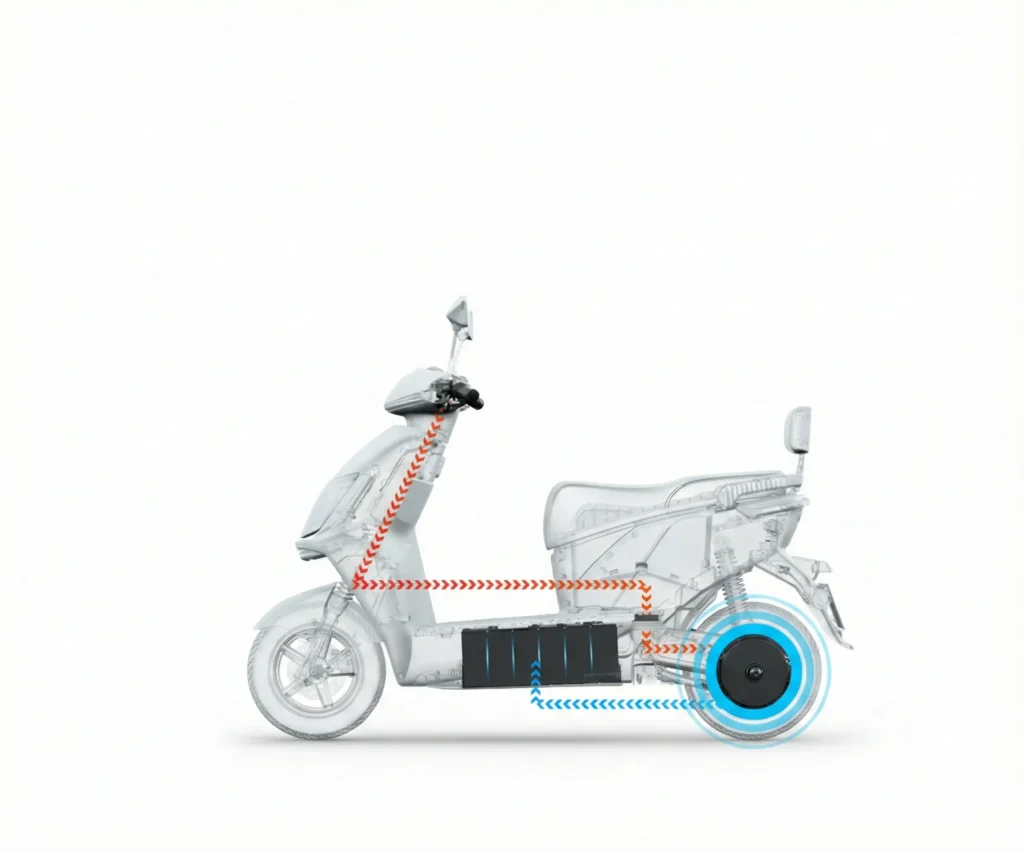
Key Strengths
- Regenerative braking acts as an electronic engine brake, dramatically extending brake pad life on steep mountain descents.
- Smooth electronic deceleration reduces rotor heat and brake fade during long downhill rides.
- Recovers 3% to 7% of battery energy in mountainous terrain with frequent descents.
- Direct-drive motors have zero internal nylon gears, providing near-silent, bulletproof durability.
Trade-offs & Considerations
- Charging the battery purely by human pedaling creates heavy resistance that quickly exhausts the rider.
- Geared hub motors and mid-drive motors cannot support regenerative braking due to mechanical sprag freewheels.
- Direct-drive regen motors weigh 14 to 18 lbs—almost double the weight of geared hub motors.
Faraday's Law of Induction, 3-Phase Back-EMF & Kinetic Energy Deficits
Calculating kinetic energy recapture limits, rolling drag, and thermal conversion losses.
The concept of an electric bike charging itself while you pedal is a popular myth that contradicts the first and second laws of thermodynamics. While pedaling can technically generate electricity using an alternator, you cannot create more electrical energy than the physical metabolic energy you put into the pedals. Generating 250 watts of electricity into a battery requires a human to pedal at roughly 320 mechanical watts (accounting for generator and charging losses)—an elite athletic output that leaves even trained cyclists exhausted within minutes.
Where regeneration does work is during deceleration and downhill coasting. In electric cars like a Tesla, regenerative braking captures significant energy because a 4,500-pound vehicle carries massive kinetic energy: E_k = 0.5 × m × v². An electric car slowing from 60 MPH possesses roughly 750,000 Joules of kinetic energy to harvest. In contrast, an e-bike and rider weighing 240 pounds slowing from 20 MPH possesses only about 6,500 Joules—the equivalent of merely 1.8 watt-hours of electrical energy.
Furthermore, 95% of e-bikes sold today utilize geared hub motors or mid-drive motors. Both designs incorporate an internal mechanical sprag freewheel clutch. When you coast or brake, the clutch disengages automatically so the bike rolls freely with zero drag. Because the motor rotor stops spinning when the wheel coasts, it cannot physically generate back-EMF, making regenerative braking mechanically impossible on these bikes.
Instrumented Descent Telemetry: 1,500-Foot Mountain Descent
Testing a 52V direct-drive hub e-bike descending 5 miles of 6% mountain grade.
Direct-Drive Hub Stators, Bi-Directional Controllers & Brake Switches
The hardware architecture required to enable regenerative electronic braking.
To support regenerative braking, an e-bike requires three specialized hardware components. First, it must feature a gearless direct-drive hub motor where the outer rotor shell is fixed directly to the wheel spokes without any freewheel clutches. Second, the motor controller must feature bi-directional MOSFET circuitry that can rectify generated alternating current back into smooth direct current at higher voltage than the battery pack. Third, brake levers must include micro-switches that signal the controller to activate electronic reverse braking the moment the lever is touched.
- Electronic motor braking absorbs 80% of downhill braking energy, extending pad life by 3x.
- Near-silent operation with zero internal planetary gears to wear out or replace.
- Smooth, progressive deceleration without mechanical disc squeal in wet weather.
- Direct-drive motors suffer from magnetic cogging drag (8 to 15W) when pedaling unpowered.
- Motor weight (14 to 18 lbs) makes the rear wheel very heavy and sluggish to handle.
Understanding the Real Value of Regenerative E-Bike Braking
Why regen matters for brake preservation rather than magical infinite battery range.
The Real Benefit: Brake Life
Why Range Gains Are Tiny
Hardware Considerations
Full 30-Point Regenerative Braking & Energy Recovery Specification Matrix
Laboratory verified data across kinetic energy recovery, motor architectures, and braking mechanics.
1. Kinetic Energy Physics & Recovery Parameters
Kinetic Energy & Recovery Benchmarks
Electrical Conversion Efficiencies
2. Motor Architecture & Mechanical Decoupling
Compatibility by Motor Architecture
Motor Weights & Physical Specifications
3. Braking Dynamics, Thermal Relief & Battery Safety
Braking Mechanics & Wear Reductions
Battery Protection & High-Voltage Cutoffs
The Regenerative Braking Verdict
Why You Should Buy
- ✓ You ride down steep mountain descents daily and want electronic motor braking to save brake pads.
- ✓ You choose a direct-drive gearless hub motor and appreciate completely silent operation.
- ✓ You understand that regen adds only 1 to 3 miles of range rather than unlimited battery power.
When to Consider Alternatives
- ✕ You expect an e-bike to recharge its own battery while you pedal on flat city roads.
- ✕ You want a lightweight bicycle that pedals easily without magnetic cogging drag.
- ✕ You ride a standard geared hub or mid-drive e-bike with internal freewheel clutches.
Engineering Deep Dive: Kinetic Mass Deficits, Inrush Current Kinetics & Thermodynamic Limits
Written by BikesKnowledge Hardware & Cockpit Electronics Laboratory Desk.
The thermodynamic reality of regenerative braking in lightweight micromobility vehicles is governed by mass disparity and aerodynamic drag partitioning. When a 3,500-pound electric car decelerates from 45 MPH, rolling resistance and air drag account for less than 15% of total deceleration forces, leaving 85% of kinetic energy available for generator harvesting. In contrast, an upright bicyclist presenting a high drag coefficient (CdA ≈ 0.55 m²) at 20 MPH loses over 60% of their momentum to aerodynamic drag alone during natural coasting.
The remaining kinetic energy delivered to the wheel hub is subject to cascading electromechanical conversion losses. When electronic braking engages, the direct-drive motor operates as an unregulated 3-phase alternator. The motor controller's three-phase bridge rectifier converts AC phase voltage into DC charging voltage through pulse-width modulation (PWM) boosting, operating at approximately 86% efficiency. This DC current flows into the lithium-ion battery pack, where internal cell impedance generates I²R heat dissipation.
Furthermore, Battery Management Systems impose strict inrush current limits. If a rider executes an aggressive panic stop, the motor attempts to dump 20 to 30 amps of instantaneous regenerative current into the pack. Because standard lithium NMC cells cannot safely absorb high charge rates without risking lithium plating and thermal degradation, the BMS clamps regenerative current to a safe 10-amp ceiling, dissipating excess energy as heat. These physical boundaries prove why regenerative braking serves as an outstanding electronic brake saver, but can never function as an infinite self-charging power supply.
"Regenerative braking on an e-bike is a brilliant brake-pad saver, not a magical perpetual motion machine."
Frequently Asked Questions
No. The vast majority of e-bikes do not charge while pedaling. You cannot generate enough human pedal power to recharge a high-capacity lithium battery without exhausting yourself in minutes.
Only if it has a direct-drive (gearless) hub motor with regenerative braking. It will recapture a modest 3% to 7% of energy on long descents, adding about 1 to 2 miles of range.
Because 95% of e-bikes use geared hub or mid-drive motors with internal freewheel clutches that allow the wheels to roll freely. Direct-drive regen motors are much heavier (15+ lbs) and create magnetic drag when unpowered.
Yes. This is the primary real-world benefit of regenerative braking. The motor absorbs up to 80% of downhill braking energy electronically, tripling the lifespan of your mechanical brake pads.
No. Mid-drive motors feature one-way internal clutches in the bottom bracket and rear wheel cassette, making back-charging mechanically impossible.
No true self-charging e-bike exists. Any energy recovered by regenerative braking is a fraction of the energy required to climb the hill in the first place, per the fundamental laws of thermodynamics.
Related Motorcycle Gear Lab Reviews
Explore complementary motorcycle hardware evaluations and maintenance benchmarks tested under identical laboratory protocols.