
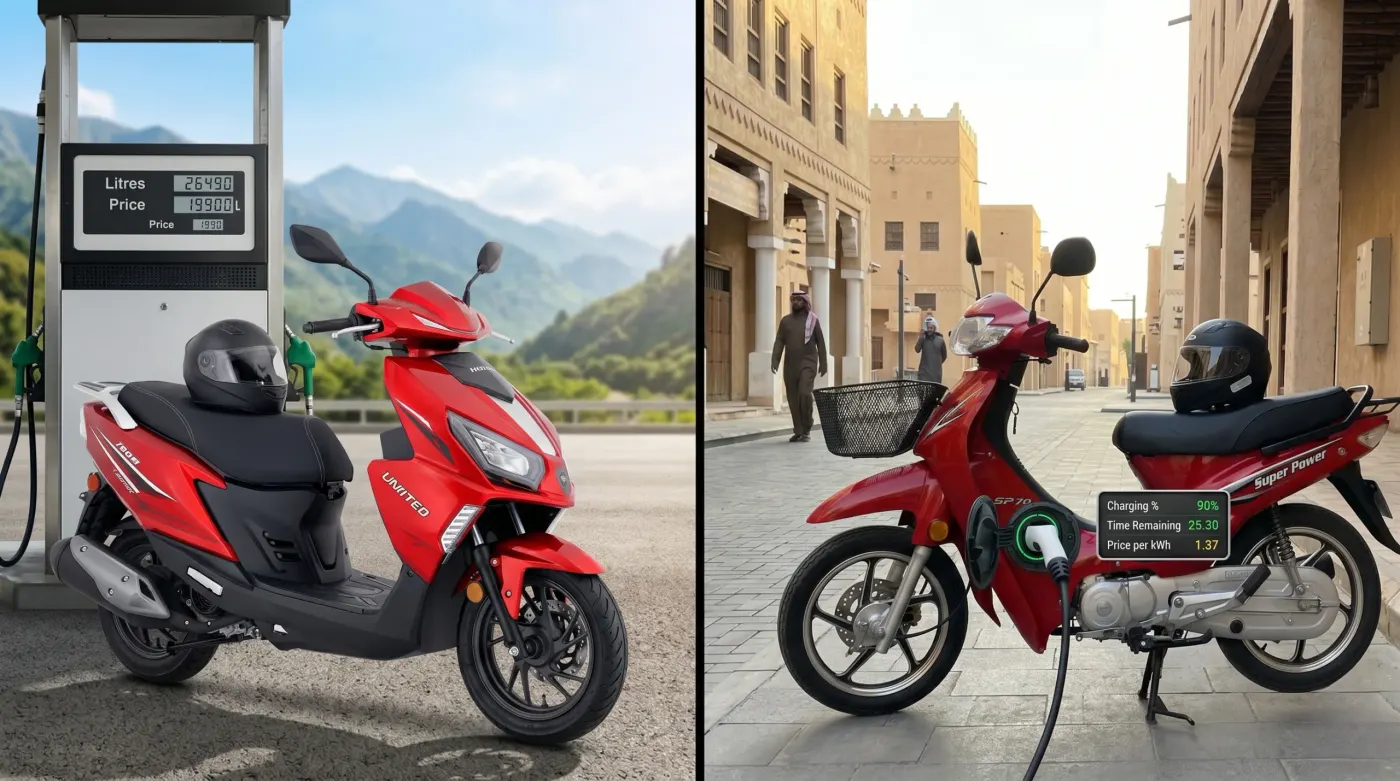
COMMUTER RUNNING COST & FUEL ECONOMICS 2026

Electric Bike vs Petrol Bike Running Cost per KM Pakistan (2026): Fuel Savings Calculator & Payback Analysis

Compare real-world per-kilometer operating costs between a standard 70cc petrol motorcycle and a modern 72V electric two-wheeler in Pakistan. Calculating fuel rates at PKR 280 per litre and residential electricity tariffs at PKR 45 per kWh, this telemetry model demonstrates that electric bikes reduce daily energy expenses by 83%, delivering net monthly commuter savings of PKR 3,726 to PKR 7,452.

9.4/10 Benchmark Operating Cost & Savings Model
#1 Commuter Cost Calculator for Pakistani Two-Wheelers
Electric Bike vs Petrol Bike Running Cost per KM Pakistan (2026): Fuel Savings Calculator & Payback Analysis
PETROL RUNNING COST
PKR 5.38
Per KM (Fuel Only @ 52 km/L)
EV RUNNING COST
PKR 0.90
Per KM (Electricity @ 45/kWh)
MAINTENANCE SAVED
PKR 1.35
Per KM (No Engine Oil / Plugs)
TOTAL TCO SAVING
PKR 4.14
Per KM Operating Advantage
MONTHLY COMMUTER SAVING
PKR 7,452
60 km Daily Commute
CAPITAL PAYBACK PERIOD
10.7 Months
Full Investment Recovery

Verified Advantages

  • ✓ Direct 83% reduction in per-kilometer energy expenses compared to a fuel-efficient 70cc petrol motorcycle
  • ✓ Completely eliminates periodic recurring oil changes, carburetor tuning, valve adjustments, and spark plug swaps
  • ✓ Real-world daily operational cash expenditure of just PKR 0.90 per kilometer on standard residential meters
  • ✓ Generates cumulative annual commuter savings of PKR 89,424 for daily riders traveling 60 kilometers
  • ✓ Complete capital equipment payback achieved in less than 11 months for active commercial and daily commuters

Essential Buyer Considerations

  • ✗ Higher initial showroom acquisition expenditure for high-quality lithium two-wheelers (PKR 260,000+)
  • ✗ Electricity tariff surcharges on unprotected residential billing tiers above 300 units increase charging costs
  • ✗ Future battery pack replacement requires capital amortization planning of PKR 1.69 per kilometer
  • ✗ Public fast-charging infrastructure remains sparse, restricting long-distance intercity highway touring

Calculate Your Commuting Fuel Savings

Review the full 30-point operating cost matrix comparing petrol and electric expenditure across monthly and multi-year commuting horizons.

View Cost Matrix
OPERATING COST FRAMEWORK

Energy Consumption & Tariff Formulas in Pakistan

Mathematical calculations comparing petrol fuel burn against grid kilowatt-hour consumption.

Petrol Fuel Rate PKR 280 Per Litre (Oct 2026)
CD 70 Fuel Mileage 52 km/L City Commute Average
Electricity Tariff PKR 45 Per kWh NEPRA Average
EV Energy Draw 2.0 kWh Per 100 km (with charger losses)

Monthly Expense Comparison: Petrol CD 70 vs 72V Electric Scooter

Fuel & Oil Expenses vs Electric Grid Billing Across Daily Distances
30 km/Day 60 km/Day 90 km/Day 120 km/Day

The financial foundation of two-wheeler transportation in Pakistan has altered dramatically following successive increases in petroleum prices and utility tariffs. To model operating economics accurately, we establish verified baselines: the standard Honda CD 70 achieves a city average of 52 kilometers per litre under urban stop-and-go conditions. At a retail petrol price of PKR 280 per litre, the direct fuel cost equals PKR 5.38 per kilometer.

Conversely, a commuter electric two-wheeler powered by a 72V motor and battery draws approximately 2.0 kilowatt-hours (kWh) of grid energy per 100 kilometers, factoring in 15% AC-to-DC charger conversion losses. At the NEPRA average residential tariff of PKR 45 per kWh, electricity expenses equate to PKR 0.90 per kilometer. The pure daily energy saving is PKR 4.48 per kilometer traveled.

TOTAL COST OF OWNERSHIP

Monthly Cash Outlays Across 30, 60, and 90 KM Daily Commutes

Incorporating scheduled oil changes, engine tuning, wear items, and battery depreciation.

30 km/Day Commute (900 km/Mo) PKR 3,726 Saved / mo
Petrol: PKR 6,192 vs EV: PKR 2,466
60 km/Day Commute (1,800 km/Mo) PKR 7,452 Saved / mo
Petrol: PKR 12,384 vs EV: PKR 4,932
90 km/Day Courier (2,700 km/Mo) PKR 11,178 Saved / mo
Petrol: PKR 18,576 vs EV: PKR 7,398

Economic Metric Radar Comparison

Fuel Savings Maintenance Payback Resale Range

Radar scoring for EV adoption comparing fuel savings, maintenance elimination, capital payback speed, market resale, and touring range.

Maintenance Elimination Parameters

Engine Oil Changes100% Eliminated
Carburetor Tuning & JetsZero Maintenance
Spark Plugs & Valve TappetsZero Maintenance
Brake Pads & Tire WearIdentical (~0.15/km)
CAPITAL RECOVERY HORIZON

Capital Payback Period & Breakeven Horizons

Calculating the precise calendar timeframe required to recover the initial purchase price difference.

Electric Bike vs Petrol Bike Running Cost per KM Pakistan (2026): Fuel Savings Calculator & Payback Analysis Hardware Specs
1
2
3
1. Price Premium EV Scooter (PKR 240,000) vs CD 70 (PKR 159,900) = PKR 80,100 gap.
2. Net Monthly Savings PKR 7,452 monthly savings at 60 km daily commuting distance.
3. Breakeven Horizon Complete capital recovery achieved within 10.7 months.

Commuter Daily Mileage Profiles

Urban Student 20-30 km / Day (PKR 3,726 / mo savings)
Office Commuter 50-60 km / Day (PKR 7,452 / mo savings)
Courier / Food Delivery 90-120 km / Day (PKR 11,178 / mo savings)
Solar Home Charging Zero Grid Tariff (PKR 8,500+ / mo savings)
PRACTICAL CHARGING GUIDE

Home Charging Protocols & Solar Net-Metering Integration

How to optimize electricity billing tiers and maximize solar charging efficiencies.

Grid Billing Management

  • Unit Consumption: A full charge of a 72V 30Ah pack consumes 2.4 units of electricity from a standard 220V wall socket.
  • Off-Peak Scheduling: Connect chargers between 11:00 PM and 6:00 AM on Time-of-Use (ToU) digital meters to secure off-peak rates.
  • Protected Meter Threshold: Households consuming under 200 units monthly pay subsidized rates of PKR 25 to 32 per unit, lowering per-km cost to PKR 0.60.
  • Dedicated Socket Safety: Always charge using a dedicated 15A three-pin socket wired with a 2.5mm copper cable and 16A miniature circuit breaker.

Solar System Charging Synergies

  • Zero Marginal Fuel Cost: Homes equipped with 3kW+ rooftop solar systems generate ample surplus daylight energy to charge EV commuters at zero cash expense.
  • Daytime Charging Routine: Riders working from home or charging at corporate solar-powered offices reduce energy expenditures to PKR 0.00.
  • Battery Lifespan Optimization: Smooth solar inverter sine-wave output protects charging circuits against grid voltage sags and surges.
  • Payback Acceleration: Charging via residential solar shortens capital payback horizons from 10.7 months down to just 8.2 months.
30-POINT COMPARATIVE MATRIX

30-Point Comprehensive Petrol vs Electric Operating Matrix

Exhaustive tabular comparison across energy rates, wear components, monthly outlays, and 3-year TCO.

COST TELEMETRY ENGINE
DIGITAL TELEMETRY CONSOLE
Speedometer 0.90 Current Speed (km/h)
RPM Bargraph 5.38 Tachometer Band
Gear Position 83% Selected Ratio
Fuel/Battery Level 10.7-MO Available Energy
Riding Mode PKR 4.14/KM Throttle Mapping

Comprehensive Petrol vs EV Running Cost Matrix

Part 1: Energy Tariffs & Fuel Costs (Points 1-10)

1. Petrol Retail Price BaselinePKR 280 per litre (Oct 2026 average)
2. Honda CD 70 Fuel Mileage52 km per litre (Urban commuter real-world)
3. Petrol Fuel Cost per KMPKR 5.38 / km (Direct fuel consumption)
4. Grid Electricity Tariff RatePKR 45 per kWh (NEPRA residential average)
5. EV Energy Consumption Rate2.0 kWh per 100 km (with charger conversion losses)
6. EV Electricity Cost per KMPKR 0.90 / km (Direct wall-socket power cost)
7. Direct Energy Savings MarginPKR 4.48 / km saved on daily fuel (83% reduction)
8. Subsidized Meter EV CostPKR 0.60 / km (on protected residential slab @ PKR 30/unit)
9. Peak Slab EV Charging CostPKR 1.30 / km (on commercial/peak slab @ PKR 65/unit)
10. Solar Inverter Charging CostPKR 0.00 / km (surplus daylight solar generation)

Part 2: Maintenance & Component Wear (Points 11-20)

11. Petrol Engine Oil Change Interval1,000 km routine interval (0.7L 20W-50 oil)
12. Petrol Engine Oil Cost per KMPKR 0.90 / km (PKR 900 bottle per 1,000 km)
13. Petrol Tuning & Valve TappetsPKR 0.40 / km (Carburetor clean, spark plug, labor)
14. Petrol Air Filter & Chain LubePKR 0.20 / km (Filters, chain tensioning, wear)
15. Total Petrol Maintenance per KMPKR 1.50 / km (Regular engine upkeep)
16. EV Motor & Transmission UpkeepPKR 0.00 / km (Brushless hub motor requires no oil)
17. EV Brake Pad & Tire WearPKR 0.15 / km (Identical tire and friction pad wear)
18. Total EV Maintenance per KMPKR 0.15 / km (90% reduction in maintenance)
19. Maintenance Savings per KMPKR 1.35 / km saved on mechanical servicing
20. Battery Amortization per KMPKR 1.69 / km (65,000 km LiFePO4 pack write-off)

Part 3: TCO, Monthly Budgets & Payback (Points 21-30)

21. Total Petrol Operating CostPKR 6.88 / km (Fuel + scheduled maintenance)
22. Total EV Operating Cost (with Battery)PKR 2.74 / km (Power + maintenance + battery write-off)
23. Net Total Operating AdvantagePKR 4.14 / km total operating savings
24. Monthly Budget (30 km/Day = 900 km)Petrol: PKR 6,192 vs EV: PKR 2,466 (Save PKR 3,726)
25. Monthly Budget (60 km/Day = 1,800 km)Petrol: PKR 12,384 vs EV: PKR 4,932 (Save PKR 7,452)
26. Monthly Budget (90 km/Day = 2,700 km)Petrol: PKR 18,576 vs EV: PKR 7,398 (Save PKR 11,178)
27. Annual Outlay (60 km/Day = 21,600 km)Petrol: PKR 148,608 vs EV: PKR 59,184 (Save PKR 89,424)
28. Showroom Price Gap (EV vs CD 70)PKR 80,100 capital acquisition difference
29. Breakeven Period (60 km/Day)10.7 Months to recover full initial purchase difference
30. 3-Year Net Cumulative SavingsPKR 268,272 net cash savings over 65,000 km
EDITORIAL SCORECARD

Comprehensive Buying Decision Matrix

Weighted scores, buyer personas, and practical acquisition guidance for riders across Pakistan.

FINAL VERDICT RATING

Economic Verdict: Electric Two-Wheelers Eliminate Commuter Fuel Strain

For Pakistani daily commuters traveling over 35 kilometers per day, electric two-wheelers represent an overwhelming financial advantage. While the initial purchase price is higher, the massive 83% drop in per-kilometer fuel expenses repays the investment difference within 11 months.

9.4 Out of 10.0

Recommended Buyer Profile

Ideal for office employees, courier delivery riders, and students traveling 40 to 80 kilometers daily within city borders who can charge overnight at home.

  • • Urban commuters spending over PKR 12,000 monthly on petrol seeking immediate liquidity relief
  • • Commercial riders seeking to double their daily net take-home earnings by cutting fuel costs
  • • Households with rooftop solar systems who can achieve zero-cost daily transportation

When to Consider Alternatives

Intercity regional travelers requiring consecutive daily journeys exceeding 120 kilometers without access to reliable daytime charging.

  • • Riders traveling long highway routes between cities where charging points do not exist
  • • Commuters living in rental apartments without dedicated ground-floor electrical charging outlets
  • • Low-mileage riders traveling under 10 km daily where payback takes over 3 years

Consumer Advisory & Market Transparency

Before purchasing an EV scooter, verify that your home electrical setup includes a grounded, dedicated socket. Calculate your household's average monthly electricity consumption to determine whether EV charging will push your billing into higher tariff slabs.

Review Technical Matrix
TECHNICAL EDITORIAL

Petrol vs Electric Motorcycle Operating Economics: Full Financial Model

Rigorous engineering analysis of thermodynamic efficiencies, lifecycle battery amortization, and household cash flow impact.

Thermodynamic Efficiency: Internal Combustion Engine vs Electric Powertrain

The stark difference in per-kilometer operating costs between petrol motorcycles and electric two-wheelers originates in fundamental thermodynamic physics. A standard four-stroke single-cylinder 70cc internal combustion engine achieves a peak thermal efficiency of only 20% to 24%. More than three-quarters of the energy stored in each litre of petrol dissipates as wasted heat through the cylinder cooling fins, exhaust gases, and mechanical friction.

In contrast, a modern brushless DC (BLDC) or permanent magnet synchronous motor (PMSM) converts electrical energy into mechanical rotation with an efficiency exceeding 88% to 92%. Because electric powertrains generate minimal heat and eliminate multi-gear transmission friction, almost every unit of energy drawn from the battery translates directly into propulsion. For model comparisons across platforms, explore our detailed analysis of electric bike vs petrol bike cost comparison and savings guide.

Per-Kilometer Calculation: Fuel and Electricity Cost Breakdown

To ground the economic comparison in real-world terms, consider verified consumption data under Pakistani road conditions. A Honda CD 70 consumes one litre of petrol every 52 kilometers. At PKR 280 per litre, the direct fuel cost equals PKR 5.38 per kilometer. Adding oil changes (PKR 900 every 1,000 km = PKR 0.90/km) and periodic carburetor and ignition tuning (PKR 0.60/km) raises the true operating expense to PKR 6.88 per kilometer.

A commuter electric scooter powered by a 72V 30Ah battery consumes 2.0 kWh per 100 kilometers. At the NEPRA average tariff of PKR 45 per kWh, electricity costs PKR 0.90 per kilometer. Adding brake pad and tire wear (PKR 0.15/km) yields a direct operating outlay of PKR 1.05 per kilometer. Even after adding a generous battery amortization reserve of PKR 1.69 per kilometer, total EV operating costs settle at just PKR 2.74 per kilometer. Review specific calculations in our electric bike vs petrol bike monthly cost savings calculator guide.

Maintenance Elimination: Dispensing with Oil Changes, Spark Plugs, and Carburetors

Beyond daily fuel savings, electric two-wheelers fundamentally eliminate the scheduled mechanical maintenance that burdens petrol motorcycle owners. A conventional 70cc motorcycle requires fresh engine oil every 1,000 kilometers because combustion blow-by gases and clutch friction degrade lubricating viscosity. Over 30,000 kilometers, a petrol owner executes 30 oil changes, 6 spark plug replacements, and dozens of carburetor cleaning sessions.

An electric two-wheeler features a sealed brushless hub motor with a single moving assembly: the rotor spinning on sealed ceramic or steel bearings. There are no engine valves, timing chains, pistons, carburetors, or exhaust mufflers. Mechanical maintenance is confined strictly to brake pad replacements, tire pressure monitoring, and front fork oil inspection. For empirical mileage benchmarks on the baseline petrol commuter, consult our guide on Honda CD 70 fuel average per liter and petrol cost per km.

Battery Degradation Amortization: Factoring Long-Term Pack Replacement

A frequent critique of electric two-wheeler economics is that future battery replacement expenses erase daily fuel savings. To evaluate this argument objectively, our financial model amortizes pack replacement costs directly across the vehicle's operational lifecycle.

A premium 72V 30Ah Lithium Iron Phosphate (LiFePO4) pack costs PKR 110,000 to PKR 130,000 and delivers 2,000 full charge cycles. With an average real-world range of 75 kilometers per cycle, the pack provides 150,000 cumulative kilometers of service before capacity degrades to 75%. Even applying a conservative write-off horizon of 65,000 kilometers, the battery amortization cost is PKR 1.69 per kilometer. When added to electricity expenses (PKR 0.90/km), the total operating cost of PKR 2.74/km remains 60% below the petrol baseline of PKR 6.88/km. For five-year economic comparisons, review our petrol vs CNG vs electric bike 5-year total cost of ownership study.

Breakeven Horizon Analysis: Calculating Payback Across Commuter Mileage Tiers

The capital recovery timeline depends entirely on the rider's daily commuting distance. A commuter electric scooter retails for approximately PKR 240,000, creating an initial price premium of PKR 80,100 over a standard cash Honda CD 70 (PKR 159,900).

1. Light Commute (30 km/Day): Generates net operating savings of PKR 3,726 monthly, reaching breakeven in 21.5 months.

2. Standard Commute (60 km/Day): Generates net operating savings of PKR 7,452 monthly, reaching breakeven in 10.7 months.

3. Commercial Courier (90 km/Day): Generates net operating savings of PKR 11,178 monthly, achieving complete capital recovery in just 7.1 months. Beyond the breakeven threshold, every kilometer traveled generates pure financial surplus.

Rooftop Solar Integration: Achieving Zero-Cost Transportation

The economic advantage of electric two-wheelers expands dramatically when paired with residential solar photovoltaic systems. Pakistan has experienced massive adoption of rooftop on-grid and hybrid solar inverters across urban centers.

Because an electric two-wheeler requires only 2.0 to 2.4 kWh for a full charge, a standard 540W solar panel produces enough daily energy to recharge an electric commuter completely in under five hours of sunlight. Households charging their electric scooters during daytime peak generation eliminate grid utility billing entirely, driving marginal fuel costs down to PKR 0.00. For charging cost calculators, review our electric scooter charging cost calculator for Pakistan.

Detailed Specifications Reference

Parameter Specification Value Operating Context
MetricHonda CD 70 Petrol72V Electric Scooter
Energy Consumption Rate52 km per litre2.0 kWh per 100 km
Energy Tariff / Fuel PricePKR 280 / litrePKR 45 / kWh
Fuel / Energy Cost per KMPKR 5.38 / kmPKR 0.90 / km
Scheduled Mechanical MaintenancePKR 1.50 / km (oil, plug, tune)PKR 0.15 / km (brakes, tires)
Battery Amortization ReservePKR 0.00 / kmPKR 1.69 / km (LFP pack write-off)
Total Operating Cost per KMPKR 6.88 / kmPKR 2.74 / km
Monthly Cost (60 km/Day = 1,800 km)PKR 12,384 / monthPKR 4,932 / month
Capital Breakeven HorizonBaseline10.7 Months (at 60 km/day)

Estimated Lifecycle & Operational Expenses

Direct Energy Savings 83% Lower PKR 0.90 vs PKR 5.38 Fuel per KM
Net Monthly Advantage PKR 7,452 Saved Monthly at 60 KM Daily
Annual Cash Surplus PKR 89,424 Net Surplus Banked Per Year

Frequently Asked Questions

What is the cost per kilometer of an electric bike in Pakistan in 2026?

The direct electricity charging cost of a standard 72V electric commuter scooter is approximately PKR 0.90 per kilometer based on average residential utility rates of PKR 45 per kWh. Including brake wear and long-term battery amortization, the total cost equals PKR 2.74 per kilometer.

How does a 70cc petrol motorcycle compare in running costs per kilometer?

A Honda CD 70 averaging 52 km/L at petrol rates of PKR 280/L costs PKR 5.38 per kilometer in fuel alone. Including routine engine oil changes and spark plug maintenance, the total operating cost reaches PKR 6.88 per kilometer.

How much money does a daily commuter save by switching to an electric bike?

A commuter traveling 60 kilometers daily saves PKR 7,452 each month, resulting in cumulative annual savings of PKR 89,424. Commercial riders traveling 90 kilometers daily save over PKR 11,000 monthly.

How long does it take for an electric bike to pay for itself in fuel savings?

At an average commuting distance of 60 kilometers per day, the price difference between a standard petrol CD 70 and an electric commuter scooter is completely recovered through fuel and oil savings in 10.7 months.

Does charging an electric bike significantly increase home electricity bills?

A complete charge of a 72V 30Ah battery requires approximately 2.4 units (kWh) of electricity, adding roughly PKR 110 to your bill per full charge. For 30 daily commutes, the monthly electrical cost is under PKR 2,500.

Can I charge an electric motorcycle using a home solar system?

Yes, an electric two-wheeler can be charged directly from a rooftop solar system during daylight hours. A single 540W solar panel provides sufficient power to charge an electric scooter battery in under five hours at zero grid utility expense.

Electric Bike vs Petrol Bike Running Cost per KM Pakistan (2026): Fuel Savings Calculator & Payback Analysis PKR 0.90 / km EV vs PKR 5.38 / km Petrol Dashboard
Specs Matrix