Complete Technical Specifications
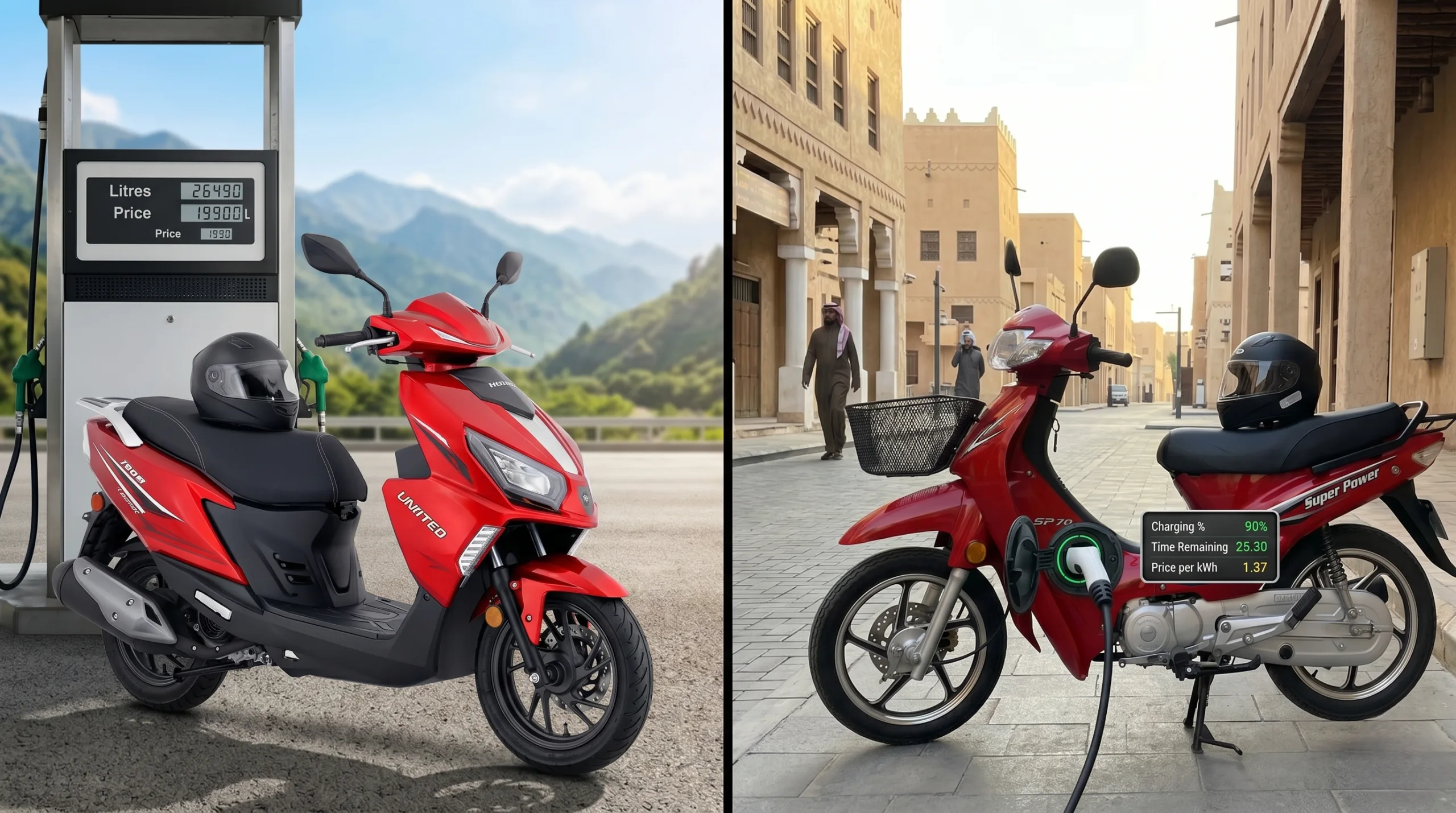
Market Context: Petrol hit Rs. 458 per litre in Pakistan on April 3, 2026 — the highest price in the country's history. Even after a partial relief cut brought it down to Rs. 366.58 per litre by April 11, one thing is clear: riding a petrol bike has never been this expensive.
The Big Question: So every rider is asking the same question: should I switch to an electric bike?
Our Methodology: Not the vague, marketing-flavoured answer you'll find on brand websites — where every company tells you their own product will save you a fortune. This article gives you the actual PKR numbers, based on today's real petrol and electricity prices, for a typical Pakistan commuter doing 30–40 km per day.
By the end, you'll know exactly what you'd spend per month on either option, how long it takes an EV to break even, and which type of bike makes sense for your situation.
What Does Petrol Actually Cost You Per Month in 2026?
Setting the Baseline: Before we compare anything, let's set the baseline.
Current Fuel Prices: As of April 11, 2026, petrol (MS-92) is priced at Rs. 366.58 per litre — down from the April 3 peak of Rs. 458.41 per litre, but still dramatically higher than the Rs. 293 it cost just two years ago. OGRA revises prices every 15 days, so the number moves, but the trend over the past three years has been consistently upward.
Calculation Basis: Now let's take Pakistan's most popular bike, the , and run the real math. The CD 70 gives a real-world fuel average of around 50–55 km/l for city riding. Let's use 52 km/l as our working figure. A typical commuter travels 35 km per day, totaling 1,050 km per month.
| Item | Calculation | Monthly Cost |
|---|---|---|
| Litres consumed | 1,050 ÷ 52 km/l | ~20.2 litres |
| Petrol cost | 20.2 × Rs. 366.58 | Rs. 7,405 |
| Engine oil change (monthly share) | Rs. 1,200 oil ÷ 12 | Rs. 100 |
| Air filter, chain, minor service (annual share) | Rs. 8,000 ÷ 12 | Rs. 667 |
| Total monthly running cost | ~Rs. 8,172 |
That's Rs. 8,172 per month just to keep a Honda CD 70 running — before any major repair or tyre replacement. With a bigger bike like the (fuel average ~38 km/l), the monthly petrol bill alone jumps to approximately Rs. 10,130.
What Does an Electric Bike Cost to Run Per Month?
Charging Economics: An electric bike charges from a standard home socket. The cost you pay is your electricity bill — which in Pakistan is priced by NEPRA on a slab system.
Electricity Rates: For a typical household consuming 300–400 units per month, the residential electricity rate is approximately Rs. 33–38 per unit (kWh).
Efficiency Metrics: Most entry-to-mid-range electric bikes consume 1.2 to 1.5 kWh per full charge and give a real-world range of 60–80 km.
| Item | Calculation | Monthly Cost |
|---|---|---|
| Charges needed | 1,050 km ÷ 70 km/charge | ~15 charges |
| Electricity used | 15 × 1.5 kWh | 22.5 kWh |
| Electricity cost | 22.5 × Rs. 36 | Rs. 810 |
| Annual maintenance (tyres, brakes, minor) ÷ 12 | Rs. 4,000 ÷ 12 | Rs. 333 |
| Total monthly running cost | ~Rs. 1,143 |
That's Rs. 1,143 per month — compared to Rs. 8,172 for the CD 70.
The Direct Comparison: Rs. Per Month, Per Year
| Honda CD 70 (Petrol) | Entry EV Bike | |
|---|---|---|
| Fuel/electricity per month | Rs. 7,405 | Rs. 810 |
| Maintenance per month | Rs. 767 | Rs. 333 |
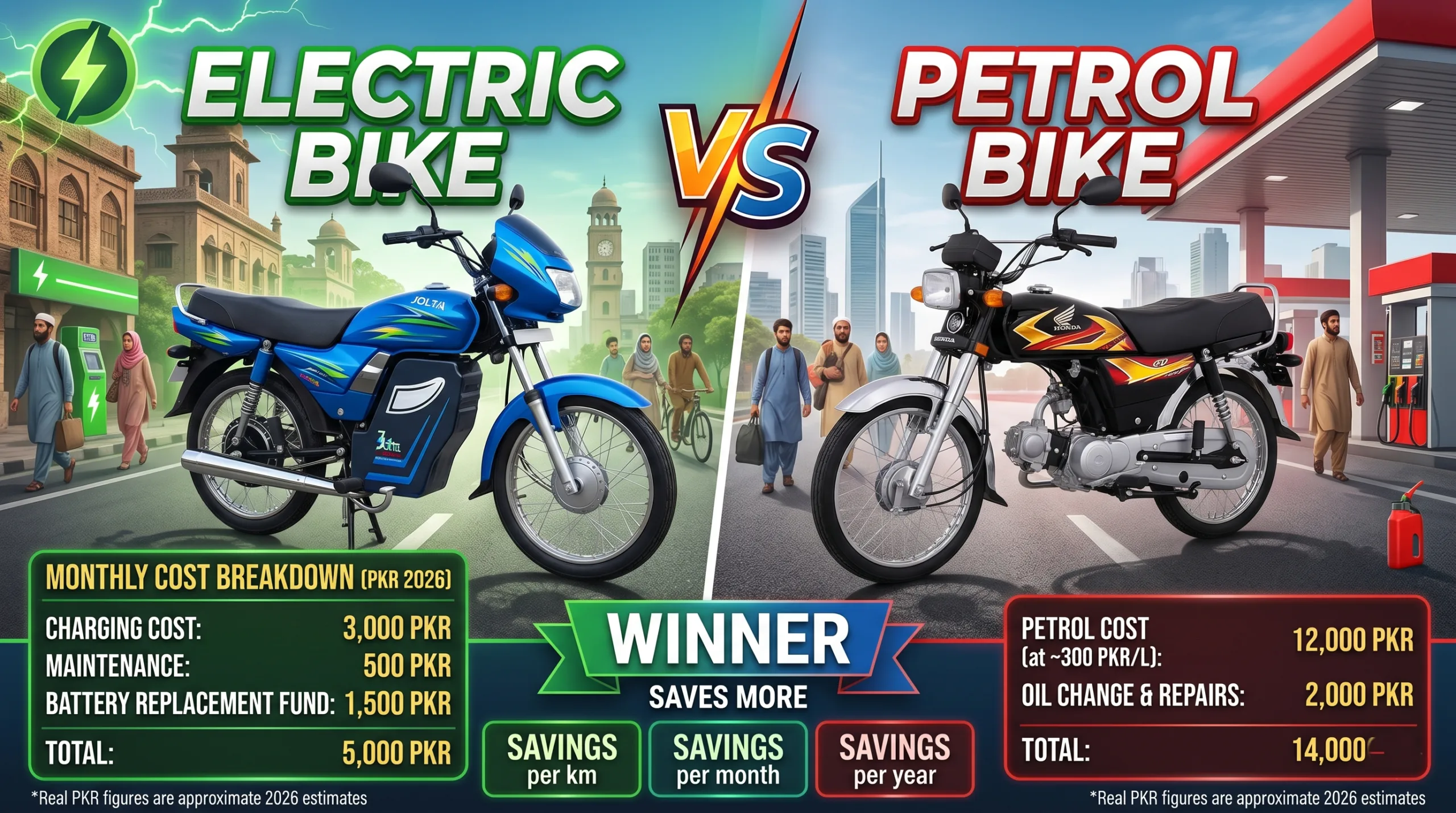
| Total monthly cost | Rs. 8,172 | Rs. 1,143 |
| Total annual cost | Rs. 98,064 | Rs. 13,716 |
| Annual saving with EV | Rs. 84,348 |
An electric bike saves you roughly Rs. 84,000 per year in running costs compared to a Honda CD 70, at current petrol and electricity prices. That's not a marketing claim. That's the math.
Purchase Price: What Does Each Bike Cost to Buy?
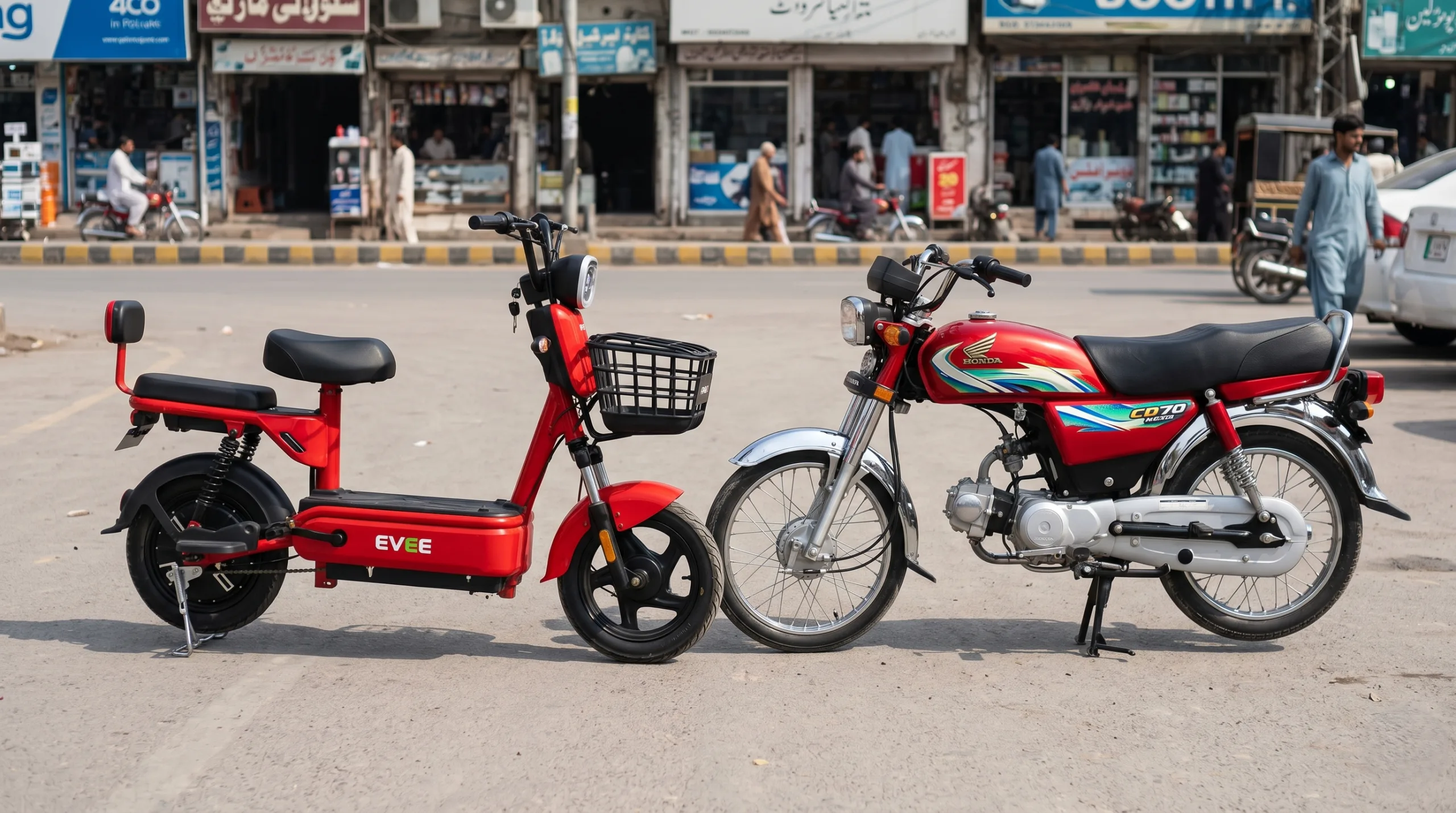
Upfront Investment: Running costs are only half the picture. You need to factor in the upfront price too. As of April 2026, the market offers several competitive choices:
- Honda CD 70 Dream: Rs. 186,000 (Entry petrol)
- Yamaha YB 125Z: Rs. 390,000 (Mid petrol)
- Jolta JE-70: Rs. 95,000 (Entry EV)
- EVEE Flipper: Rs. 130,000 (Entry EV)
- Crown EV 350: Rs. 140,000 (Mid EV)
- Yadea GT30: Rs. 189,000 (Mid-range EV)
- Jolta JE 125-L: Rs. 215,000 (Performance EV)
Investment Verdict: Some EVs are now cheaper to buy outright than a Honda CD 70. For example, the EVEE Flipper at Rs. 130,000 saves you Rs. 56,000 at the moment of purchase, plus the annual savings of Rs. 84,000.
Break-Even Analysis: When Does an EV Start Saving You Money?
Financial Recovery: If you are replacing a paid-off CD 70 with a Yadea GT30 (Rs. 189,000), your monthly savings of Rs. 7,029 mean you will recover the purchase price in roughly 26.9 months.
| EV Model | Price | Monthly Saving | Break-Even |
|---|---|---|---|
| EVEE Flipper | Rs. 130,000 | Rs. 7,029 | ~18.5 months |
| Crown EV 350 | Rs. 140,000 | Rs. 7,029 | ~19.9 months |
| Yadea GT30 | Rs. 189,000 | Rs. 7,029 | ~26.9 months |
| Jolta JE 125-L | Rs. 215,000 | Rs. 7,029 | ~30.6 months |
Battery Life: The Concern Nobody Talks About Honestly
The Truth About Batteries: The most common objection is the fear of battery replacement costs. The reality is that modern Lithium-Ion or LiFePO4 batteries are rated for 1,500 to 2,000 charging cycles, providing 4–5 years of service.
Warning on Imports: Avoid unbranded Chinese imports that use lead-acid batteries, as they often fail within 12–18 months. Always prioritize brands offering at least a 1–2 year warranty on the battery pack.
Where Electric Bikes Still Fall Short
- Range Anxiety: Most EVs in Pakistan are limited to 70–90 km in real-world city conditions, making them unsuitable for intercity travel.
- Charging Infrastructure: Public charging points are nearly non-existent outside of major urban hubs like Karachi, Lahore, and Islamabad.
- Top Speed: Affordable models are typically capped at 45–60 km/h, which is inadequate for motorway or highway use.
- After-Sales Support: While petrol bike repair is universal, EV specialized service is currently concentrated in major cities.
Who Should Buy an Electric Bike?
You are an ideal EV buyer if:
- Your daily commute is under 60 km.
- You have a dedicated home charging socket.
- You are tired of fluctuating petrol costs.
- You perform most of your riding solo.
The 2026 Government Policy Angle
Regulatory Support: The Pakistani government's New Energy Vehicle Policy 2025–2030 provides incentives for local assembly, leading to falling prices and more consistent availability. As fuel subsidies continue to be removed per IMF requirements, the economic advantage of EVs is likely to grow, not shrink, over the coming years.
Summary: The Real Monthly Numbers Side by Side
| Petrol Bike (CD 70) | Electric Bike (Mid-Range EV) | |
|---|---|---|
| Petrol / Electricity | Rs. 7,405 | Rs. 810 |
| Monthly maintenance | Rs. 767 | Rs. 333 |
| Monthly total | Rs. 8,172 | Rs. 1,143 |
| Monthly saving with EV | — | Rs. 7,029 |
| Annual saving with EV | — | Rs. 84,348 |
| Break-even on purchase price | — | 18–31 months |
Frequently Asked Questions
Is an electric bike cheaper than a petrol bike in Pakistan?
Yes — significantly cheaper to run. At current prices, an electric bike costs around Rs. 1,143/month versus Rs. 8,172/month for a Honda CD 70, saving you roughly Rs. 84,000 annually.
How much does it cost to charge an electric bike in Pakistan?
A full charge uses 1.2–1.5 kWh, costing Rs. 43–54 at current residential rates. A typical monthly commute of 1,050 km costs about Rs. 810 in electricity.
What is the best electric bike in Pakistan under Rs. 150,000?
Top options include the EVEE Flipper (Rs. 130,000), Crown EV 350 (Rs. 140,000), and Jolta JE-70 (Rs. 95,000), all of which feature reliable lithium battery tech.
Will petrol prices keep rising in Pakistan?
Given IMF commitments and the removal of subsidies, the structural trajectory remains upward, making long-term transport budget planning difficult for petrol users.
How long does an electric bike battery last in Pakistan?
Quality lithium-ion packs offer 4–5 years of daily use. Always check for a manufacturer warranty of at least 1–2 years before buying.
Can I charge an electric bike at home in Pakistan?
Yes, all consumer EVs use standard 220V domestic sockets, requiring no specialized electrical installation.
Conclusion
At today’s fuel prices, the economic case for switching to electric is overwhelming. By saving Rs. 84,000 per year, most riders recoup their initial investment within two years. While challenges regarding long-distance range and charging infrastructure remain, the urban commuter is better served by the efficiency and low running costs of modern electric motorcycles.