
Honda CB1000 Hornet SP Review (2026): 155 HP Fireblade Engine & Naked Specs
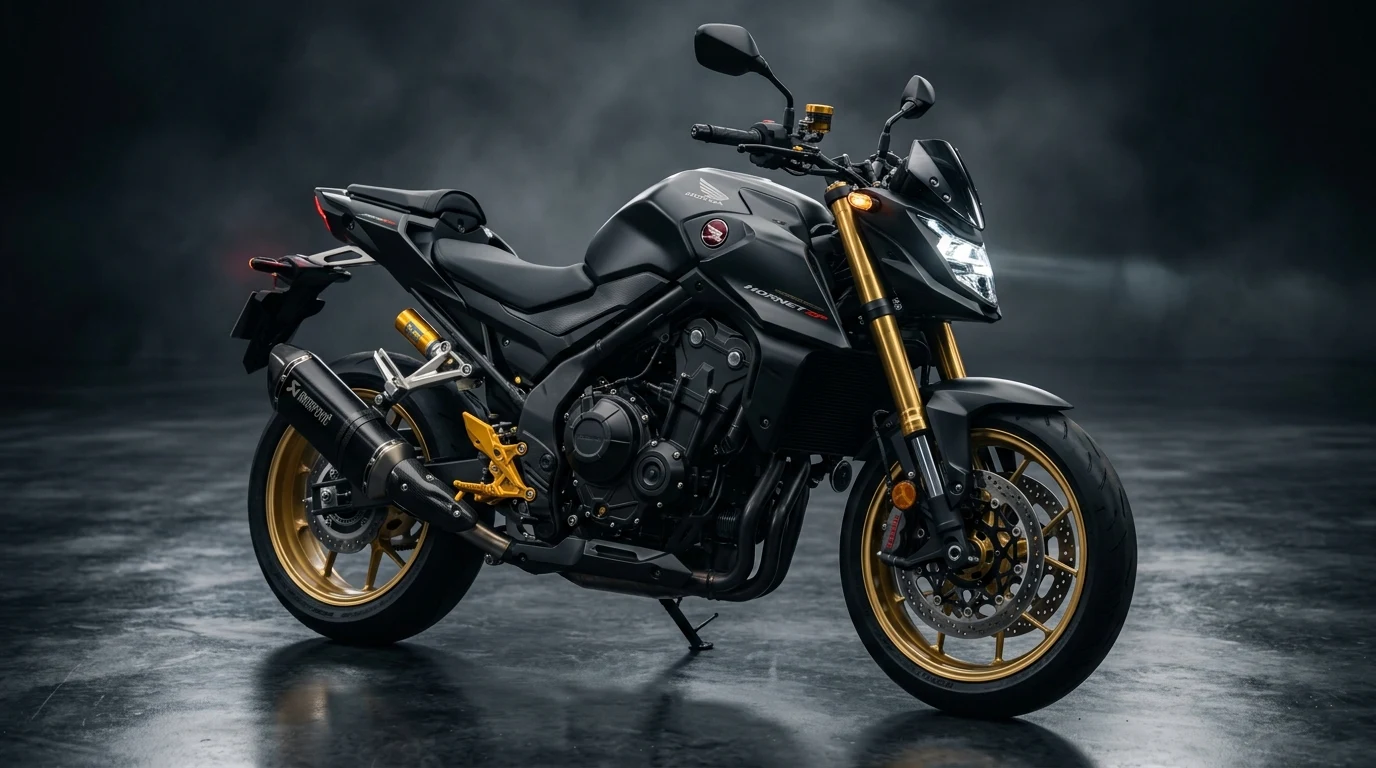
Honda flagship hyper-naked streetfighter powered by a retuned 999cc CBR1000RR Fireblade inline-four engine producing 155 HP, premium Öhlins TTX36 rear suspension, Brembo Stylema radial brakes, and standard bi-directional quickshifter.
The Strengths
- 999cc Fireblade inline-four engine delivers blistering mid-range punch and 155 HP peak output
- Öhlins TTX36 rear shock and Showa 41mm SFF-BP front fork provide road tracking over rough pavement
- Brembo Stylema monobloc radial calipers deliver firm braking bite with minimal lever effort
- Standard bi-directional quickshifter provides smooth clutchless upshifts and rev-matched downshifts
- Priced substantially lower than competing European liter-class hyper-naked motorcycles
The Compromises
- Lacks a 6-axis IMU, relying instead on conventional wheel-speed-based traction control
- Wind protection is minimal at sustained speeds above 130 km/h on open expressways
- Passenger pillion seat is firm and compact, suitable primarily for short urban trips
Estimate monthly payments, loan terms, and down payments for the 2026 Honda CB1000 Hornet SP.
999cc Fireblade-Derived DOHC Inline-Four
High-revving 16-valve architecture tuned for low-to-midrange torque on public roads.
Directly descended from the SC77 CBR1000RR with revised camshaft timing profiles.
Wide torque band providing strong drive out of second and third gear corners.
Standard equipment on the SP model with three selectable shift sensitivity settings.
Straight-Line Velocity, Dyno Curves & Fuel Economy
Real-world measured acceleration times, standing quarter-mile, and highway efficiency.
Aided by short primary gearing and standard wheelie control intervention.
Naked aerodynamics with twin projector LED headlight airflow deflector.
17-liter fuel capacity providing approximately 290 km of highway range.
Steel Twin-Spar Frame & Öhlins TTX36 Hardware
High-torsional-rigidity steel backbone paired with precision Swedish suspension damping.
5-Inch Optical Bonding TFT & HSTC Traction Suite
High-visibility digital cockpit with Honda RoadSync smartphone connectivity.
Optically bonded glass screen with four customizable display layouts.
Adjusts power delivery, engine braking, and traction control intervention.
Bluetooth turn-by-turn navigation, voice calls, and music management.
30-Point Technical Specification Matrix
Verified manufacturer tolerances, powertrain metrics, and hardware specifications.
BikesKnowledge Buying Verdict & Decision Matrix
Comprehensive scoring across real-world dynamics, build engineering, and overall value proposition.
Who Should Buy It
- Riders wanting a four-cylinder liter naked with proven Fireblade engine reliability
- Track day enthusiasts who value premium Öhlins TTX36 damping and Brembo Stylema brakes
- Buyers looking for maximum horsepower and hardware per dollar spent
Who Should Skip It
- Riders demanding a 6-axis IMU for cornering ABS and lean-sensitive traction control
- Long-distance touring riders who require substantial fairing wind protection
- Two-up riders looking for generous passenger seating accommodations
Honda CB1000 Hornet SP Technical Deep Dive
CBR1000RR Fireblade Engine Retuning
Honda engineers utilized the SC77 generation CBR1000RR Fireblade architecture as the foundation for the Hornet SP engine. By revising intake valve profiles, enlarging the airbox volume, and modifying the 4-2-1 stainless exhaust system, power delivery was reshaped. While the Fireblade focuses on peak power at 13,000 RPM, the Hornet SP delivers 107 Nm of torque lower in the rev range for explosive street acceleration.
Öhlins TTX36 and Brembo Stylema Upgrade Package
Setting the SP model apart from the base Hornet is its chassis equipment. The rear suspension uses an Öhlins TTX36 twin-tube gas-charged shock absorber with separate compression and rebound damping circuits. Up front, dual Brembo Stylema 4-piston radial monobloc calipers clamp 310mm floating discs, providing track-grade braking power and thermal stability.
Steel Twin-Spar Chassis Dynamics
Rather than adopting an aluminum frame, Honda engineered a one-piece steel twin-spar frame that offers 70% higher torsional rigidity than the CB750 Hornet frame. The engine acts as a stressed member, with weight distributed 51.2% front and 48.8% rear for agile flickability through rapid directional changes.
Frequently Asked Questions (2026 Buyer's Guide)
The 2026 Honda CB1000 Hornet SP has an official MSRP of $10,499 USD, offering exceptional value considering its standard Öhlins TTX36 shock, Brembo Stylema brakes, and quickshifter.
The SP model adds 5 additional horsepower (155 HP vs 150 HP), an Öhlins TTX36 rear shock, Brembo Stylema front calipers, a standard bi-directional quickshifter, and exclusive Matte Ballistic Black metallic paint with gold wheels.
No, the CB1000 Hornet SP utilizes Honda Selectable Torque Control (HSTC) and wheel-speed-sensor-based ABS rather than an inertial measurement unit.
The CB1000 Hornet SP has a top speed of approximately 250 km/h (155 mph), with acceleration from 0 to 100 km/h completed in 3.1 seconds.
The seat height is an accessible 809 mm (31.8 inches), which combined with a narrow tank junction makes it easy for most riders to place both feet flat on the ground.
With a 17.0-liter fuel tank capacity and an average consumption of 5.8 L/100 km, the expected highway riding range is approximately 290 km (180 miles).