
Honda CD 70 Carburetor Tuning Guide
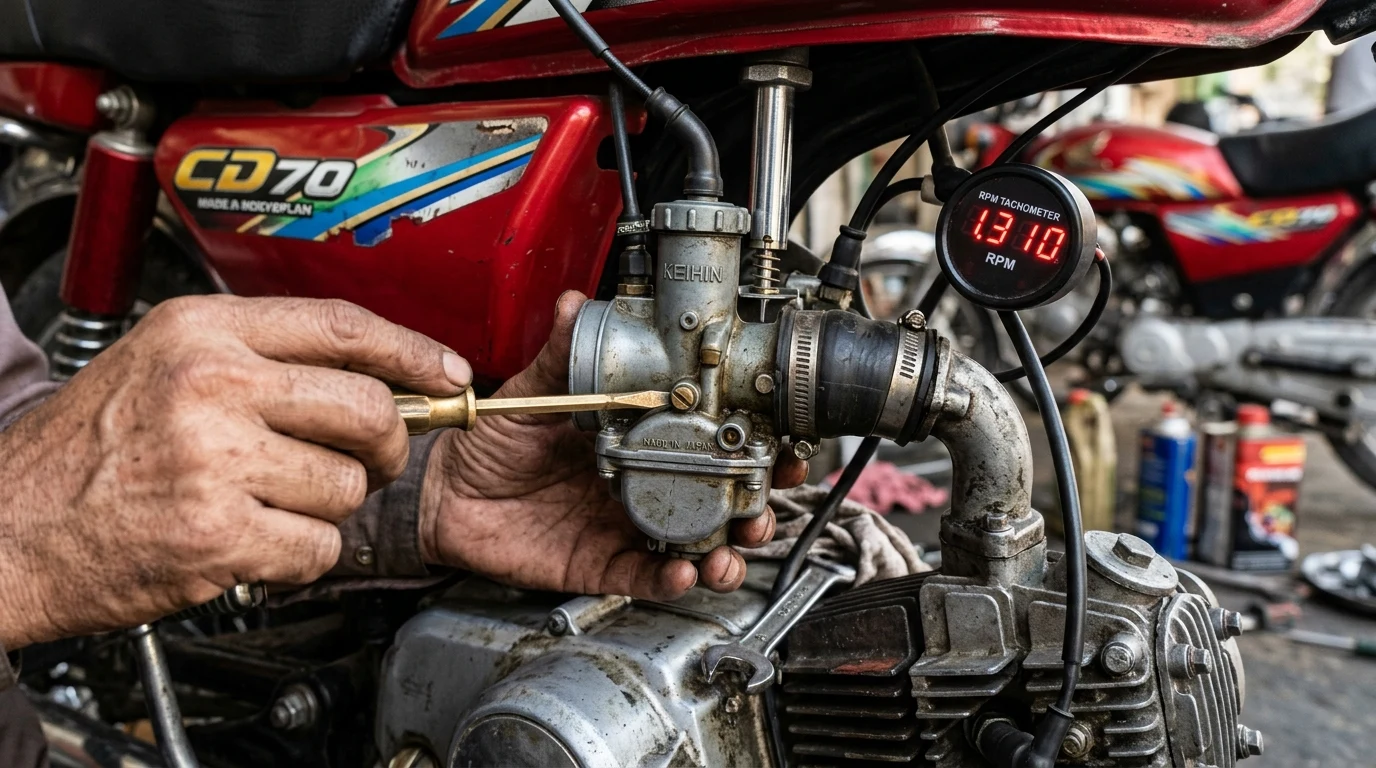
Complete step-by-step DIY tuning manual for the genuine Keihin slide carburetor on the Honda CD 70 in Pakistan. Learn exact pilot air screw calibration (2.25 turns out), throttle slide needle clip optimization, float level setting (20 mm), and idle speed adjustment to achieve 65+ km/L fuel economy.
Signs of Perfect Carburetor Tuning
- Instant one-kick cold start with minimal choke usage and steady 1,350 RPM warm idle
- Crisp, lag-free throttle roll-on in 2nd and 3rd gears with zero hesitation or bogging
- Spark plug tip displays a dry, light golden-tan color indicating stoichiometric 14.7:1 air-fuel combustion
- Exhaust tip remains dry with zero black carbon soot deposits or unburnt fuel smell
Symptoms of Incorrect Tuning
- Overly rich mixture (air screw <1.5 turns out) causing black smoke, plug fouling, and 45 km/L mileage
- Overly lean mixture (air screw >3.0 turns out) causing engine overheating, cylinder popping, and valve burning
- Clogged brass pilot jet causing engine stalling as soon as throttle is rolled off at traffic signals
- Incorrect float level causing fuel overflow from the overflow drain pipe onto the engine case
Inside the Genuine Keihin Slide Carburetor
Understanding the 3 distinct fuel metering circuits: Pilot Circuit, Jet Needle Circuit, and Main Jet Circuit.
Carburetor Fuel Delivery Metering by Throttle Slide Opening
Pilot Screw vs Needle vs Main Jet Fuel RatioAir-Fuel Ratio & Spark Plug Reading
How air-fuel screw adjustments directly alter stoichiometric combustion and kilometer-per-liter output.
Tuning the Pilot Air-Fuel Mixture Screw
The exact workshop method using sound and engine RPM peak detection.
Throttle Needle E-Clip Position Adjustment
How moving the E-clip between slots 2, 3, and 4 alters cruising mileage at 40–50 km/h.
Honda CD 70 Carburetor Master Setup Board
Factory calibration parameters and fuel tuning values for Pakistan.
Keihin 70cc Carburetor Master Tuning Matrix
Pilot Circuit Specifications
Needle & Main Jet Specs
Complementary Engine Specs
Telemetry Fuel Mileage Impact
Fuel Mileage & Performance Impact
Best Practices During Tuning
- Always tune the carburetor after riding the bike for 5 minutes so the engine is at full operating temperature.
- Clean the polyurethane air filter foam with kerosene and lightly oil it before adjusting the air screw.
- Check the intake manifold rubber O-ring for air leaks by spraying soapy water while idling.
Mistakes That Ruin Mileage
- Forcing the brass air screw tightly into its seat, which breaks the fine needle tip and destroys the body.
- Installing oversized local Chinese jets in an attempt to gain horsepower on a 70cc commuter.
How to Tune Honda CD 70 Carburetor for Maximum Fuel Average: Expert Manual
The Honda CD 70 2026 is celebrated as Pakistan's fuel economy champion. However, improper workshop servicing often knocks its mileage down from 65 km/L to under 48 km/L. Unlike complex constant-velocity carburetors found on the Yamaha YBR 125G or larger slide carbs on the Honda CG 125, the CD 70 utilizes a straightforward Keihin slide carburetor that can be perfectly calibrated at home in under 15 minutes.
The secret to peak fuel economy lies in adjusting the pilot air-fuel mixture screw. After warming the engine to operating temperature, screw the pilot screw gently clockwise until it lightly seats. Then back it out exactly 2.25 turns counter-clockwise. Increase the idle stop screw slightly, then turn the pilot screw slowly in 1/8 turn increments to locate the spot where the engine idles at its highest, smoothest RPM. Finally, reduce the idle stop screw back to a steady 1,350 RPM. Combined with an NGK C7HSA spark plug gap of 0.60 mm and clean air filter foam, this tuning procedure ensures a crisp throttle response and restores your fuel efficiency to 65+ kilometers per liter.
"Setting the pilot air screw to 2.25 turns out and verifying stoichiometric 14.7:1 combustion delivers up to 28% more mileage on a Honda CD 70."
🌿 Related Models & Comparison Guides
Frequently Asked Questions
The standard factory baseline for the genuine Keihin CD 70 carburetor is 2.25 full turns counter-clockwise from the lightly seated position.
Inspect the spark plug insulator: a light golden tan color is perfect, black dry soot means too rich (wasting petrol), and chalky white means too lean (engine running hot).
Position 3 (the middle slot) is standard, but moving the E-clip to Position 2 (second from top) leans out mid-throttle cruising for maximum economy in warm weather.