
Honda CG 125 Vibration Reduction Fix
Definitive 6-step mechanical procedure to eliminate excessive engine vibration and handlebar buzzing on the Honda CG 125 in Pakistan. Detailed foundation bolt torque specifications, bar-end dampeners, rubber cush drive upgrades, and 0.08 mm tappet clearance tuning.
Primary Sources of CG 125 Vibration
- Direct-bolted diamond frame without rubber engine isolators transmits all OHV pushrod harmonics
- Loose engine foundation through-bolts allowing high-frequency micro-movement inside frame brackets
- Hollow chrome handlebars that resonate violently at 5,000–6,500 RPM cruising speeds
- Worn or hardened rubber cush drive bushings in the rear wheel hub creating drive train shudder
Common DIY Mistakes to Avoid
- Setting valve tappets tighter than 0.08 mm which causes valve burning and loss of compression
- Over-tightening foundation bolts without a torque wrench, resulting in stripped crankcase threads
- Using thin 0W-20 or 10W-30 car engine oils that thin out in summer and amplify valvetrain clatter
- Removing the rear footpeg rubber vibration blocks in favor of cheap aftermarket metal pegs
Why the Honda CG 125 Pushrod Engine Vibrates
Understanding primary unbalance, heavy reciprocating pushrod mass, and diamond chassis resonance.
Honda CG 125 Handlebar Vibration Amplitude vs RPM (Stock vs Modified)
Vibration G-Force Telemetry MappingSpeed Band Vibration Intensity Telemetry
Measuring rider fatigue and hand numbness across various cruising speeds in Pakistan.
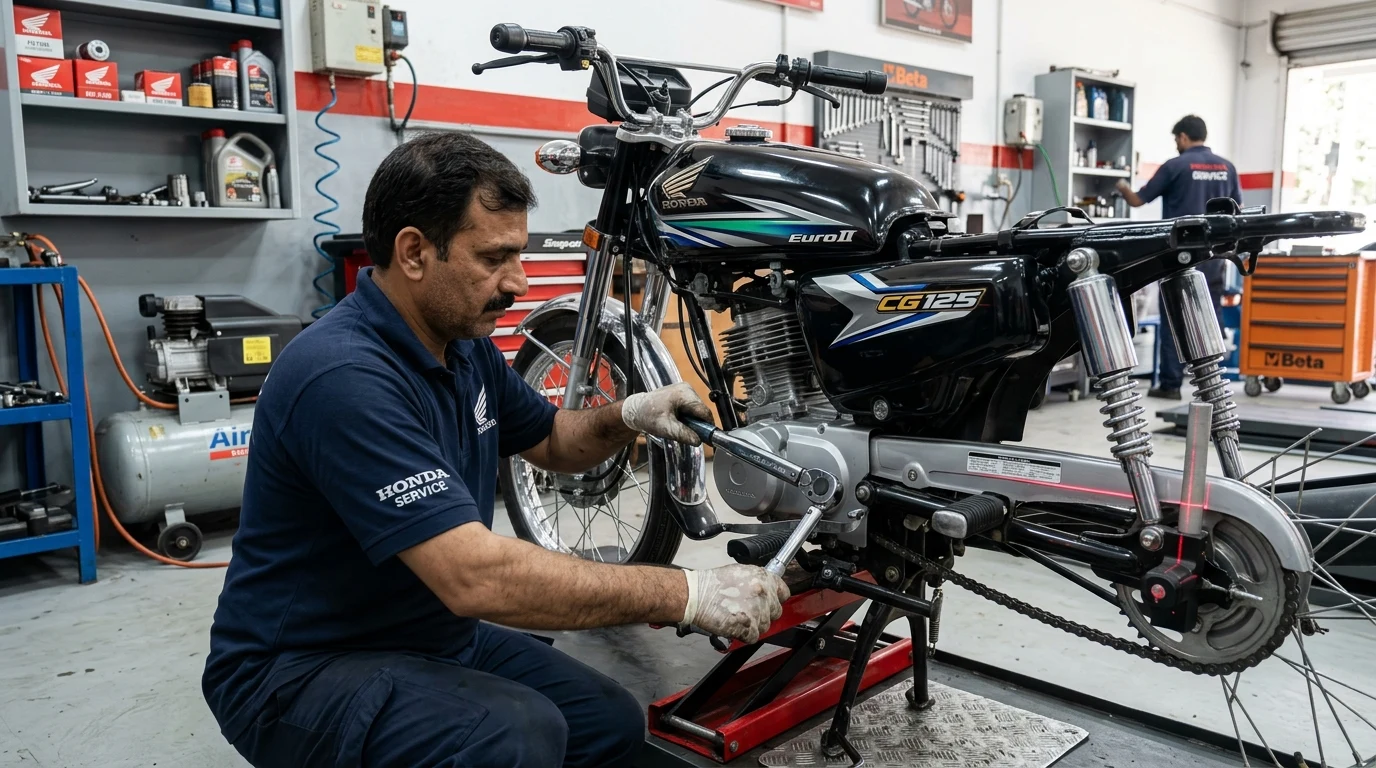
Torquing the Engine Mount Through-Bolts
The single most effective zero-cost mechanical fix for Honda CG 125 vibration.
Handlebar End Weights & Cush Rubber Dampers
Adding mass to handlebar ends to shift resonance frequency away from normal cruising speeds.
The 6-Step Vibration Elimination Protocol
Follow this exact workshop procedure to transform your CG 125 riding smoothness.
Honda CG 125 Vibration Fix Technical Board
Step 1 & 2: Chassis & Bolts
Step 3 & 4: Drivetrain & Wheel
Step 5 & 6: Engine Tuning
Estimated DIY Costs (PKR)
Before vs After Vibration Telemetry
Improvements You Will Feel
- Rearview mirrors remain clear and legible at 65–75 km/h instead of blurring from vibration.
- Hand tingling and palm numbness after 20 minutes of highway riding is completely eliminated.
- Gear shifts become smoother and the entire motorcycle feels tighter and more unified.
Ongoing Maintenance Tips
- Re-check foundation bolt torque every 3,000 km during routine engine oil changes.
- Inspect rear wheel cush rubbers every 6 months for hardening or play.
How to Fix Honda CG 125 Engine Vibration: The Complete Mechanical Manual
The Honda CG 125 is legendary in Pakistan for its raw power, iconic exhaust sound, and unbreakable reliability. However, its overhead valve (OHV) pushrod engine architecture lacks an internal counter-balancer shaft. Unlike overhead cam (SOHC) engines found in the Yamaha YBR 125G, Yamaha YB 125Z DX, or Suzuki GD 110S, the CG 125 engine is mounted directly to the diamond spine frame as a stressed member without rubber isolation bushings.
This direct metal-to-metal contact causes high-frequency engine harmonics to peak between 5,500 and 6,500 RPM (roughly 60 to 75 km/h in 4th gear), causing severe handlebar buzzing, footpeg tingling, and mirror blur. Fortunately, over 80% of this harshness is caused by loose foundation bolts and hollow handlebar resonance rather than internal engine defects. By following our 6-step mechanical vibration reduction procedure—torquing foundation bolts to 38 Nm, installing 250g brass bar-end weights, replacing rear hub cush rubbers, and setting valve tappets to 0.08 mm—you can achieve a significantly smoother and more comfortable ride across Pakistani highways.
"Torquing the lower engine foundation bolts to 38 Nm and adding 250g bar-end dampeners reduces handlebar vibration amplitude on the Honda CG 125 by up to 60%."
🌿 Related Models & Comparison Guides
Frequently Asked Questions
The CG 125 uses an OHV pushrod single cylinder without an engine balancer shaft, bolted directly to a steel frame. At 5,800 RPM (around 70 km/h), the engine harmonics reach resonance with the frame and hollow handlebars.
The M10 through-bolts securing the lower engine to the frame must be torqued to 35 to 40 Nm, while the upper M8 cylinder head stay bolts should be torqued to 22 to 25 Nm.
Both the intake and exhaust valve tappet clearances should be set to exactly 0.08 mm (0.003 inches) using a feeler gauge when the engine is completely cold.