
Kawasaki Ninja e-1 Review 2026: 9.0 kW E-Boost, Dual Removable Battery Specs & Price
Kawasaki brings genuine Ninja supersport handling to zero-emission commuting. Featuring an air-cooled 9.0 kW (12 HP) motor, dual 1.5 kWh removable battery modules, handlebar e-boost burst acceleration, and low-speed walk mode with reverse gear.
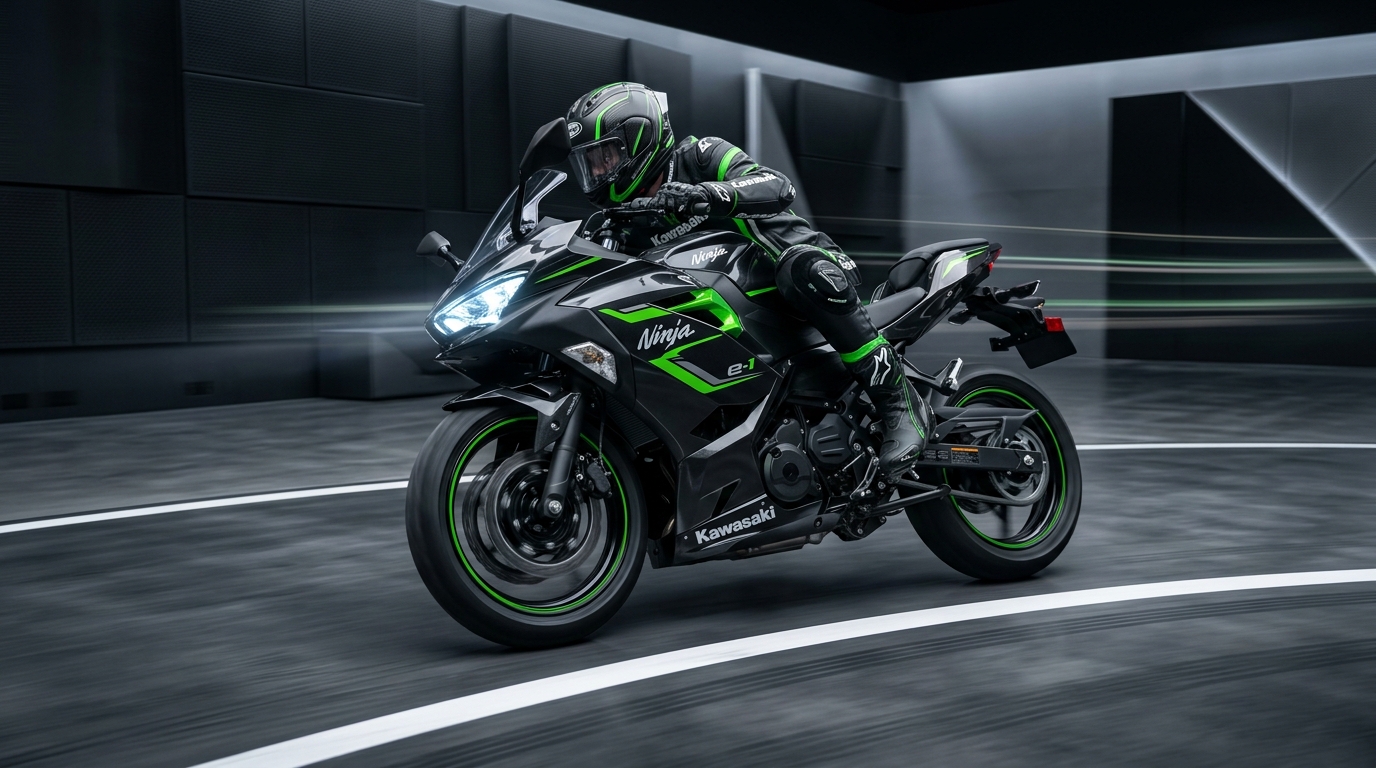
The Strengths
- Authentic Ninja full-fairing aerodynamics and aggressive twin LED headlight styling
- Dual removable 11.5 kg battery modules allow indoor home and office recharging
- Handlebar e-boost button delivers instant 15-second power surge for confident highway passing
- Low-speed Walk Mode with reverse gear simplifies tight parking space maneuvers
- Clutchless twist-and-go operation paired with proven Ninja 400 trellis chassis stability
The Compromises
- Urban battery capacity restricts real-world mixed riding range to approximately 66 to 72 km
- Premium $7,599 USD price point commands a high entry barrier compared to 125cc petrol rivals
- Under-seat storage space is limited due to the secondary battery housing
Compare monthly running costs, battery payback periods, or check BOP & Meezan zero-markup EMI plans.
9.0 kW IPM Motor & Dual Removable Lithium Battery Modules
Air-cooled synchronous interior motor with primary chain drive and regenerative braking.
Acceleration Dynamics, Top Speed & Real-World Range
Dual riding modes with on-demand e-boost button and Walk Mode reverse capability.
Steel Trellis Frame & Ninja Supersport Ergonomics
Derived from the Ninja 400 platform with 41mm telescopic front forks and Uni-Trak rear shock.
4.3-Inch Color TFT Console & Rideology Telematics
Smartphone Bluetooth synchronization with maintenance reminders, battery status, and walk assist.
30-Point Technical Specification Matrix
Verified factory dimensions, powertrain tolerances, and component specifications.
BikesKnowledge Buying Verdict & Decision Matrix
Who Should Buy the Ninja e-1
- Urban riders seeking aggressive sportbike styling combined with twist-and-go automatic ease
- Apartment dwellers who require removable lithium batteries for indoor charging
- Beginner riders in European A1 or graduated licensing tiers wanting a lightweight sport chassis
Who Should Consider Alternatives
- Long-distance weekend highway tourers needing over 120 km of open road range
- Riders searching for budget sub-$4,000 commuter pricing
Kawasaki Ninja e-1 Detailed Engineering & Road Test Analysis
The 2026 Kawasaki Ninja e-1 represents a landmark development as one of the first electric motorcycles produced by a traditional Japanese Big Four manufacturer. Built around an agile steel trellis chassis shared with the Ninja 400 and Z400, the Ninja e-1 delivers genuine sportbike handling while substituting internal combustion with a compact permanent magnet powertrain.
Dual Removable Battery Architecture & Indoor Charging
One of the primary engineering highlights of the Ninja e-1 is its dual removable battery pack arrangement. Positioned under the top dummy tank cover, two 50.4V 30Ah (1.5 kWh) lithium-ion battery modules sit wired in parallel. Each module weighs 11.5 kg (25.3 lbs) and features a sturdy carry handle, enabling owners without exterior garage plugs to carry the batteries indoors. Charging from 0 to 100% takes approximately 3.7 hours per battery on a standard wall outlet.
E-Boost Power Delivery & Walk Mode Usability
In standard Road mode, the electric motor produces a steady 5.0 kW (6.8 HP) continuous output with a speed ceiling of 64 km/h (40 mph) to optimize battery endurance. When overtaking or entering fast traffic flows, pressing the handlebar-mounted e-boost button unlocks the full 9.0 kW (12 HP) peak power output and raises top speed to 85 km/h (53 mph) for 15 seconds. Kawasaki also incorporated an innovative bi-directional Walk Mode that operates the bike at 3 km/h forward or 2 km/h reverse via throttle modulation, eliminating the physical effort of pushing the bike backward up inclined parking spaces.
Chassis Dynamics & Everyday Commuting Costs
Weighing just 140 kg (308 lbs) with both batteries installed, the Ninja e-1 feels remarkably nimble through city chicanes and tight roundabouts. Braking is handled by a 290mm front disc and 220mm rear disc with standard dual-channel ABS. Running costs remain minimal: fully charging both packs consumes roughly 3.4 kWh of electricity, resulting in an operating cost below $0.02 USD (or PKR 1.5) per kilometer.
🌿 Related Reviews & Comparison Guides
Frequently Asked Questions
The Kawasaki Ninja e-1 retails at $7,599 USD in North America and approximately ₹8,50,000 INR / £7,799 in European and Asian markets.
In standard Road mode, top speed is 64 km/h (40 mph). Activating the handlebar e-boost button increases top speed to 85 km/h (53 mph) for 15-second overtaking bursts.
The dual 1.5 kWh batteries (3.0 kWh total) provide an estimated real-world urban range of 66 to 72 km (41 to 45 miles) in Road mode.
Engaging Walk Mode allows the rider to move the bike forward at 3 km/h or reverse at 2 km/h using the throttle, making tight parking and garage maneuvers effortless.
Each 1.5 kWh lithium module weighs 11.5 kg (25.3 lbs). They can be charged on-board via an off-board docking cradle or carried indoors for standard wall outlet charging in 3.7 hours per pack.
With its 5.0 kW continuous rated power (9.0 kW peak), the Ninja e-1 complies with European A1 and UK CBT license requirements equivalent to a 125cc petrol motorcycle.