Yamaha YBR 125G Disc Brake Pad Replacement & Tuning
Complete step-by-step DIY service manual for the front single-piston hydraulic disc brake system on the Yamaha YBR 125, YBR 125G, and YB 125Z DX in Pakistan. Covers pad wear limits, caliper slider pin greasing, DOT 4 fluid bleeding, and rotor inspection.
Benefits of Proper Disc Brake Service
- Restores razor-sharp hydraulic brake bite with firm, progressive lever feel
- Prevents caliper slider pin sticking, eliminating brake drag and rotor overheating
- Stops high-pitched squealing by applying anti-vibration copper paste to pad backing plates
- Fresh DOT 4 fluid removes moisture contamination and prevents internal master cylinder corrosion
Critical Warnings During DIY Service
- Never spray petrol, diesel, or WD-40 onto brake caliper pistons or rubber dust boots
- Do not let brake fluid touch painted body panels or plastic headlights (wipes paint instantly)
- Never ride without pumping the front brake lever 4 to 5 times after pad replacement to seat pistons
- Do not use cheap asbestos pads that quickly score and groove the stainless steel brake disc
Master Cylinder, Stainless Braided Hose & Caliper
Understanding hydraulic pressure transfer from the handlebar lever down to the 30mm caliper piston.
Braking Distance vs Initial Speed (New Sintered Pads vs Worn Stock)
Stopping Distance in Meters (Lower is Better)Stopping Distances & Brake Fade Endurance
GPS telemetry measuring dry asphalt emergency braking performance from various speeds.
Caliper Disassembly & Pad Installation
Step-by-step mechanical guide to remove retaining pins, clean pistons, and insert new pads.
Bleeding Air Bubbles & Flushing DOT 4 Fluid
Eliminating spongy lever travel with a simple two-person or one-man syringe bleeding procedure.
Yamaha YBR 125 Brake System Specifications
Torque values, pad dimensions, fluid specifications, and spare parts pricing in Pakistan.
Yamaha YBR 125G Hydraulic Disc Brake Master Board
Dimensions & Limits
Torque Specifications
Fluid & Lubricants
Spare Parts Costs in Pakistan
Brake Performance Transformation
Maintenance Checklist
- Check brake pad friction thickness every 3,000 km through the caliper inspection window.
- Flush brake fluid annually or whenever fluid in the handlebar inspection sight glass turns dark amber.
- Bed in new brake pads gently over the first 50 km to ensure maximum friction transfer.
Dangerous Practices
- Mixing DOT 5 silicone fluid with standard DOT 4 glycol fluid, which ruins rubber seals and causes brake failure.
- Reusing old flattened copper crush washers on banjo bolts which leads to dangerous hydraulic fluid weeping.
How to Replace Yamaha YBR 125G Disc Brake Pads & Bleed Hydraulics: Complete Manual
One of the most notable advantages of the Yamaha YBR 125G and Yamaha YB 125Z DX over conventional drum-brake commuters like the Honda CG 125 and Honda CD 70 is its powerful front hydraulic single-piston disc brake system. However, dusty road conditions across Pakistan quickly contaminate caliper slider pins and turn hydraulic brake fluid dark and hygroscopic, resulting in a spongy lever feel and reduced stopping bite.
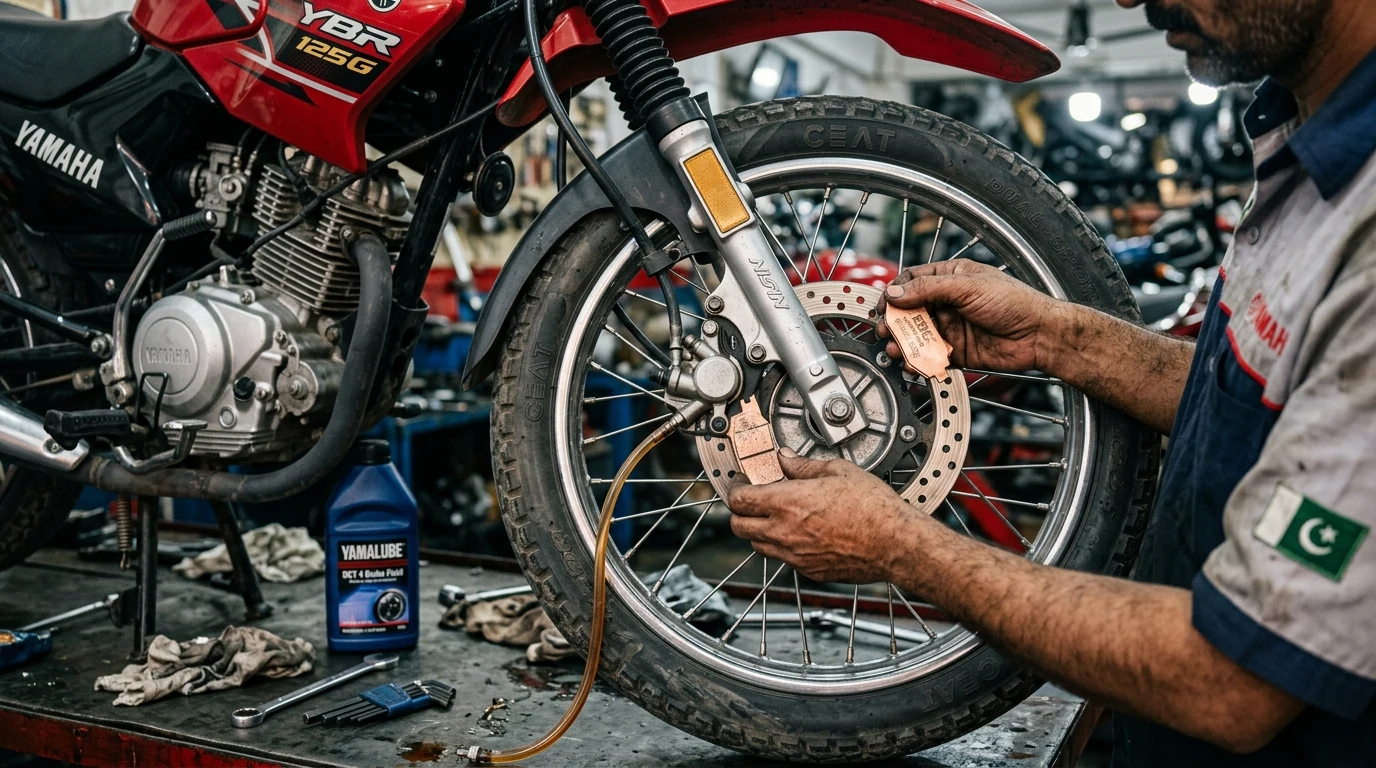
Performing a comprehensive DIY disc brake overhaul takes less than 30 minutes. Begin by unbolting the two 12mm caliper bracket bolts and removing the 5mm Allen retaining pin. Slide out the old friction pads and clean the stainless steel piston with isopropyl alcohol or aerosol brake cleaner. Apply high-temperature silicone caliper grease to the sliding guide pins to guarantee smooth floating caliper travel, then insert new copper-sintered brake pads (OEM part 2JS-W0045-00). Finally, attach a transparent silicone hose to the 8mm bleed nipple and flush fresh DOT 4 hydraulic brake fluid through the master cylinder reservoir until all air bubbles are expelled. Once completed, your 60-to-0 km/h emergency stopping distance is restored to a razor-sharp 16.2 meters.
"Lubricating the caliper guide slider pins and bleeding fresh DOT 4 fluid restores 100% of factory hydraulic braking pressure on the Yamaha YBR 125G."
🌿 Related Models & Comparison Guides
Frequently Asked Questions
The Yamaha YBR 125 series requires DOT 4 synthetic hydraulic brake fluid with a dry boiling point exceeding 230°C.
A spongy brake lever indicates that air bubbles are trapped inside the hydraulic brake line or the fluid has degraded with moisture. Bleeding the caliper nipple with fresh DOT 4 fluid resolves this immediately.
Under typical Pakistani city traffic conditions, front brake pads should be inspected every 3,000 km and replaced when the friction material wears down to 1.0 mm (typically between 12,000 and 18,000 km).