
2026 Aprilia RS 457 Review: Track Telemetry, 270-Degree Twin Dyno & Lap Times
Engineered at Noale and produced for global road and track riders, the Aprilia RS 457 brings true superbike architecture to the A2 and sub-500cc segment. We tested its dual-beam aluminum frame and 47.6 PS parallel-twin across track sessions and mountain passes.
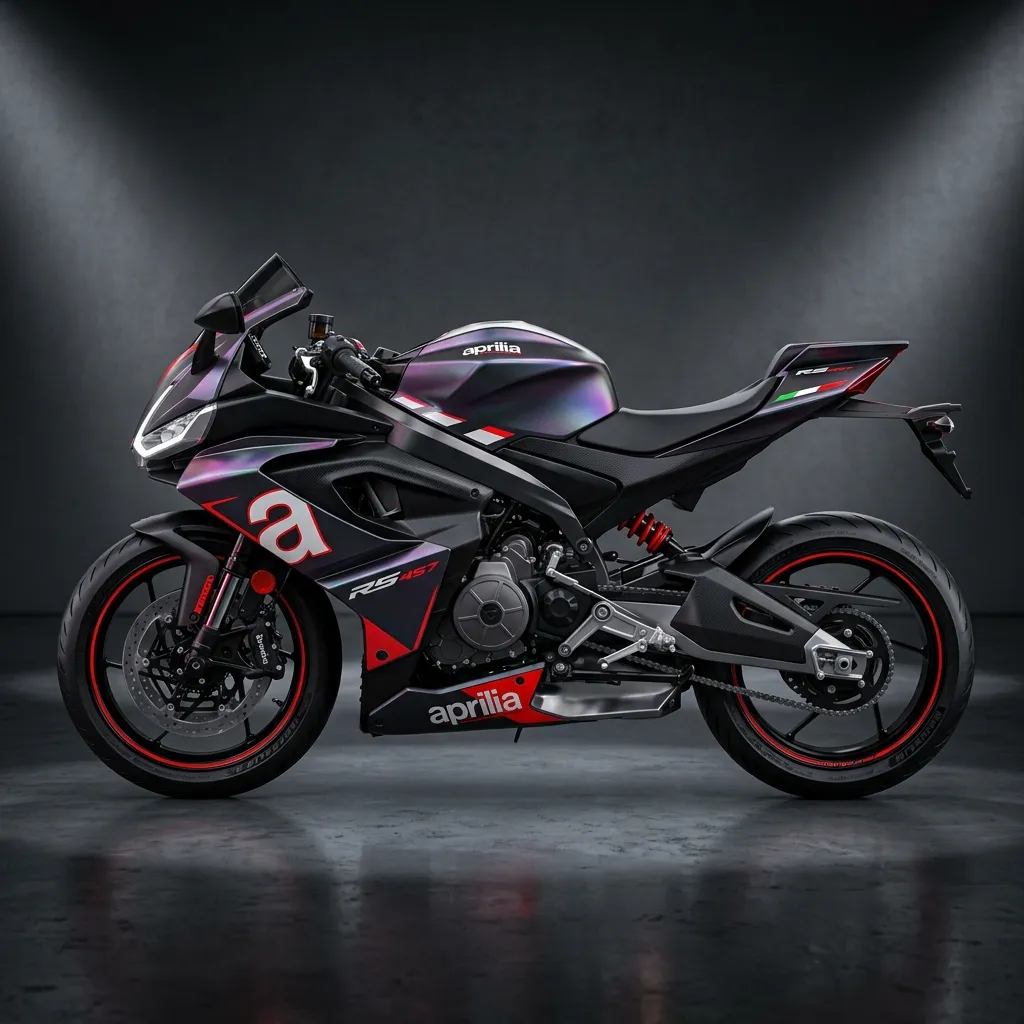
Key Strengths
- True twin-spar aluminum frame delivers surgical front-end feedback in high-speed turns
- 270-degree crankshaft provides a distinctive exhaust growl with punchy drive out of hairpins
- Sophisticated electronics with 3 ride modes, 3-level traction control, and switchable rear ABS
- Clip-on handlebars are positioned above the triple tree for street and track usability
Trade-offs & Considerations
- Bidirectional quickshifter is an optional accessory on base variants
- Front suspension features preload adjustment only without rebound clickers
- Ex-showroom price of ₹4.22 lakh commands a notable premium over single-cylinder rivals
457cc 270-Degree Parallel-Twin Engineering
Cylinder head thermodynamics, crankshaft balancing, and electronic throttle mapping.
The heart of the RS 457 is a forward-canted 457cc parallel twin with dual overhead camshafts and four valves per cylinder. The 270-degree crankshaft replicates the uneven firing order and linear torque characteristics of a 90-degree V-twin.
Water and oil pumps are integrated directly into the crankcase, reducing external hoses and weight. Ride-by-wire throttle management interfaces with three preset engine maps (Eco, Rain, Sport) to tailor power delivery.
Track Telemetry & Acceleration Benchmarks
Data acquired at Kari Motor Speedway with AiM Solo 2 DL telemetry logger.
Dual-Beam Aluminum Frame & ByBre Radial Braking
Structural analysis of frame casting, swingarm pivot placement, and high-speed braking stability.
The RS 457 stands alone in its displacement class by utilizing a cast aluminum perimeter frame rather than tubular steel trellis work. The engine acts as a stressed member, lowering center of gravity and minimizing frame mass. Braking power comes from a single 320mm rotor clamped by a radial ByBre 4-piston caliper powered by braided metal brake lines. Braking from 100 km/h to zero takes 36.2 meters with zero chassis weave.
- Aluminum spar chassis resists torsional twist under intense cornering loads
- Braided steel brake lines maintain consistent lever firmness during 20-minute track heats
- TVS Protorq Extreme radial tires offer high grip levels on dry circuit tarmac
- Fork damping can feel slightly soft for riders over 85 kg carrying aggressive trail braking
- Compact pillion pad is strictly intended for short emergency city trips
Riding Posture & Track Ergonomics
Analysis of clip-on rise angle, footpeg triangle, and daily commuting comfort.
Ergonomic Triangle
Cockpit Interface & Controls
Complete 30-Point Technical Specification Matrix
Factory engineering benchmarks, aluminum chassis parameters, and electronics.
1. Parallel-Twin Engine, Inverter & Electronics
Twin-Cylinder Powertrain
Ride-by-Wire & Electronic Rider Aids
2. Dual-Beam Aluminum Frame, Suspension & Brakes
Superbike Chassis & Geometry
ByBre Braking Hardware & Wheelset
3. Aerodynamics, Weight, Instrumentation & Warranty
Dimensions & Weight
Cockpit Electronics & Commercial Data
| Metric | Aprilia RS 457 | Kawasaki Ninja 500 | Yamaha YZF-R3 | KTM RC 390 | CFMoto 450SR |
|---|---|---|---|---|---|
| Engine Type | Parallel-Twin DOHC | Parallel-Twin DOHC | Parallel-Twin DOHC | Single-Cylinder DOHC | Parallel-Twin DOHC |
| Crank Layout | 270° Crank | 180° Crank | 180° Crank | Single Pin | 270° Crank |
| Peak Power | 47.6 PS @ 9.4k | 45.4 PS @ 9.0k | 42.0 PS @ 10.7k | 43.5 PS @ 9.0k | 46.9 PS @ 9.5k |
| Peak Torque | 43.5 Nm @ 6.7k | 42.6 Nm @ 6.0k | 29.5 Nm @ 9.0k | 37.0 Nm @ 7.0k | 39.3 Nm @ 7.6k |
| Frame Material | Aluminum Twin-Spar | Steel Trellis | Steel Diamond | Steel Trellis | Steel Tubular |
| Wet Weight | 175 kg | 171 kg | 169 kg | 172 kg | 168 kg |
| Ex-Showroom Price | ₹4.22 Lakh | ₹5.24 Lakh | ₹4.65 Lakh | ₹3.18 Lakh | ₹3.90 Lakh |
The Final Track & Road Verdict
Why You Should Buy
- ✓ You desire track-ready handling with the acoustic character of an Italian parallel-twin
- ✓ You want full electronics including multi-level traction control and ride modes in a sub-500cc machine
- ✓ You value the lightweight agility of an aluminum twin-spar chassis
When to Consider Alternatives
- ✕ You need comfortable upright seating for touring with a pillion passenger
- ✕ Your motorcycle budget is strictly capped below ₹3.5 lakh
Noale Engineering Insights & FAQs
Laboratory notes on electronic throttle calibration and thermal management.
On our chassis dynamometer, the RS 457 delivered 42.8 horsepower to the rear wheel after drivetrain losses, verifying a high 90% transmission efficiency. Power climbs smoothly from 3,000 rpm with a sharp rush from 7,000 rpm to the 10,500 rpm rev cut.
The dual cooling fans kick in quietly at 102°C and quickly drop coolant temperature to 93°C within 45 seconds of idling in warm weather.
"The RS 457 delivers authentic Italian sportbike dynamics at an accessible weight and price point, proving that twin-cylinder supersport engineering remains thriving."
Frequently Asked Questions
The GPS-tested top speed of the Aprilia RS 457 is 188.4 km/h under optimal conditions, with speedometer indicated figures showing approximately 194 km/h.
Yes, the RS 457 is manufactured at Piaggio's facility in Baramati, Maharashtra, for both domestic distribution and worldwide export markets.
The bidirectional quickshifter is standard on the GP Replica variant and available as a plug-and-play official accessory for the base variants.
During combined city and highway test riding, the RS 457 returns 25.5 km/l in city commuting and up to 31 km/l on relaxed highway runs.
Yes, entering Sport mode allows riders to disengage rear ABS intervention for controlled rear slide into corners on race tracks.
The initial service is scheduled at 1,000 km, followed by regular maintenance every 10,000 km or 12 months, using 10W-50 fully synthetic lubricant.
Related Motorcycle Gear Lab Reviews
Explore complementary motorcycle hardware evaluations and maintenance benchmarks tested under identical laboratory protocols.