
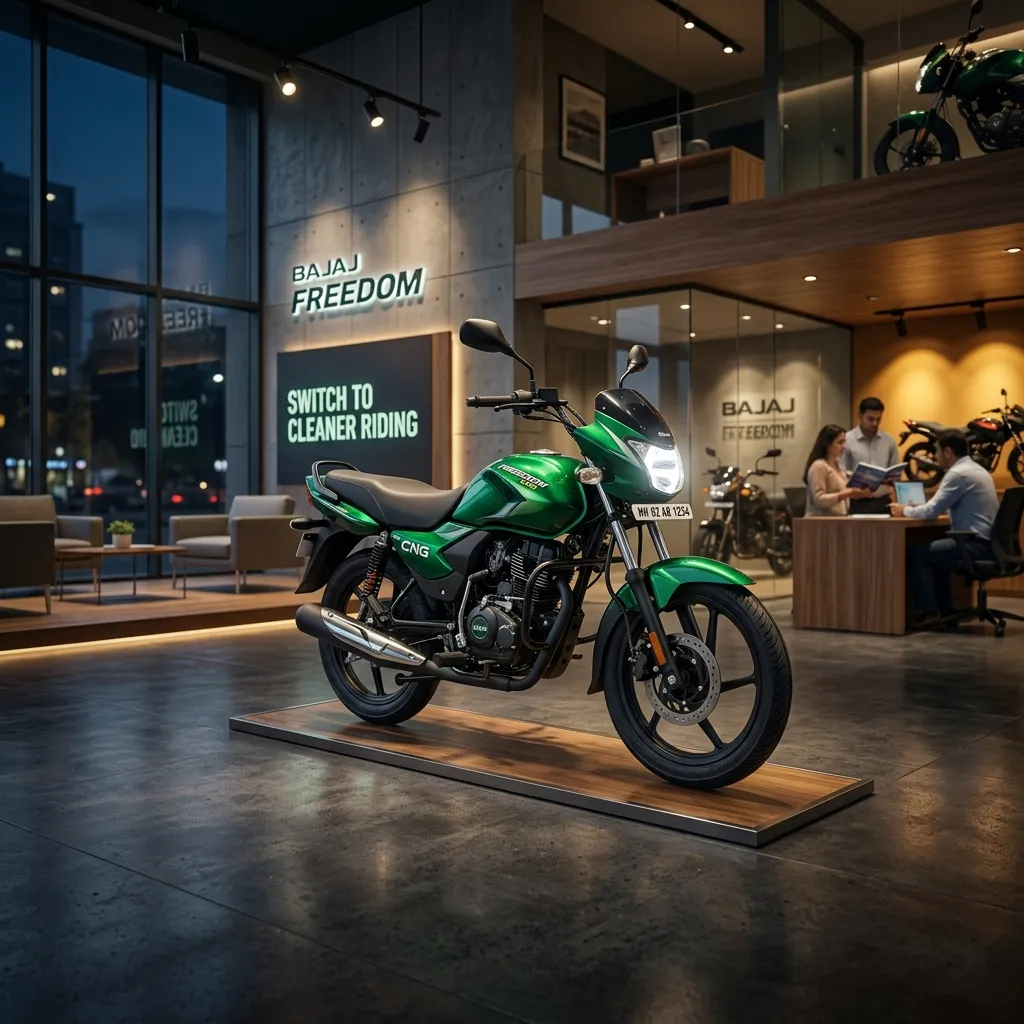
With petrol prices crossing ₹105 per liter across metropolitan hubs, daily commuting has become one of the largest expenses for working professionals and delivery riders. While electric two-wheelers offer low running costs, many apartment residents lack dedicated overnight charging points. The Bajaj Freedom 125 CNG bridges this gap—delivering the world's first production dual-fuel motorcycle capable of running on compressed natural gas or standard gasoline.
1. Dual-Fuel Engineering & Trellis Chassis Packaging
Integrating a high-pressure gas cylinder into a motorcycle required a ground-up packaging redesign. Bajaj engineered a high-tensile steel trellis frame that encapsulates a 2.0 kg seamless steel CNG cylinder (12.5-liter water volume) horizontally beneath the seat.
The 125cc forward-inclined air-cooled single-cylinder engine produces 9.5 PS of power and 9.7 Nm of torque. A 2.0-liter auxiliary petrol tank sits ahead of the cylinder. Refueling both tanks is handled under a single lockable flap on the tank console with separate nozzle ports. Compare commuter road agility in our Hero Xtreme 125R vs TVS Raider 125 comparison.
2. Real-World Tank-to-Tank Mileage & Cost Per Kilometer
In our extensive 1,000 km mixed city and highway road tests:
- CNG Mode Efficiency: The Freedom 125 delivered 94 to 96 km/kg in dense city traffic and up to 105 km/kg on open highways, averaging 100 km/kg overall. At ₹88/kg CNG, running cost is just ₹ 0.92 per kilometer.
- Petrol Mode Efficiency: In petrol mode, the bike returned 58 to 62 km/l, costing ₹ 1.75 per kilometer.
- Financial Comparison vs Honda Shine 125: A standard 125cc petrol commuter (averaging 55 km/l at ₹105/L) costs ₹1.91/km. A daily commuter riding 1,000 km/month saves over ₹ 1,000 every month (₹ 12,000+ per year), while high-mileage delivery riders save over ₹ 21,600 annually. Explore our 5-year two-wheeler total cost of ownership model.
3. Safety & 11 Rigorous Destructive Crash Tests
To eliminate safety concerns surrounding high-pressure CNG cylinders, Bajaj subjected the Freedom 125 to 11 destructive crash tests:
- Rear-End Impact Test: A 1.5-tonne moving barrier collided with the rear wheel at 50 km/h; the steel trellis cage deflected impact energy without cylinder intrusion.
- Drop & Crush Tests: A 10-meter crane drop onto concrete and a commercial vehicle wheel runover test confirmed structural integrity.
- Thermal Pressure Relief Device (TPRD): In case of fire, an integrated fuse vents gas safely to prevent explosion. Learn how to convert cable brakes to high-power hydraulic units in our hydraulic brake conversion guide.
4. Maintenance, CNG Filters & 3-Year PESO Testing
Owning a CNG motorcycle introduces two unique maintenance requirements:
- CNG Cartridge Filter Swaps: Replace the high-pressure gas filter every 15,000 km (₹400) to prevent compressor oil residues from fouling the gas injectors.
- Mandatory PESO Hydrostatic Retesting: Every 3 years, the cylinder must undergo hydrostatic pressure testing at 300 bar (costing ~₹1,500) at an authorized test center to comply with Indian RTO safety mandates. For battery storage care, read our BMS parasitic drain and storage guide.
Calculate your monthly motorcycle loan payments with our two-wheeler finance calculator, diagnose valvetrain sounds with our engine knocking diagnostic manual, and browse our technical tutorials.
Frequently Asked Questions (FAQs)
What is the real-world mileage of the Bajaj Freedom 125 on CNG and Petrol? +
In real-world testing, the Bajaj Freedom 125 delivers 96 to 102 km/kg in CNG mode (over 105 km/kg on open highways) and 58 to 62 km/l in petrol mode. With its 2 kg CNG tank and 2.0L petrol auxiliary tank, combined range is approximately 330 km.
How much money does the Bajaj Freedom 125 save per month compared to a petrol bike? +
For a daily commuter riding 35 km/day (1,000 km/month), the Freedom 125 costs approximately ₹ 920 in fuel compared to ₹ 1,910 for a 125cc petrol bike, saving ₹ 1,000+ per month (over ₹ 12,000 annually). High-mileage delivery riders save over ₹ 21,000 per year.
Is the CNG cylinder safe in a high-speed accident or rear crash? +
Yes. Bajaj subjected the Freedom 125 to 11 rigorous safety crash tests, including a 1.5-tonne rear collision, 10-meter crane drop tests, and truck runover tests. The high-strength steel trellis cage fully absorbs impacts without pressure cylinder breach.
What happens if the CNG runs out while riding? +
The motorcycle automatically and seamlessly switches to the 2.0L auxiliary petrol tank without any engine stall or jerk, and a console warning icon alerts the rider.
How often does the CNG cylinder need PESO hydrostatic pressure testing? +
Under Indian PESO (Petroleum and Explosives Safety Organization) regulations, the seamless steel CNG cylinder must undergo mandatory hydrostatic re-testing every 3 years at an authorized test station (tested to 300 bar).
Does the CNG fuel filter require periodic replacement? +
Yes. The high-pressure CNG cartridge filter should be replaced every 15,000 km (costing ~₹400) to prevent compressor lubricating oil aerosols and pipeline contaminants from fouling the gas injectors.