
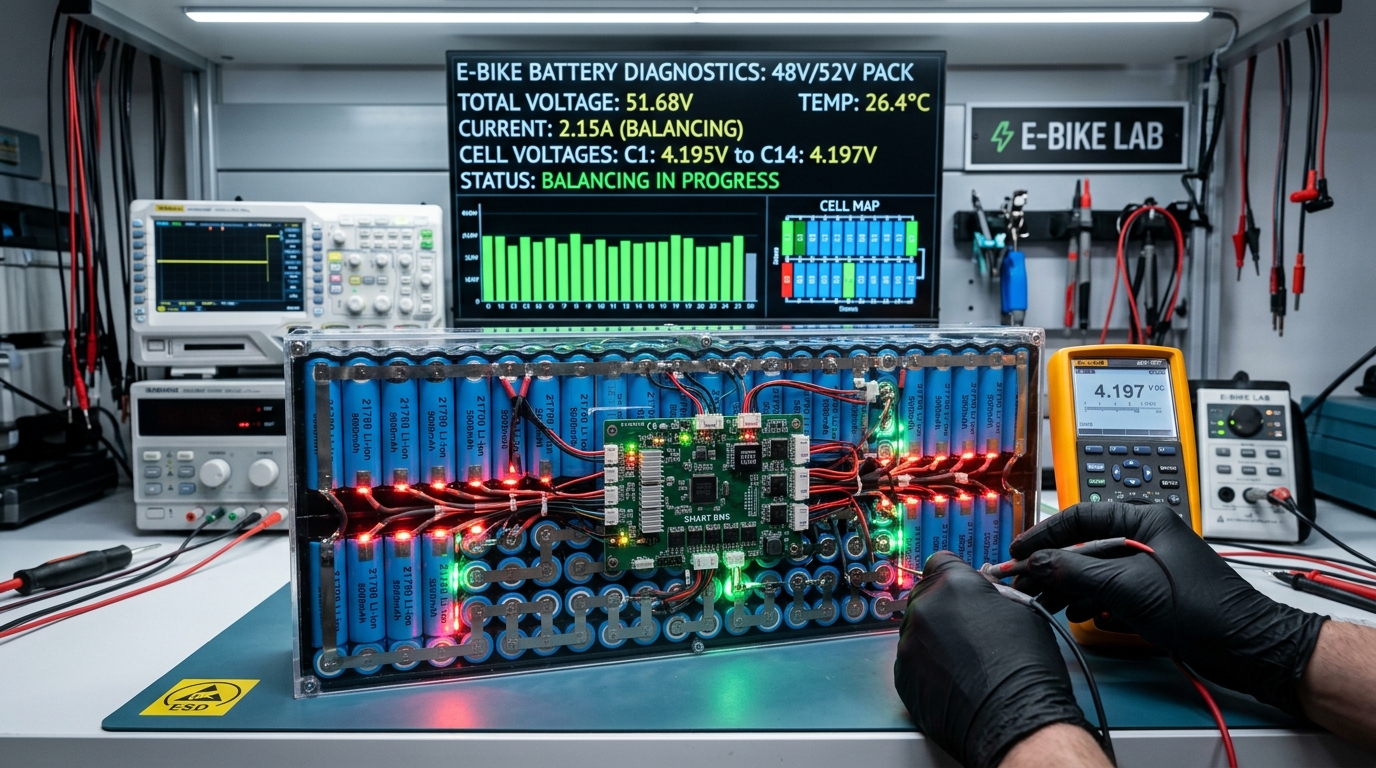
Every spring, thousands of e-bike owners discover that their battery packs have dropped to 0 volts and refuse to accept a charge from their stock power brick. The primary culprit is not battery failure, but rather parasitic quiescent current drain from the internal Battery Management System (BMS) circuit board over 3 to 6 months of winter hibernation. Understanding the electrochemistry behind standby drain is essential to protecting your battery investment.
1. The Physics of BMS Parasitic Quiescent Drain
Even when an e-bike is powered off and removed from the frame, its internal BMS remains electrically connected across the cell groups. The BMS constantly powers voltage divider networks, analog front-end (AFE) sensing ICs (such as Texas Instruments BQ769x series), microcontroller polling loops, and Bluetooth Low Energy (BLE) beacons.
On basic hardware-only BMS boards, this quiescent current draw ranges from 30 µA to 60 µA (0.03 to 0.06 mA), draining approximately 36 mAh per month. However, on modern "Smart BMS" boards with continuous Bluetooth broadcasting or digital microcontrollers, standby current rises to 0.5 mA to 2.0 mA (1,440 mAh per month). If a pack is stored near empty (20% SoC / 3Ah remaining), a 2 mA parasitic drain will pull the cells below the critical 2.5V cutoff in less than 90 days. For motor system comparisons, see our DJI Avinox vs Bosch CX Gen 5 shootout and check the Lectric XPeak 2.0 fat tire review.
2. Copper Dissolution & Dendrite Short Hazards (<2.0V/Cell)
When a lithium-ion cell drops below 2.00 Volts, a dangerous chemical breakdown occurs at the negative electrode: the copper foil current collector oxidizes and dissolves into the liquid electrolyte as copper ions ($Cu^{2+}$).
When the user reconnects a standard 2A–4A fast charger, these dissolved copper ions plate back out onto the anode surface not as smooth foil, but as sharp, microscopic metallic copper dendrites. These microscopic spikes puncture the ultra-thin (15–20 µm) polymer separator between the cathode and anode, creating internal micro-short circuits. This causes severe localized heating, Solid Electrolyte Interphase (SEI) decomposition, and catastrophic thermal runaway during subsequent charge cycles. For maintenance fundamentals, read our comprehensive guide to maintaining lithium-ion e-bike batteries.
3. Step-by-Step 0V Low-Current Pre-Charge Recovery Protocol
If a battery pack has entered sleep mode or dropped below the BMS low-voltage threshold (between 1.5V and 2.5V per cell) but has not been left in that state for extended months:
- Step 1 - Laboratory Bench Supply: Set an adjustable DC power supply to a low constant-current mode limited to 0.05C (e.g., 250 mA for a 5,000 mAh cell, or 750 mA for a 15Ah pack).
- Step 2 - Thermal Monitoring: Attach an infrared thermometer or thermocouple to the cells. If cell temperature rises by more than 5°C above ambient, terminate the recovery immediately.
- Step 3 - Transition to CC/CV: Once all series groups surpass 3.00V per cell without overheating, the pack can safely be connected to its standard 0.5C charger for a full balancing cycle.
- Step 4 - Recycling Triage: Any cell that rests below 1.00V or shows signs of swelling or electrolyte venting cannot be safely recovered and must be recycled at an authorized battery collection depot.
4. Winter Storage Rules: Voltage, Temperature & 60-Day Top-Ups
To guarantee 5+ years of battery health, adhere to three core rules:
- Storage Voltage (50%–60% SoC): Charge or discharge the pack to 3.80V–3.85V per cell (~38.2V for 36V packs, ~49.7V for 48V packs, ~53.5V for 52V packs). This minimizes stress on both the cathode and anode crystal structures.
- Cool, Dry Temperature: Store the pack indoors at 10°C to 15°C (50°F to 59°F). Never store a battery in freezing unheated garages or near high-heat radiators.
- 60-Day Top-Up Interval: Set a calendar reminder every 60 days to measure terminal voltage with a multimeter. If pack voltage drops by more than 1.5V, charge for 20 minutes to restore the 55% baseline.
For more technical guides, explore our e-bike technical tutorials, calculate financing for replacement battery packs with our finance calculator, and stay updated on battery safety regulations in our news section.
Frequently Asked Questions (FAQs)
What causes an e-bike battery to drain to 0V during winter storage? +
The Battery Management System (BMS) continuously draws a quiescent standby current (between 50 µA on analog boards and up to 2 mA on smart Bluetooth/MCU boards) to power microcontrollers and monitoring circuits. Over 3 to 6 months without maintenance, this parasitic load discharges cells below the 2.5V safe threshold.
Why is it dangerous to recharge a lithium battery that has dropped below 2.0V? +
Below 2.0V per cell, the copper current collector dissolves into the liquid electrolyte. When recharged rapidly, copper plates out as sharp microscopic dendrites that pierce the polymer separator, creating internal short circuits that can cause thermal runaway.
What is the correct storage voltage and temperature for winter storage? +
Store lithium-ion e-bike batteries at 50% to 60% State of Charge (approximately 3.80V to 3.85V per cell / 38.2V for 36V packs, 53.5V for 48V/52V packs) in a dry environment at 10°C to 15°C (50°F to 59°F), checking and topping up every 60 days.