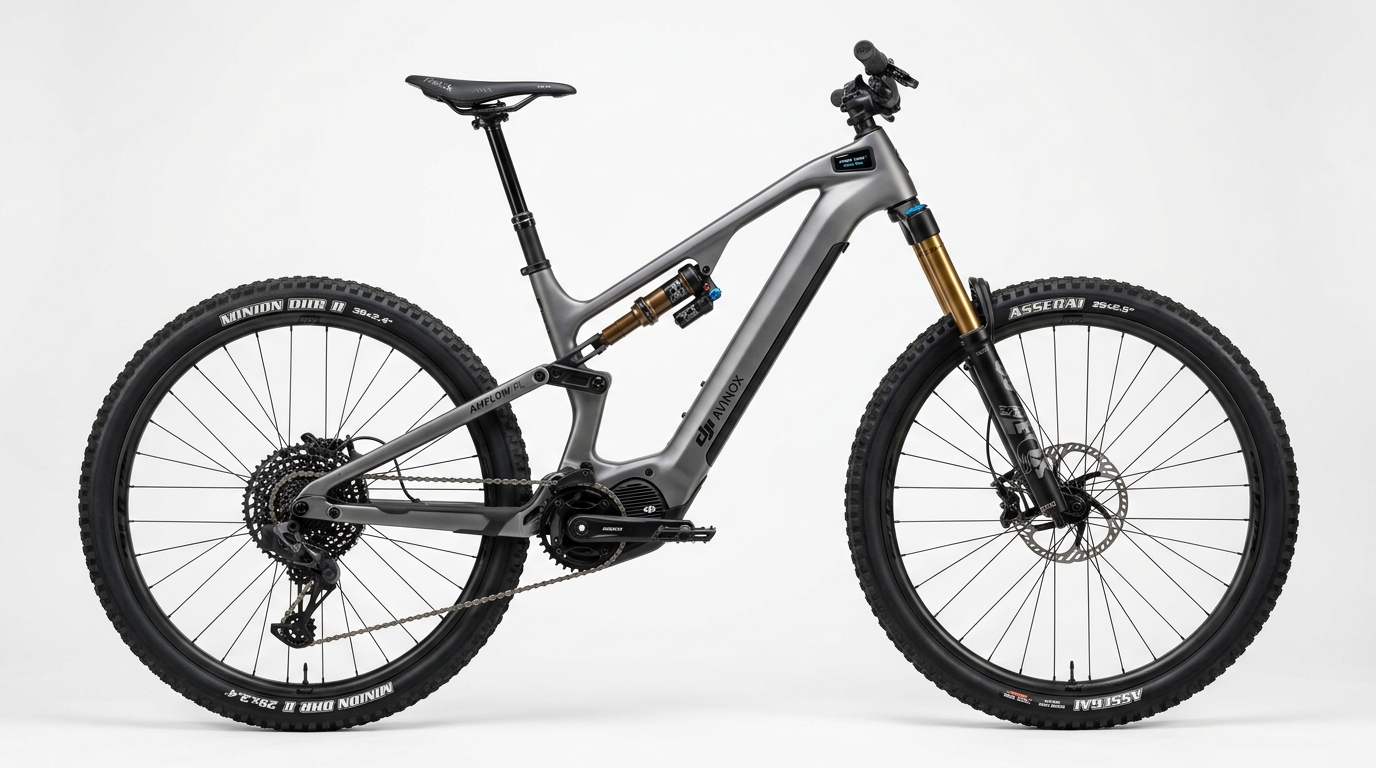
The electric mountain bike powertrain market entered a new era of engineering with the arrival of the DJI Avinox M1 drive unit on the Amflow PL Carbon e-MTB and the fifth-generation Bosch Performance Line CX (BDU384Y). For over a decade, Bosch established the industry standard for full-power e-MTB reliability, natural assist dynamics, and global service support. However, DJI's entry brings high-density drone brushless motor manufacturing, 6-axis inertial sensor fusion, and GaN fast-charging technology that fundamentally changes rider expectations.
1. Mechanical Architecture & Power Density Teardown
In physical dimensions and weight, the DJI Avinox M1 sets a new milestone. Weighing just 2.52 kg in its die-cast magnesium shell, it produces 105 Nm of continuous torque and 120 Nm in Boost mode, reaching 1,000 Watts of peak electrical output. This delivers an extraordinary power-to-weight ratio of 0.40 kW/kg. In contrast, the Bosch Performance Line CX Gen 5 weighs 2.80 kg (approx. 100 grams lighter than Gen 4), outputting 85 Nm of consistent torque (scalable up to 120 Nm in situational bursts via software updates) with a nominal 600W mechanical rating (up to 750W with Performance Upgrade 2.0). For riders comparing standalone e-MTB platforms, read our in-depth Bosch CX Gen 5 dyno review and check our guide to the best electric bikes for steep hill climbing.
2. Dyno Cadence Analysis: 40 to 120 RPM Grinds
Laboratory dynamometer bench testing reveals distinct power delivery curves between the two systems. At ultra-low cadences (40 to 60 RPM), the DJI Avinox delivers 112 to 120 Nm of torque, allowing riders to start from a complete standstill on steep 25% rock slabs without stalling. Bosch adopts a more progressive torque ramp, delivering 82 to 85 Nm to prevent rear-tire spin on loose gravel.
At optimal climbing cadences (75 to 90 RPM), both drive units hit their mechanical sweet spot: DJI generates 997 Watts of burst power, while Bosch delivers a rock-solid, predictable 603 Watts. As cadence spins up to 120 RPM, Bosch begins tapering output past 110 RPM (~553W at 120 RPM), whereas DJI’s compound planetary gear reduction maintains over 930 Watts in Boost mode, rewarding fast-spinning athletic riders.
3. Thermal Throttling Curves on Sustained Alpine Climbs
While DJI dominates peak sprint wattage, continuous thermal dissipation under heavy loads presents a different dynamic. In continuous 100% duty cycle climb tests on 20–25% gradients, DJI’s stator winding temperature rises at 3.9°C to 4.4°C per minute due to high electrical throughput (up to 32A phase current). When internal windings reach 85°C–90°C, the Avinox controller initiates soft step-down current modulation to protect rotor permanent magnets.
Bosch CX Gen 5, leveraging a larger magnesium casing with higher thermal inertia and optimized conduction ribbing, heats up at a slower rate of 2.4°C to 2.7°C per minute. As a result, Bosch can sustain its full 600W output indefinitely in 35°C ambient summer heat without power degradation.
4. Downhill Decoupling & Acoustic Sound Profiles
One of the primary rider complaints regarding the fourth-generation Bosch CX was the metallic clattering noise produced on rough descents when the internal clutch oscillated against the reduction gear train. On Gen 5 (BDU384Y), Bosch introduced a mechanical freewheel decoupling system that completely disengages the chainring from internal planetary gears when coasting. This reduces downhill motor clatter to 0 dB, matching the silence of traditional non-motorized mountain bikes.
DJI achieves identical downhill silence through a precision sprag clutch and polymer-damped gear teeth. On uphill climbs under full Turbo assist, Bosch generates a lower-frequency hum (53–56 dBA at 1 meter), while DJI produces a slightly higher-frequency planetary whine (58–62 dBA) due to higher internal rotor RPMs.
5. GaN 12A Fast Charging vs Standard 4A Charging
DJI introduces Gallium Nitride (GaN) power electronics to the cycling sector with its 12A / 508W Super Charger. This compact charger recharges an 800Wh battery from 0% to 75% in just 1 hour and 10 minutes (70 minutes), with a complete 100% top-up in 105 minutes. In contrast, standard 4A chargers require 3 hours and 50 minutes to reach 75% and 5 hours and 35 minutes for a full charge. To ensure battery cell longevity under high charging rates, review our guide to e-bike battery care and BMS preservation.
Discover more e-bike motor benchmarks in our top e-bike brands overview, compare financing options with our e-bike EMI calculator, and track the latest motor updates in our industry news hub.
Frequently Asked Questions (FAQs)
Which motor is lighter: DJI Avinox M1 or Bosch CX Gen 5? +
The DJI Avinox M1 drive unit weighs 2.52 kg in its compact magnesium housing, making it approximately 280 grams lighter than the Bosch Performance Line CX Gen 5 (BDU384Y), which weighs 2.80 kg.
Does the Bosch Performance Line CX Gen 5 fix the downhill rattle noise? +
Yes, Bosch completely redesigned the internal drivetrain on the Gen 5 (BDU384Y) with a mechanical freewheel decoupling system that separates the chainring from internal planetary gears when coasting, eliminating the metallic clunking noise found on Gen 4 motors.
What is the peak power difference between DJI Avinox and Bosch CX Gen 5? +
DJI Avinox delivers up to 1,000 Watts of peak electrical power and 120 Nm of torque in 30-second Boost bursts (850W / 105 Nm continuous). The Bosch CX Gen 5 outputs 600 Watts nominal peak (up to 750W with Performance Upgrade 2.0) and 85–120 Nm situational torque.
How fast does the DJI Avinox 12A GaN charger charge the 800Wh battery? +
The 12A / 508W Gallium Nitride (GaN) charger brings an 800Wh battery from 0% to 75% in approximately 1 hour and 10 minutes (70 minutes), and to 100% full charge in 1 hour and 45 minutes, compared to 5 hours and 35 minutes on standard 4A chargers.