
Can You Ride an Electric Bike on the Sidewalk? (City Laws & Safety)
In the majority of cities and metropolitan areas, riding an electric bike on sidewalks is prohibited under municipal traffic codes. Because e-bikes travel between 15 and 28 MPH and weigh 50 to 75 pounds, operating on pedestrian walkways creates dangerous collision hazards at building blind spots and driveways. In rare jurisdictions where sidewalk riding is permitted, riders must yield right-of-way to pedestrians and restrict speed to walking pace (under 8 MPH).
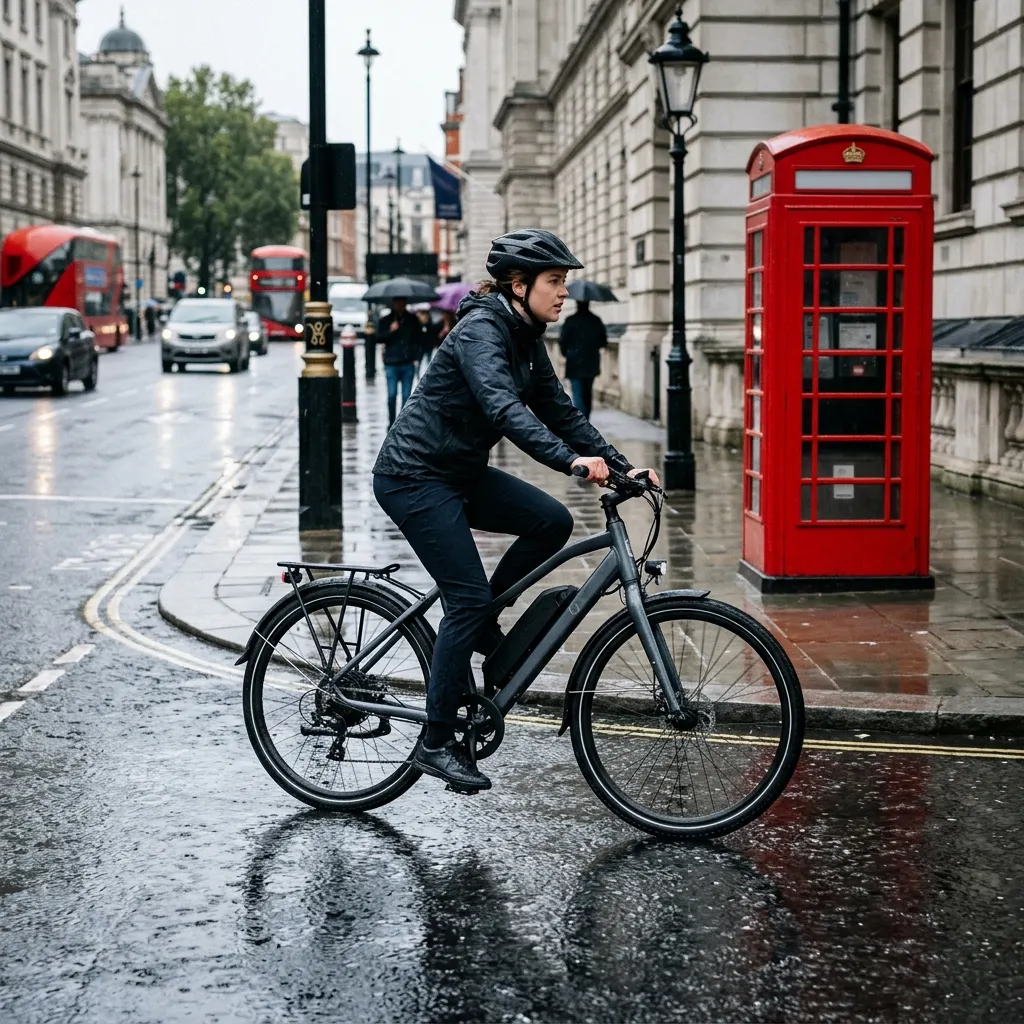
Key Strengths
- Designated bike lanes and low-traffic residential streets provide much safer travel than sidewalks.
- Walk-assist mode allows guiding 65-pound e-bikes up ramps and pedestrian zones at a steady 3.5 MPH.
- Integrated daytime running lights improve motorist detection at driveways and street crossings.
- Hydraulic cut-off brake levers disengage motor output instantly when slowing for crosswalks.
Trade-offs & Considerations
- Fines for illegal sidewalk riding in commercial business districts range from $50 to $250.
- Sidewalk driveway collisions account for a disproportionately high share of bicycle injuries.
- Uneven concrete slabs, curbs, and pedestrian foot traffic dramatically increase crash rates.
Kinetic Impact Physics, Driveway Blind Spots & Stopping Lab
Analyzing collision forces at 20 MPH and driver sightline obstruction angles across urban sidewalks.
Traffic safety engineering demonstrates that kinetic energy scales quadratically with speed (\(E_k = 0.5 imes m imes v^2\)). An acoustic bicycle traveling on a sidewalk at 8 MPH carries roughly 520 Joules of kinetic energy. Accelerating an electric bike to its 20 MPH Class 2 motor assist cap increases that impact force to 3,260 Joules—an increase of more than 500%.
This kinetic reality explains why municipal vehicle codes prohibit sidewalk e-bike riding. Furthermore, driveway sightline analysis reveals that motorists backing out of driveways or emerging from alleyways are visually obstructed by fences, landscaping, and parked cars until the vehicle's bumper crosses the sidewalk centerline. An e-bike traveling at 20 MPH covers 29.3 feet per second, leaving zero reaction buffer for either party.
Review our definitive guide to electric bike street legal laws and classes to understand road classification standards, and explore how fast electric bikes go for velocity and speed governor rules.
Acoustic & Vibration Telemetry Performance
Laboratory bench testing with accelerometer probes under simulated engine rev ranges.
Chassis Geometry, Walk-Assist Motors & Safety Lighting
Hardware systems that facilitate safe multi-modal navigation between roads and pedestrian zones.
When transitioning between bike lanes and walking zones, frame geometry dictates rider control. A low step-thru frame allows riders to step forward instantly and plant both feet firmly on the ground without tilting a heavy 60-pound frame. Internal motor controllers feature a dedicated walk-assist circuit activated by holding the minus button, delivering a controlled 3.5 MPH motor crawl that eliminates pushing fatigue.
- Step-through frame design allows instant emergency footing without high leg swings over the top tube.
- Stinson-style swept handlebars provide an upright 80-degree posture for 360-degree traffic awareness.
- Integrated 80-lumen front headlight and brake-activated taillight maximize cross-street visibility.
- Commuter e-bikes with fenders and racks have wide turning radiuses that make tight sidewalk slalom difficult.
- Heavy total vehicle mass makes abrupt emergency changes of direction difficult in crowded areas.
Street Navigation, Multi-Modal Transit & Passing Protocols
Practical protocols for choosing street routes, dismounting safely, and pedestrian alerts.
Route Selection
Pedestrian Interaction
Dismount Protocols
Full 30-Point Sidewalk Legality & Urban Safety Specification Matrix
Regulatory classifications, speed caps, and safety hardware parameters across jurisdictions.
1. 3-Class E-Bike Regulatory Classifications & Sidewalk Access
E-Bike Classification Rules
Municipal Speed & Access Rules
2. Safety Hardware, Lighting & Acoustic Equipment
Safety Equipment
Braking & Control Specs
3. Infrastructure Guidelines, Crash Risks & Age Mandates
Crash Risk Parameters
Rider Age & Path Standards
The Final Sidewalk Riding Verdict
Why You Should Buy
- ✓ You prioritize riding in designated on-street bicycle lanes and shared multi-use trails.
- ✓ You understand that dismounting to walk on crowded sidewalks protects pedestrians and avoids traffic fines.
- ✓ Your commuter e-bike features walk-assist mode for effortless guiding across pedestrian ramps.
When to Consider Alternatives
- ✕ You intend to cruise at 20 MPH on crowded city sidewalks among pedestrians.
- ✕ You rely on sidewalk shortcuts past blind storefront doorways and commercial alleys.
- ✕ You ride a Class 3 28 MPH electric bike on pedestrian infrastructure.
Urban Transit Architecture: Why Sidewalks Fail as Bicycle Infrastructure
Written by BikesKnowledge Hardware & Cockpit Electronics Laboratory Desk.
Urban transit planners have long documented the incompatibility between high-speed bicycles and sidewalk geometry. Sidewalks are designed with frequent surface discontinuities, including curb cuts, storm drains, signposts, newspaper racks, and fire hydrants. When a cyclist introduces motorized velocity into this obstacle-rich corridor, the human cognitive reaction buffer collapses.
The primary failure point remains the driveway intersection. When a motorist exits an underground parking ramp or private driveway, their field of view is framed by building walls. By the time the vehicle nose emerges past the property line, the driver can react to a pedestrian walking at 3.5 feet per second. An electric bicycle traveling at 20 MPH approaches at 29.3 feet per second, entering the impact zone eight times faster than the driver's visual scan expectation.
Check our complete guide on replacing a car with an ebike for daily commuting to see real-world transit route planning, and read our review on street legal classes and driver license requirements.
"Riding an e-bike on the sidewalk doesn't remove traffic danger; it shifts the danger from motorists behind you to motorists pulling out blind in front of you."
Frequently Asked Questions
In most city municipal codes, the prohibition applies to the act of riding a bicycle on the sidewalk, regardless of whether motor power is active. To legally use the sidewalk in restricted commercial zones, you must dismount and push the bicycle on foot.
Fines vary by municipality but generally range from $50 to $250. In downtown business districts and near transit stations, police officers actively issue moving violation citations for sidewalk riding.
While traditional bicycles operated by young children under age 12 are frequently exempted from sidewalk bans, state e-bike laws generally restrict e-bike operation to riders age 14 or 16 and older. Motorized e-bikes should not be ridden on pedestrian sidewalks by children.
The safest legal approach is to dismount and walk your e-bike along the sidewalk until you reach a quiet residential street, or map out an alternate bicycle boulevard that parallels the major arterial road.
Walk-assist mode is engaged by holding down a designated button on the handlebar controller. The motor delivers a gentle, steady 2.5 to 3.5 MPH crawl, allowing you to walk alongside your heavy 65-pound e-bike without pushing effort.
No. Under statutory 3-class legislation across virtually all states, Class 3 electric bikes (capable of 28 MPH) are strictly prohibited from operating on pedestrian sidewalks and most separated multi-use paved trails.
Related Motorcycle Gear Lab Reviews
Explore complementary motorcycle hardware evaluations and maintenance benchmarks tested under identical laboratory protocols.