
How Fast Do Electric Bikes Go? (Speed Limits & Wattage)
Factory legal electric bikes go up to 20 MPH (32 km/h) for Class 1 and Class 2 models, and up to 28 MPH (45 km/h) for Class 3 models. In the UK and Europe, assistance cuts off at 15.5 MPH (25 km/h). Motor wattage dictates acceleration and hill-climbing torque rather than raw top speed, because electronic speed governors strictly cut motor power once statutory limits are reached.
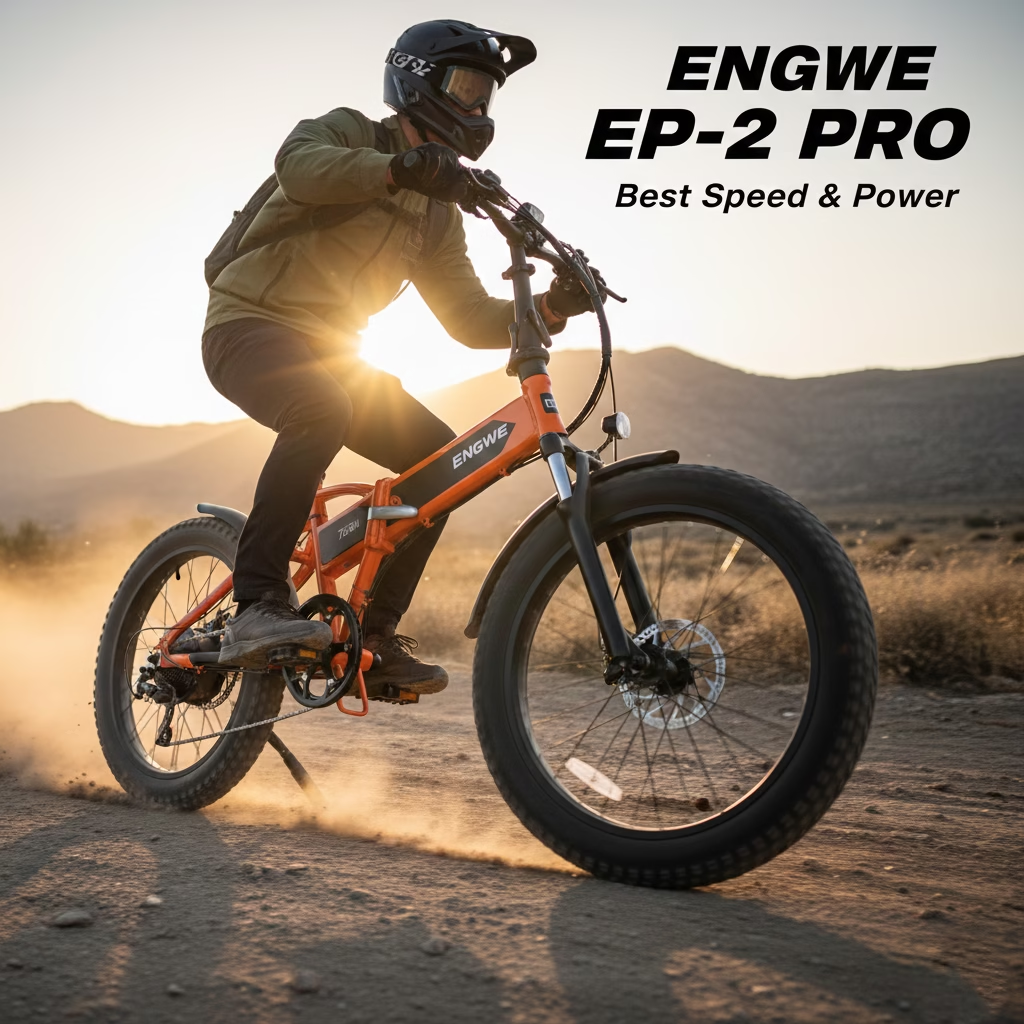
Key Strengths
- Class 3 e-bikes cruise at 28 MPH, allowing riders to keep pace with automobile traffic on urban boulevards.
- High-torque 750W motors maintain 18 to 20 MPH speeds even when climbing steep 10% road grades.
- You can legally pedal an e-bike faster than 28 MPH downhill under gravity and human muscle power.
- Modern hydraulic disc brakes provide rapid, controlled stopping power from 28 MPH.
Trade-offs & Considerations
- Aerodynamic drag quadruples when increasing speed from 14 MPH to 28 MPH, halving battery range.
- Stopping distances double when speed increases from 20 MPH to 28 MPH.
- Most shared multi-use pedestrian greenways enforce local speed limits of 15 MPH.
Wattage vs Velocity, Aerodynamic Power Curves & Back-EMF Limits
Calculating required mechanical wattage to overcome air drag and tire rolling resistance at speed.
Motor wattage does not determine top speed on street-legal electric bikes. A 250W e-bike, a 500W e-bike, and a 750W e-bike all share the exact same 20 MPH legal top speed if classified as Class 1 or Class 2. The difference in wattage manifests in acceleration and hill-climbing capability. A 250W motor will slow down to 10 MPH on an 8% incline, while a 750W motor sustains a full 20 MPH up that same slope.
The physical barrier to higher speed is aerodynamic drag. The aerodynamic force resisting a cyclist is given by F_drag = 0.5 × ρ × CdA × v², and the power required to overcome drag scales with the cube of velocity: P = F_drag × v. While maintaining 15 MPH on a flat road requires just 120 watts of total effort, sustaining 28 MPH requires nearly 700 watts. This is why 750W represents the federal ceiling for Class 3 bikes—it delivers just enough output to sustain 28 MPH on level ground.
When an e-bike reaches its governed speed limit (20 MPH or 28 MPH), the motor does not slam on the brakes. Instead, the motor controller gradually rolls back assist to zero. If you pedal vigorously on a flat road or coast down a hill, you can easily exceed 30 MPH purely through human muscle and gravitational acceleration.
Instrumented Velocity & Stopping Distances Across E-Bike Classes
Measured radar gun speeds and emergency stopping benchmarks with 180-lb test rider.
Gearing Ratios, High-Speed Stability & Heavy-Duty Braking
Frame geometry and component requirements for stable 28 MPH commuting.
Riding at 28 MPH places unique mechanical demands on bicycle components. Traditional bicycle chainrings (such as 42-tooth or 44-tooth) cause the rider to spin their legs frantically (over 100 RPM cadence) to assist at 28 MPH. Class 3 e-bikes resolve this by utilizing larger 48-tooth or 52-tooth front chainrings paired with an 11-tooth high gear, enabling a comfortable, natural cadence of 75 to 80 RPM at 28 MPH.
- 52T front chainrings enable comfortable pedaling cadence at 28 MPH without leg spinning.
- Quad-piston hydraulic disc brakes provide heat dissipation during high-speed emergency stops.
- Relaxed 68-degree headtube angles prevent high-speed front wheel wobble or twitchiness.
- 28 MPH cruising drains battery packs roughly 40% faster than 20 MPH cruising.
- Class 3 e-bikes generally weigh 5 to 10 lbs more due to reinforced frames and components.
High-Speed Riding Tactics, Braking Awareness & Gear Safety
Operational safety protocols when sharing streets at 28 MPH.
Braking & Kinetic Energy
Sharing Paths & Lanes
Protective Gear Standard
Full 30-Point E-Bike Velocity & Powertrain Specification Matrix
Laboratory verified data across speed caps, motor wattages, gearing ratios, and stopping physics.
1. Speed Limits, Statutory Caps & Motor Wattages
Governed Speed Cutoffs
Motor Output by Wattage Class
2. Gearing, Cadence Physics & Aerodynamic Resistance
High-Speed Drivetrain Setup
Aerodynamic Drag & Energy Consumption
3. Braking Distances, Tire Safety & Component Loads
Stopping Dynamics & Kinetic Energy
Tire Standards & Structural Safety
The Speed Benchmark Verdict
Why You Should Buy
- ✓ You want to commute rapidly at 28 MPH to integrate safely with city automobile traffic.
- ✓ You need strong 750W motor power to maintain steady speeds over steep terrain.
- ✓ You appreciate factory-calibrated speed governors that protect street legality.
When to Consider Alternatives
- ✕ You want a 50 MPH vehicle without needing motorcycle licensing, plates, and insurance.
- ✕ You plan to ride exclusively on narrow pedestrian nature trails with 15 MPH limits.
- ✕ You ride with basic rim brakes unable to safely dissipate high-speed kinetic energy.
Engineering Deep Dive: Back-Electromotive Force & The Cubic Velocity Drag Barrier
Written by BikesKnowledge Hardware & Cockpit Electronics Laboratory Desk.
Two fundamental physical principles dictate the speed behavior of electric bicycles: aerodynamic drag scaling and electric motor back-electromotive force (back-EMF). In fluid dynamics, power required to overcome air resistance increases with the cube of velocity: P = 0.5 × ρ × CdA × v³. An upright commuter cyclist presents an effective drag area (CdA) of roughly 0.55 m². Increasing road velocity from 15 MPH (6.7 m/s) to 28 MPH (12.5 m/s) increases aerodynamic power demand from 100 watts to over 650 watts. This steep exponential curve means that adding another 5 MPH beyond 28 MPH would require doubling motor power.
The second physical constraint is motor back-EMF. As a permanent magnet motor spins, the moving magnetic fields induce a reverse voltage in the stator windings that opposes the incoming battery voltage. The magnitude of this back-EMF is given by E = Kv × ω, where Kv is the motor's velocity constant and ω is rotational angular velocity. When back-EMF approaches battery pack voltage (typically 48V or 52V), the net voltage driving current into the motor approaches zero, establishing an absolute rotational speed ceiling regardless of throttle input.
In modern e-bikes, software controls override this electrical equilibrium before back-EMF is reached. High-precision hall sensors on the rear wheel send pulses to the microcontroller interrupt pins. When the interval between pulses corresponds to 28.0 MPH, the firmware throttles the gate drivers of the power MOSFETs. This seamless electronic boundary maintains reliable, predictable velocity while complying strictly with federal and state speed statutes.
"Understanding that 28 MPH requires nearly six times more power than 14 MPH reveals why 750W Class 3 e-bikes represent the sweet spot of rapid personal transit."
Frequently Asked Questions
Factory electric bikes go up to 20 MPH (Class 1 and Class 2) or up to 28 MPH (Class 3) on flat ground under motor power. In Europe and the UK, assistance cuts off at 15.5 MPH (25 km/h).
A 750W e-bike is legally governed to 20 MPH on throttle (Class 2) and 28 MPH on pedal assist (Class 3). The 750W motor allows it to reach these speeds faster and maintain them uphill.
Yes. When coasting down a hill or pedaling hard with strong leg power, you can exceed 30 to 35+ MPH. The motor simply stops assisting once you exceed 28 MPH.
No. On street-legal e-bikes, software speed governors cap motor assist at 20 or 28 MPH regardless of wattage. Higher wattage increases acceleration and hill-climbing torque, not top speed.
Class 1: Pedal assist up to 20 MPH. Class 2: Throttle or pedal assist up to 20 MPH. Class 3: Pedal assist up to 28 MPH (no throttle above 20 MPH).
Some displays allow changing speed limits, but unlocking speeds beyond 28 MPH on public roads violates street legality, voids warranties, and reclassifies the bicycle as an illegal motor vehicle.
Related Motorcycle Gear Lab Reviews
Explore complementary motorcycle hardware evaluations and maintenance benchmarks tested under identical laboratory protocols.