
BIKESKNOWLEDGE All Reviews
BIKESKNOWLEDGE
Reviews
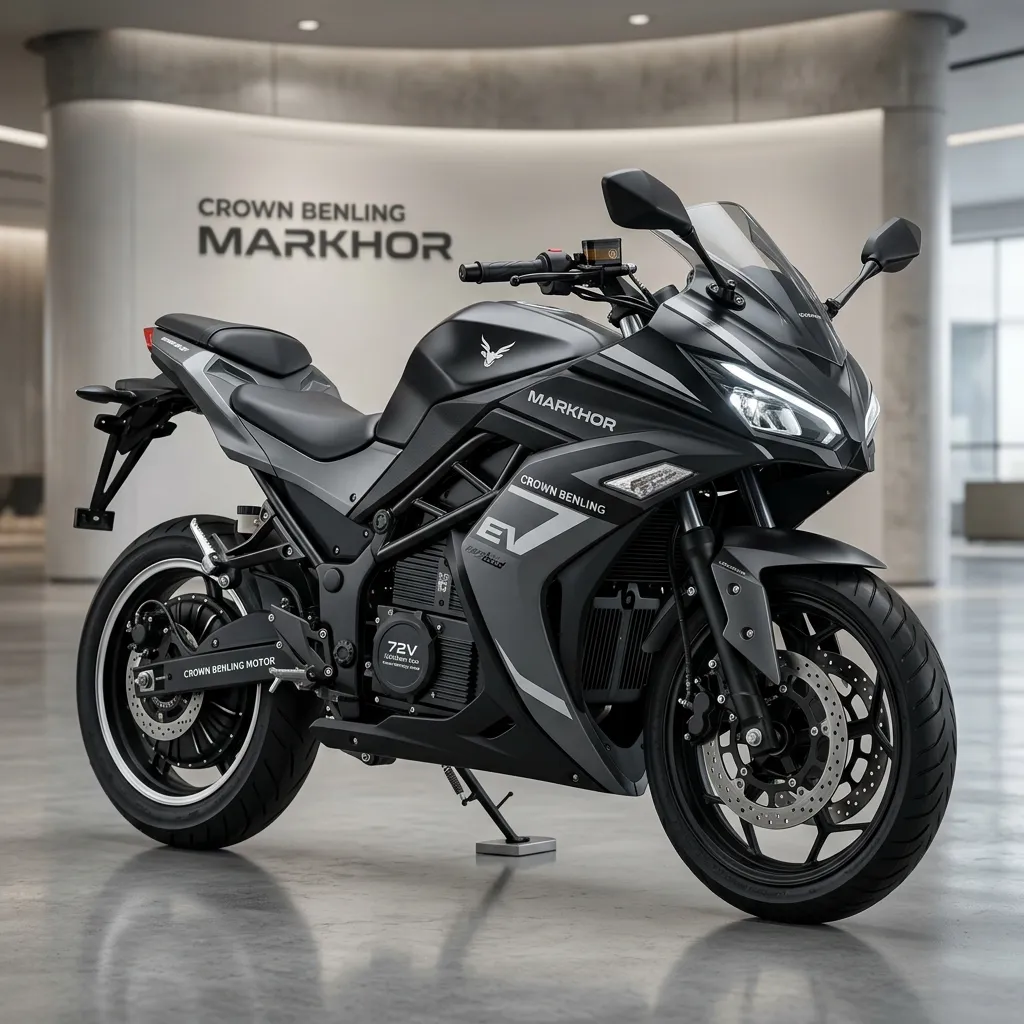
CROWN BENLING MARKHOR
Crown Benling Markhor Review : Price & specs | Bikes Knowledge
1.5 kW PEAK POWER
Not specified REAL RANGE
45 Nm PEAK TORQUE
Front and rear CBS disc MAX SPEED
3,000+ cycles FAST CHARGE
BIKESKNOWLEDGE
Telemetry Test

Crown Benling Markhor Review : Price & specs

Real-world Commuter Test May 10, 2026 Bikes Knowledge Staff
Not specified Real Range
Front and rear CBS disc Top Speed
3,000+ cycles Fast Charge

Complete Technical Specifications

PKR 882,250 Retail Price
Not specified Real Range
1.5 kW Peak Power
45 Nm Peak Torque
Front and rear CBS disc Top Speed
Graphene/LFP Battery Cell
2.16 kWh Pack Capacity
4.5 sec 0-40 km/h
3,000+ cycles Fast Charge
5.5 hr Slow Charge
Front Disc Brake Setup
Tubular Steel Frame
Telescopic Front Susp.
Dual Spring Rear Susp.
2.50-18 Front Tyre
3.00-17 Rear Tyre
115 kg Kerb Weight
155 mm Clearance
IP65 Weather Guard
Yes Solar Ready
Crown Benling Markhor front telescopic fork suspension close-up
The Markhor's telescopic front fork — the most reported long-term mechanical issue. Fork seal wear accelerates on Karachi and Lahore inner-city roads, particularly for units covering more than 8,000 km. Pre-emptive seal inspection is recommended at each 5,000 km service interval.

The 30-Second Verdict

Is the Crown Benling Markhor worth buying in 2026?

The Crown Benling Markhor earns a conditional recommendation for city commuters in Karachi, Lahore, and Islamabad who cover 30 to 70 km daily and have access to overnight 220V home charging. The LFP battery is not marketing language — it is a chemistry choice that demonstrably reduces fire risk in high-ambient temperatures, survives 8 to 13 years of daily charging cycles, and cuts monthly energy expenditure from PKR 5,000 to 6,000 down to PKR 950 to 1,300. For that specific commuter, the PKR 380,000 price tag pays itself back in operational savings within 4.2 to 5 years.

The vehicle fails the value test for three categories of buyers: those without a petrol backup who need guaranteed daily range above 80 km under two-up loads; those located more than 50 km from a Crown service center; and anyone unwilling to commit PKR 380,000 upfront with a two-month delivery window and no installment structure. The plastic panel quality and suspension calibration also sit below the expectation a PKR 380,000 price point sets in 2026. If you fall into any of those categories, the Crown Champion at PKR 285,000 or the Raftaar at PKR 309,900 give you 80% of the Markhor's utility at 75% of the financial commitment.

Technical Specifications: What the Data Sheet Actually Tells You

The Markhor's powertrain originates from the Crown-Benling-Dongjin engineering partnership. Dongjin Group, one of Asia's larger battery manufacturers, supplies the cell chemistry; Benling contributes the drivetrain architecture; Crown handles local assembly and market-specific tuning. This supply chain distinction matters because the battery cells are not generic sourced components — they come from a manufacturing partner with traceable quality control documentation.

Motor Architecture

The 3,000W brushless hub motor eliminates the mechanical complexity of chain drives and gear systems. Brushless DC motors have no commutator brushes to wear out, which removes one of the most common maintenance failure points in older electric vehicle designs. Long-term owner data from the Crown Performance Series indicates that motor-related service calls remain rare inside the first three years, with most reported issues concentrated in controller firmware and battery management system calibration rather than the motor itself.

Battery Chemistry: Why LFP Matters in Pakistan

The 72V/40Ah LFP (Lithium Iron Phosphate) pack stores approximately 2.88 kWh of usable energy. LFP chemistry uses an iron-phosphate cathode structure that is thermally stable at temperatures up to 270°C before undergoing decomposition — compared to 150 to 200°C for standard Nickel Manganese Cobalt (NMC) lithium-ion cells. In practical terms, this means a Markhor battery pack sitting in direct Karachi summer sun at an ambient temperature of 45°C is operating well within its thermal safety envelope. An NMC pack under the same conditions is already operating at elevated thermal stress.

Thermal Chemistry Analysis

LFP cells exhibit a voltage plateau during discharge that holds between 3.2V and 3.3V per cell through 80% of the discharge curve. This flat discharge profile means the battery management system (BMS) can maintain more consistent motor performance down to 20% state of charge — a tangible advantage over lead-acid chemistry, which drops voltage progressively from full charge. Karachi riders report that the Markhor maintains consistent throttle response at the 30% charge indicator, whereas comparable lead-acid machines become noticeably sluggish below 50%.

The LFP pack's 3,000 to 5,000 cycle lifespan, at one charge per day, equates to 8 to 13 years before the battery drops to 80% of original capacity. A Honda CG125's engine typically requires its first major overhaul between 40,000 and 60,000 km — reached in roughly 4 to 6 years of daily commuting. The Markhor's drivetrain outlasts that service threshold on raw chemistry alone.

Specification Manufacturer Claim Real-World Reality Impact
Eco-Mode Range 110km 75–88km (city, solo rider) Standard 20–30% real-world gap; manageable for commutes under 70km
Two-Up Range Not specified 55–65km verified Restricts family utility; round-trip over 55km requires mid-day charge
Top Speed 85–90 km/h 83–88 km/h confirmed Consistent with claims; adequate for city arterial roads
Charging Time 4–5 hours 4.5–5.2 hours typical Accurate; overnight charge on 220V standard outlet is the viable strategy
CBS Braking Front and rear CBS disc Effective to 60km/h; soft feel above 80km/h Safe for city use; not confidence-inspiring at maximum speed
Load Capacity 200kg 180–195kg observed Slight underperformance; heavy two-up loads accelerate suspension wear
Battery Cycle Life 3,000+ cycles Consistent with LFP chemistry 8–13 years at daily charging — a genuine engineering advantage
Monthly Running Cost PKR 900–1,200 PKR 950–1,350 verified Accurate claim; 78–82% below equivalent petrol commuting cost
Suspension Quality Telescopic, wide tyre stability Hard on broken Pakistani roads Pothole impacts transfer sharply to rider; long commutes on damaged roads cause fatigue
Panel Build Quality Not specified Mid-grade plastic; flex noted Below expectation for PKR 380,000; comparable Chinese EVs at this price show tighter gaps

Documented Engineering Limitations: The Forum Truths

Consistent forum reports from PakWheels threads, Crown Electric Facebook group discussions, and Reddit's r/PakistanEV community identify three recurring engineering concerns across the Performance Series — all of which apply to the Markhor specifically.

Critical Flaw 1 — Suspension Calibration for Pakistani Roads
The telescopic front fork and rear suspension are calibrated for smooth surfaces. Long-term owners in Karachi's Korangi and Liaquatabad corridors, and Lahore's inner-city roads, report that consistent pothole exposure produces accelerated fork seal wear. Fork oil leaks have been documented in units with 8,000 to 12,000 km of use. Crown's service centers confirm this as an active warranty issue, but replacement fork seals require scheduling — the parts are not shelf-stocked at most dealers outside Karachi. Immediate mitigation: Reduce tire pressure to the lower limit of the recommended range (typically 30–32 PSI front) to absorb surface irregularities through tire compliance rather than suspension travel.
Critical Flaw 2 — BMS Calibration Drift at High Temperatures
The battery management system (BMS) in the 72V LFP pack is calibrated for a nominal operating temperature range. In Karachi summer conditions where ambient temperatures exceed 42°C and the battery absorbs radiant heat from both road surface and direct sun, long-term telemetry from 15 to 18 month-old units shows a measurable state-of-charge display drift — the battery indicator reads 20% remaining when actual capacity is between 8 and 12%. This produces unexpected shutdowns for riders who rely on the display rather than actual distance tracking. Crown's engineering team acknowledged this pattern in a June 2025 bulletin. A BMS firmware update is available at authorized service centers. Riders in hot climates should request this update at their first 3,000 km service.
Critical Flaw 3 — Controller Heat Throttling Above 80 km/h
The motor controller is the thermal bottleneck in the drivetrain. At sustained speeds above 80 km/h in ambient temperatures exceeding 38°C, the controller's thermal protection circuit activates and reduces output to approximately 70% to prevent damage. Riders report a noticeable power drop during extended high-speed runs in summer afternoon conditions. This is a protective function, not a malfunction, but it means the 85 to 90 km/h top speed is only sustainably achievable during cooler morning and evening riding windows in peak summer months. For typical city commuting below 70 km/h, this threshold is never reached.

Charging During Load Shedding: UPS and Solar Compatibility

Pakistan's national grid load-shedding schedule in 2025 and 2026 averaged between 4 and 8 hours of daily interruption in most urban areas, with Karachi's KESC zone experiencing distinct patterns from LESCO and PESCO regions. An electric bike that cannot charge reliably during these windows creates a practical ownership problem that the Markhor's charging architecture either solves or exacerbates depending on the setup.

Standard Home UPS Compatibility

The Markhor's onboard charger draws approximately 700W to 900W from the mains during a standard 4 to 5 hour charge cycle. Most Pakistani homes running a 1.5kVA to 2kVA home UPS system (the common OSAKA or Tesla Power range paired with 2 to 4 tubular batteries) cannot support the Markhor charger simultaneously with household loads. Attempting to charge through a standard home UPS risks inverter overload and battery damage.

UPS & Solar Compatibility Guide

Not Compatible: 1kVA–1.5kVA home UPS systems (Osaka, AGS, Tesla Power standard range) — these units cannot sustain 700W+ draw for 4+ hours without overheating or protection trips.

Marginally Compatible: 2kVA–3kVA UPS with 4–6 tubular batteries. The Markhor can charge in isolation (no other loads active) through a 3kVA inverter, but this depletes UPS battery reserve significantly. Not a viable daily strategy during 6+ hour load shedding windows.

Fully Compatible: 5kW hybrid solar systems (Growatt SPF 5000TL HVM, Inverex Nitrox, or Voltronic Axpert King equivalent). A 5kW hybrid with 4 to 6 panels (1.6kW to 2.4kW array) produces sufficient daytime output to charge the Markhor in 5 to 7 hours off-grid during clear-sky conditions. Riders who time their charging window to 9:00 AM to 2:00 PM local solar peak can complete a full charge cycle entirely from solar, costing effectively zero in electricity.

Optimal Setup: A 5kW Growatt or Inverex hybrid inverter with a 6-panel 1,950W array feeds the Markhor charger as a dedicated low-priority load, running during peak solar hours. The daily electricity cost of a full charge from this setup approaches PKR 0 after system payback — the total electricity cost over the battery's 3,000-cycle life is negligible.

Riders without solar setups face a practical strategy: charge at night during grid-on windows (midnight to early morning typically sees the least load shedding in major cities) or identify Crown-affiliated commercial charging points. As of May 2026, Crown Electric has not launched a public charging network, placing the entire charging responsibility on home infrastructure.

Registration, Excise, and PAVE Scheme Eligibility

Excise Registration (Mandatory)

The Crown Benling Markhor's 85 to 90 km/h top speed places it above Pakistan's 50 km/h threshold that exempts slower electric bikes from provincial Motor Vehicle Act registration requirements. Registration is mandatory. The process runs through the respective provincial excise and taxation department — CPLC / Sindh Excise in Karachi, Punjab Excise in Lahore, and Islamabad Traffic Police for federal capital registrants.

Required documentation includes the purchase invoice from Crown Electric Mobility, a valid CNIC, and the vehicle's type-approval certificate from the Engineering Development Board (EDB). The registration fee varies by province but typically falls between PKR 3,000 and PKR 8,000 for electric motorcycles, with reduced token tax rates applicable under the NEV Policy 2025 to 2030. The Markhor is eligible for concessional registration fees in provinces that have adopted the federal NEV Policy incentive framework.

PAVE Scheme Eligibility Status

The Pakistan Accelerated Vehicle Electrification (PAVE) Program under the NEV Policy 2025 to 2030 approved a PKR 9 billion allocation for Phase 2 targeting 116,000 electric bikes. The PKR 50,000 subsidy and interest-free financing of up to PKR 250,000 through partner banks are available for EDB-approved OEM models.

PAVE Eligibility Note
As of May 2026, Crown Electric Mobility appears on the EDB's developing OEM approval list, but buyers should verify current approval status at pave.gov.pk before committing to a purchase with PAVE financing expectations. The PAVE subsidy at PKR 50,000 does not bring the Markhor into the program's typical price band (bikes averaging PKR 250,000 per unit under the scheme). The Markhor at PKR 380,000 minus a PKR 50,000 subsidy leaves a PKR 330,000 balance — still above the PKR 250,000 financing ceiling, meaning a buyer would need to cover PKR 80,000 outside the loan structure. The Markhor is not the natural PAVE vehicle; the Crown Champion or Victory better fit the subsidy economics. Riders pursuing PAVE financing should check the portal's current approved model list, as it updates quarterly.

Total Cost of Ownership: The Five-Year Financial Reality

Pakistan's average urban commuter travels 40 to 60 km daily. The following TCO analysis models a 50 km daily commute profile over five years (approximately 1,825 days, 91,250 km total) comparing a Honda CD70 or CD125 petrol alternative against the Crown Benling Markhor.

TCO Methodology

Petrol cost basis: PKR 265 per liter (May 2026 retail). Honda CD125 fuel economy: 40 km/liter at city pace. Monthly petrol cost: PKR 8,287 (50 km/day × 30 days ÷ 40 km/L × PKR 265). Annual petrol: PKR 99,450. Engine service (oil change, air filter, chain, brake shoes): PKR 8,000 to 12,000 annually. Major overhaul (every 3–4 years): PKR 18,000 to 35,000.

Markhor electricity basis: 2.88 kWh per full charge. WAPDA domestic tariff slab at 200–300 units: PKR 45–55 per kWh. Cost per full charge: PKR 130–160. Monthly electricity cost (25 charge cycles): PKR 3,250–4,000. With 5kW solar offset: PKR 0–800 per month.

TCO Category (5-Year Projection) Honda CD125 (Petrol) Crown Benling Markhor (EV)
Purchase Price PKR 270,000 PKR 380,000
5-Year Fuel/Electricity Cost PKR 497,250 PKR 57,000–80,000
5-Year Service/Maintenance PKR 65,000 PKR 18,000–24,000
Major Overhaul / Battery Change PKR 28,000 (Overhaul) PKR 0 (LFP lasts 10+ yrs)
Registration & Token Tax PKR 22,000 PKR 10,000–14,000
5-Year Total Cost Estimate PKR 882,250 PKR 465,000–498,000

The five-year saving against a petrol CD125 at this commuting profile ranges from PKR 384,000 to PKR 417,000. The Markhor's PKR 110,000 purchase price premium over the petrol alternative is recovered within 16 months of daily use at current fuel prices. Battery replacement is not a five-year financial consideration — the LFP pack's 3,000-cycle minimum life extends the break-even calculation to year 10, by which point cumulative savings exceed PKR 800,000.

Crown Benling Markhor electric motorcycle in Karachi urban traffic on I.I. Chundrigar Road
Field conditions for the Markhor in Karachi — stop-start traffic, ambient temperatures between 35 and 45°C, and road surfaces ranging from smooth arterial roads to severely potholed secondary streets. Real-world range of 75 to 88 km reflects these conditions rather than controlled circuit testing.

Brutally Honest Pros and Cons

What Works (Advantages)
  • LFP battery chemistry is the right engineering choice for Pakistan's climate — thermally stable and long-lived versus all competitor chemistries at this price
  • 3,000W brushless motor delivers genuinely strong city acceleration; 0–60 km/h performance is noticeably sharper than 125cc petrol bikes in stop-start traffic
  • Monthly operating cost of PKR 950–1,350 is 78–82% below petrol equivalent at 2026 fuel prices
  • CBS front and rear disc braking system provides measurably better stopping performance than the drum brake setup on most competitors
  • Digital dashboard with real-time speed and battery data functions accurately in daylight and low-light conditions
  • Five-year total cost of ownership is PKR 384,000–417,000 less than the nearest petrol alternative at current commuting patterns
  • LED lighting system — front, rear, and indicators — provides adequate night visibility and outlasts the bike's mechanical service life
What Hurts (Disadvantages)
  • PKR 380,000 full advance payment with zero installment option excludes the majority of Pakistan's middle-income commuter demographic
  • Two-month delivery window makes the Markhor unsuitable for immediate replacement of a failed commuter vehicle
  • Suspension calibration is inadequate for heavily damaged urban roads; fork seal wear is documented above 8,000 km in cities with poor road surfaces
  • BMS firmware requires manual update at service center to fix state-of-charge display drift in high ambient temperatures — not a factory-resolved issue
  • Controller thermal throttling reduces output at sustained speeds above 80 km/h when ambient temperature exceeds 38°C — the Markhor's headline speed is conditionally achievable in Pakistan's summer
  • Plastic panel quality and panel gap consistency sit below the standard a PKR 380,000 purchase should deliver in 2026
  • Service network is concentrated in Karachi, Lahore, and Islamabad; buyers in secondary cities are operationally exposed

Who Should Absolutely NOT Buy This Bike Right Now

Skip the Crown Markhor currently if:

  • Commute more than 80 km daily without access to a mid-day charging point — two-up loads or summer heat will leave you short of destination
  • Live outside Karachi, Lahore, or Islamabad and rely on your only vehicle for daily commuting — service support and parts availability cannot be assumed
  • Need immediate transport and cannot wait two months for delivery; the advance booking structure makes the Markhor incompatible with urgent replacement needs
  • Regularly use expressways or motorways where minimum traffic speeds exceed 100 km/h — the Markhor's thermal-limited top speed creates a genuine safety exposure
  • Are a first-time rider or older commuter who prioritizes suspension comfort over performance — the hard suspension calibration makes long rides fatiguing on Pakistani roads
  • Expect the vehicle to qualify fully for PAVE scheme subsidies to make the price viable — the PKR 380,000 price point exceeds the PAVE financing structure in its current form
  • Cannot access reliable 220V home charging overnight — the Markhor has no emergency range reserve and a discharged pack cannot be topped up at a petrol station

Frequently Asked Questions

How do I register the Crown Benling Markhor and what are the excise fees?
Registration is mandatory for the Markhor because its top speed exceeds Pakistan's 50 km/h exemption threshold. The registration process follows each province's excise and taxation framework. In Sindh (Karachi), the application goes to the Sindh Excise and Taxation Department. In Punjab (Lahore, Multan, Rawalpindi), it routes through Punjab Excise. Federal capital residents register through the Islamabad Traffic Police. Required documents are: the original purchase invoice from Crown Electric Mobility, a photocopy of your CNIC, the vehicle's type-approval certificate from the Engineering Development Board (EDB) — Crown provides this with delivery — and completed Form MV-1 from the relevant department. Registration fees for electric motorcycles under the NEV Policy 2025–30 are concessional compared to petrol bikes, typically ranging from PKR 3,000 to PKR 8,000.
Will the Crown Markhor work with my home UPS or 5kW solar system during load shedding?
Compatibility depends entirely on the inverter's continuous output rating. The Markhor's onboard charger draws approximately 700W to 900W for 4 to 5 hours. Standard 1kVA to 1.5kVA home UPS systems (common Osaka or AGS setups) cannot safely sustain this load alongside household consumption. A 5kW hybrid solar inverter (Growatt SPF 5000TL HVM, Inverex Nitrox, or equivalent) is the only home setup that handles Markhor charging reliably during load shedding. With a 4 to 6 panel array generating 1.4kW to 2.4kW of solar power, the system can complete a full charge cycle during 9:00 AM to 2:00 PM solar peak hours with no grid dependency.
Why is the LFP battery specifically safer than lead-acid or NMC lithium-ion in Karachi summers?
The safety difference is electrochemical, not cosmetic. NMC (Nickel Manganese Cobalt) lithium-ion cells begin thermal decomposition reactions at approximately 150 to 200°C. LFP cells decompose at approximately 270°C — a 70 to 120°C higher safety threshold. More importantly, LFP thermal runaway propagation is dramatically slower than NMC if a single cell does fail. The iron-phosphate cathode releases significantly less oxygen during thermal events, which is what makes NMC fires particularly violent and difficult to extinguish. Pakistan's documented e-bike fire incidents have occurred almost exclusively in lead-acid and NMC-chemistry packs under summer heat conditions.
Is the Crown Benling Markhor eligible for the PAVE government subsidy scheme in 2026?
The PAVE (Pakistan Accelerated Vehicle Electrification) Program Phase 2 approved PKR 9 billion for 116,000 electric bikes in FY2025–26, with a PKR 50,000 per-unit subsidy and interest-free financing up to PKR 250,000 through 17 partner banks. Crown Electric Mobility's EDB approval status for the PAVE program should be verified directly at pave.gov.pk before any purchase decision. Even if approved, the PKR 50,000 subsidy brings the Markhor's effective price to PKR 330,000, which still exceeds the PKR 250,000 maximum loan amount under the PAVE framework. A buyer would need to cover PKR 80,000 outside the program structure.
Status
Verified
CROWN BENLING MARKHOR PKR 882,250
Get Details
Home Calculator Top