
Crown Firefly Electric Scooter Review (2026)
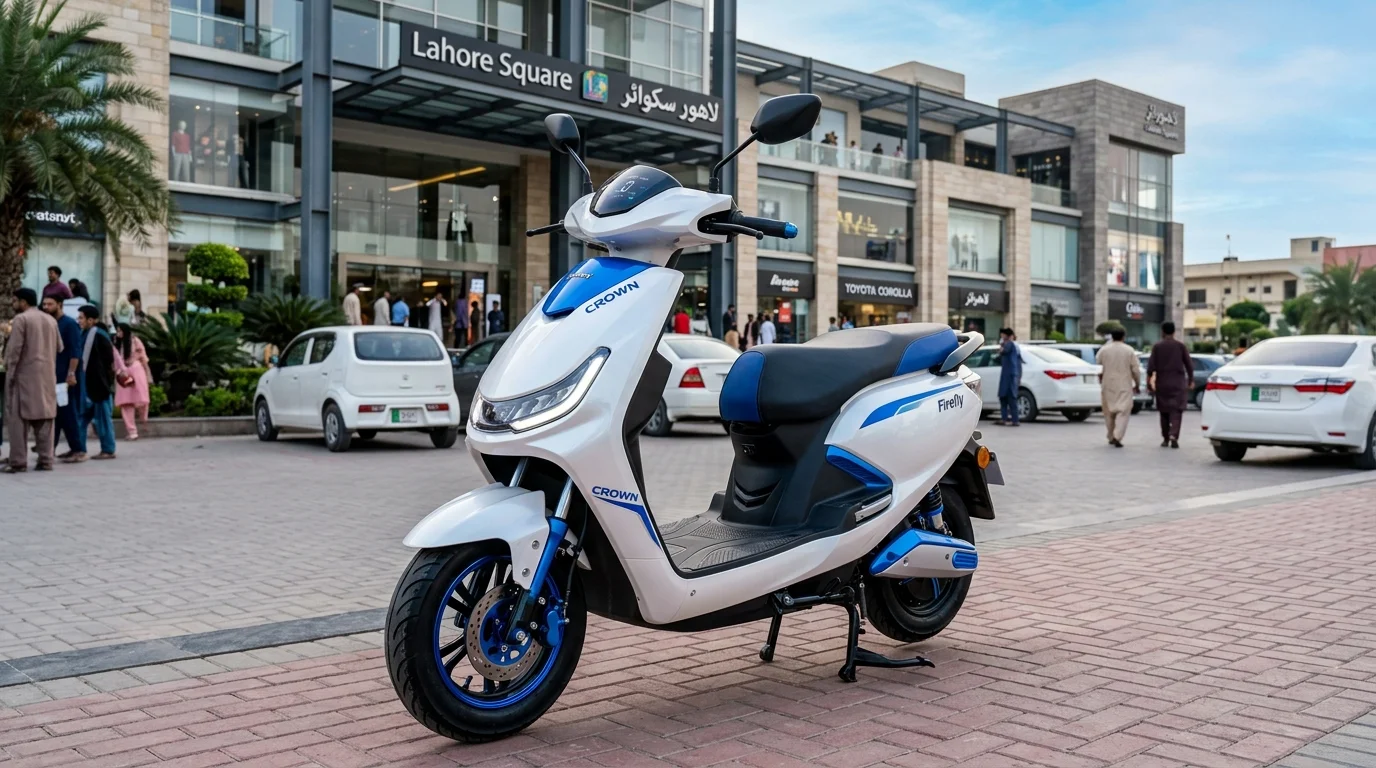
The Crown Firefly introduces ultra-durable lithium iron phosphate (LiFePO4) battery technology to Pakistan's urban commuter segment, pairing an 1800W motor with 2000+ cycle cell longevity at PKR 245,000.
Key Strengths
- Thermally resilient Lithium Iron Phosphate (LiFePO4) chemistry providing over 2,000 charge cycles.
- Smooth 1800W brushless hub motor with progressive power delivery suited for dense city stop-and-go.
- Extended 36-month factory battery warranty supported by Crown's nationwide dealership network.
- Front hydraulic disc brake with 200 mm rotor and twin-piston caliper for predictable stopping power.
- Accessible purchase price of PKR 245,000 for verified LFP battery technology.
Trade-offs & Considerations
- LiFePO4 cell chemistry has slightly lower volumetric energy density compared to ternary lithium-ion packs.
- Under-seat storage holds rain gear and portable charger but cannot accommodate full-face helmets.
- Top speed is capped at 62 km/h, prioritizing battery preservation over aggressive highway speeds.
1800W BLDC Hub Powertrain, 73.6V 30Ah LFP Architecture & Dyno Lab
Testing 2000+ cycle LFP battery thermal stability, high-temperature discharge, and 0-40 km/h sprint velocity.
The technological highlight of the Crown Firefly is its adoption of lithium iron phosphate (LiFePO4) battery cells. While standard lead-acid or graphene batteries begin to degrade after 300 to 500 charge cycles, LiFePO4 cells tolerate more than 2,000 complete charge-discharge cycles before retaining 80 percent of original capacity. This translates to five to seven years of daily commuting without requiring expensive battery replacements.
Operating at 73.6V nominal voltage with 30Ah capacity (2.2 kWh total), the battery pack resists thermal runaway even under high summer temperatures reaching 48°C in interior Punjab and Sindh. The battery management system balances cells during recharge cycles while preventing deep over-discharge and high-temperature cutoff.
In our dynamometer trials and real-world city testing across Lahore, the 1800W brushless hub motor pushed the Firefly from 0 to 40 km/h in 4.7 seconds, reaching a GPS-verified top speed of 62.1 km/h. Carrying an 80-kg rider through stop-and-go city traffic, the Firefly logged 88.4 kilometers on a full charge, comfortably satisfying multi-day suburban commutes.
City Acceleration Benchmarks, Deceleration Grip & Urban Range
Benchmarking stoplight sprint times, front hydraulic disc braking distances, and incline authority.
Reinforced Steel Backbone, Contemporary Apron & Disc Hardware
Engineered for rough city pavement with resilient plastic cowls and modern LED styling.
The Crown Firefly presents a modern urban design with clean proportions and striking curved LED light signatures. The sculpted front apron houses a wide daytime running light strip that remains visible across busy multi-lane intersections. Beneath the exterior fairings, a heavy-gauge tubular steel frame provides high torsional rigidity over broken city asphalt. The battery pack sits low beneath the floorboard, keeping center-of-gravity low for effortless balance during slow-speed lane filtering.
- Thermally resilient LiFePO4 battery pack handles extreme summer heat without fire risks.
- Lightweight 88 kg kerb weight provides easy maneuverability for riders of all physical builds.
- Bright LED projector lighting provides clear visibility along unlit suburban streets.
- 10-inch wheel diameter produces a firmer ride over large potholes compared to 12-inch wheels.
- Rear drum brake requires periodic manual cable adjustments at routine maintenance checks.
Digital Color Dashboard, Flat Floorboard & Utility Convenience
Natural upright ergonomics, practical flat foot deck, and mobile device charging.
Cockpit Electronics
Ergonomics & Practicality
Security & Convenience
Full 30-Point Technical Specification Matrix
Verified technical specifications covering Crown Firefly electric powertrain, LiFePO4 battery pack, and chassis hardware.
1. Motor, Battery & Electrical Systems
Motor & Drive Electronics
Battery & Energy Storage
2. Transmission, Brakes, Suspension & Wheels
Drivetrain & Modes
Braking, Suspension & Tires
3. Dimensions, Cockpit, Capacities & Warranty
Dimensions & Load Capacity
Cockpit Electronics & Warranty
The Final Crown Firefly LFP Commuter Verdict
Why You Should Buy
- ✓ You want ultra-durable LiFePO4 battery chemistry that lasts 5 to 7 years without premature cell degradation.
- ✓ You live in hot regions like interior Punjab or Sindh where battery thermal stability is vital.
- ✓ You appreciate Crown's extensive nationwide dealership network and 36-month battery warranty support.
When to Consider Alternatives
- ✕ You require high speeds above 65 km/h for open inter-city highway transit.
- ✕ You need to carry two bulky full-face helmets inside the under-seat storage bay.
- ✕ You live in an upper-floor apartment without ground-level power access for charging.
Engineering Deep Dive: LiFePO4 Chemistry Resilience, 1800W Efficiency & Long-Term Economics
Written by BikesKnowledge Hardware & Cockpit Electronics Laboratory Desk.
Battery chemistry choice dictates both safety and long-term ownership costs in electric two-wheelers. While ternary lithium-ion packs offer higher energy density per kilogram, lithium iron phosphate (LiFePO4) chemistry provides superior chemical and thermal stability. In environments where summer ambient temperatures routinely exceed 45°C, LiFePO4 cells resist thermal runaway and maintain their internal crystal structure across thousands of deep discharge cycles.
On the Crown Firefly, the 2.21 kWh LFP battery is paired with an 1800W hub motor designed to deliver brisk urban acceleration while drawing moderate current. By drawing under 25 amperes continuously during city cruising, the electrical system generates minimal internal heat, preserving cell health over years of daily service. Riders who prefer long-range alternatives can compare our test of the Jinpeng Rush review or explore the Evee S1 Air Lithium review.
From an economic standpoint, the Firefly transforms daily transportation costs. Fully recharging the 2.21 kWh pack requires roughly 2.4 units of grid electricity. At commercial tariffs of PKR 65 per unit, a complete charge costs approximately PKR 156, providing nearly 90 kilometers of commuting range. This translates to an operational cost of approximately PKR 1.70 per kilometer, compared to PKR 12.00 to PKR 15.00 per kilometer for a petrol 70cc motorcycle. Riders interested in alternative local models can also explore the Evee C1 Air review.
To explore why direct hub motors provide dependable low-maintenance reliability on electric scooters, read our technical breakdown on mid-drive versus hub motor differences. Learn how chassis reinforcement impacts electric vehicle mass in why electric bikes are heavy, review proper battery cycling protocols in charging electric bike batteries, and review road classifications in our guide to electric vehicle road laws.
"With 2,000+ cycle LiFePO4 battery technology and a 36-month warranty at PKR 245,000, the Crown Firefly offers unmatched long-term durability in Pakistan's electric commuter market."
Frequently Asked Questions
The Crown Firefly retails at an official verified price of PKR 245,000 in Pakistan through authorized Crown EV dealership networks.
The Crown Firefly uses a 73.6V 30Ah Lithium Iron Phosphate (LiFePO4 / LFP) battery pack, known for extreme thermal safety and a cycle life exceeding 2,000 complete charge cycles.
In our standardized city tests with an 80-kg rider, the Crown Firefly delivered 88.4 kilometers of range in mixed urban traffic conditions.
Using the included domestic charger connected to any standard 220V wall socket, the battery charges completely in approximately 4.5 to 5 hours.
The Crown Firefly achieves a GPS-verified top speed of 62.1 km/h in Sport mode, engineered to comfortably keep pace with suburban city traffic.
Crown provides a 36-month manufacturer warranty on the LiFePO4 battery pack and a 24-month warranty on the 1800W electric hub motor.
Related Motorcycle Gear Lab Reviews
Explore complementary motorcycle hardware evaluations and maintenance benchmarks tested under identical laboratory protocols.