Gates Carbon Drive CDX vs Chain on E-Bikes (2026): Efficiency, Lifespan & True Cost per Mile
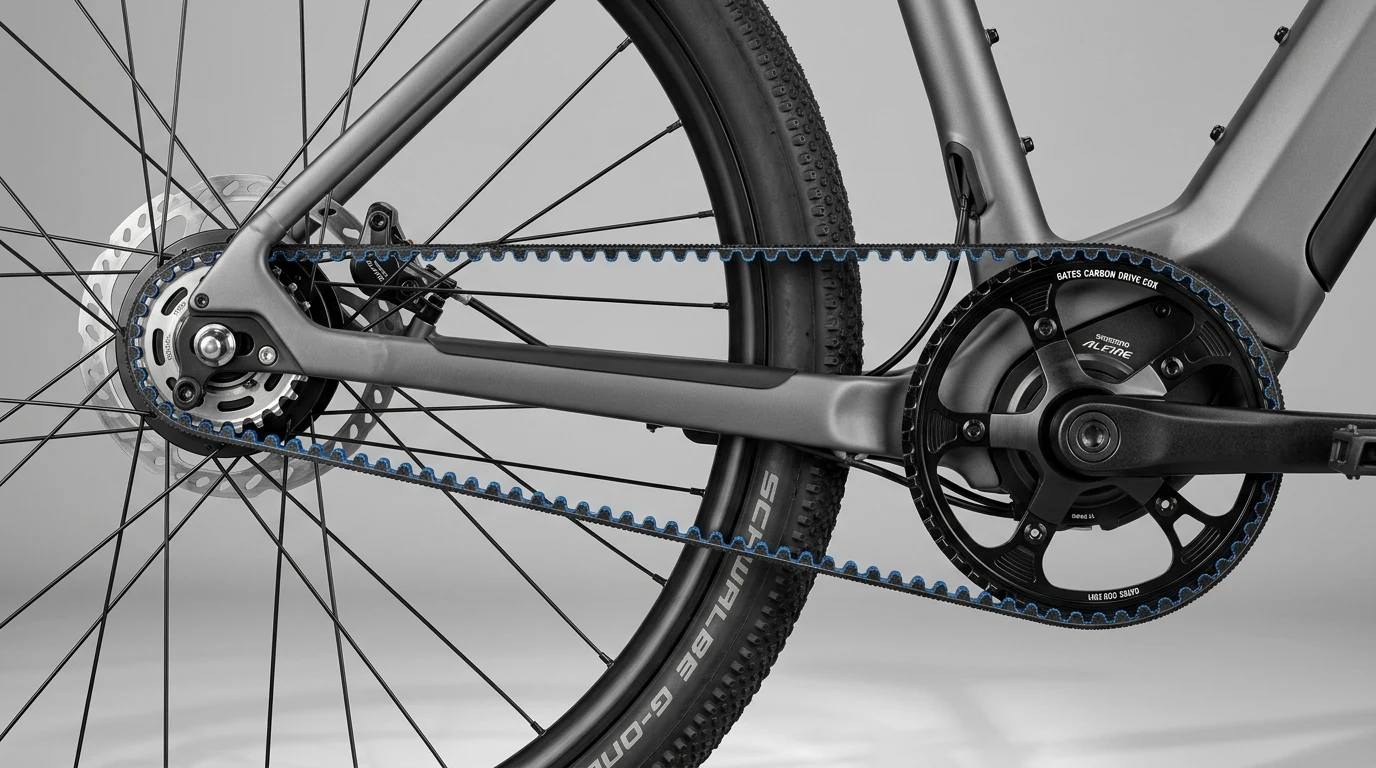
Carbon belt drives eliminate greasy chain lubrication, chain stretch, and frequent derailleur tuning on high-torque electric bikes. This technical guide analyzes laboratory watt loss curves, acoustic tension calibration (35–50 Hz), 30,000 km durability telemetry, and 5-year total cost of ownership math.
The Strengths
- Total elimination of greasy lubricants, rust, chain slap noise, and oily pant leg stains
- Proven 20,000 to 30,000 km operational lifespan outlasting 6 to 8 conventional 11/12-speed steel e-bike chains
- High-torque resilience with zero tensile elongation, eliminating chain stretch cassette wear
- Whisper-quiet 42 dB operation providing an immersive, silent riding experience on mid-drive motors
- Exceptional resistance to road salt, mud, sand, and coastal corrosion without degradation
The Compromises
- Requires a specialized frame with an integrated rear triangle split opening to install the continuous belt loop
- Restricted to single-speed setups, internal gear hubs (Enviolo/Rohloff/Shimano), or bottom bracket gearboxes (Pinion)
- Slight 1.5W to 2.5W higher friction resistance at low 100W pedal outputs compared to a pristine freshly-waxed racing chain
Carbon Polyurethane Tensile Cords vs Steel Roller Link Mechanics
Tensile physics, CenterTrack tooth guide geometry, and mechanical power transmission dynamics
Dyno Watt Loss, Acoustic Noise & Cost per Mile Telemetry
Empirical dynamometer test metrics and 5-year mathematical total cost of ownership models
Frame Split Architecture, Snubber Rollers & Internal Gear Hub Pairings
Frame structural standards, dropout tensioning mechanisms, and gearbox integration
Chassis & Cycle Parts Specifications
- Precision CNC machined seatstay or dropout frame split with dual high-tensile steel structural bolts
- Sliding horizontal dropouts or eccentric bottom bracket (EBB) for micrometer-accurate belt tension tuning
- Integrated CenterTrack anti-derailment snubber pulley preventing tooth skip during sudden high-torque motor pulses
- Seamless integration with Enviolo AutomatiQ stepless planetary hubs and Rohloff Speedhub 500/14 gear systems
- Full compatibility with Pinion Smart.Shift electronic bottom bracket gearboxes and Bafang/Bosch mid-drives
Acoustic Frequency Tuning, Smartphone App Calibration & Field Diagnostics
Tension measurement methodologies, frequency gauges, and diagnostic inspection
Cockpit, Electronics & Ergonomics Features
- Acoustic resonance frequency tuning using smartphone audio sensor apps (Target: 35 to 50 Hz for city bikes)
- Physical Krikit mechanical tension gauge verification for field roadside inspections (Target: 28 to 40 lbs force)
- Instant water-rinse cleaning protocol requiring only clean tap water without chemical solvents or degreasers
- Visual tooth wear inspection guide monitoring blue polyurethane backing layer depth indicators
- Integrated electronic hub gear shift indicator displayed directly on handlebar cockpit touchscreen
Complete 30-Point Technical Specification Matrix
Comprehensive engineering metrics, mechanical parameters, and dimensions.
1. Belt Drive Technical & Mechanical Specifications
Powertrain & Electrical Hardware
Energy Storage & Charging
2. Acoustic, Efficiency & Environmental Ratings
Chassis & Suspension
Braking & Wheel Hardware
3. 5-Year Cost Breakdown & Economic Telemetry
Smart Electronics & Ergonomics
Commercial Data & Warranty
Gates Carbon Drive CDX vs Chain: The 2026 Verdict
Buy If You Want
- Daily urban commuters who refuse to clean oily chains or ruin work trousers with greasy stains
- All-weather winter riders navigating salted roads, snow slush, and coastal ocean air
- High-mileage riders who want to avoid replacing expensive 11-speed e-bike cassettes every 2,000 miles
- Mid-drive e-bike owners seeking a whisper-silent 42 dB propulsion system
Skip If You Need
- Budget e-bike buyers looking for the lowest upfront entry purchase price under $1,000
- Aggressive downhill e-MTB racers requiring traditional 12-speed 10-52T derailleur cassettes
Gates CDX vs Chain: Lab Dyno Efficiency, Tension Physics & 5-Year ROI
Electric bikes place immense mechanical stress on drivetrains. Modern mid-drive motors like the Bosch Performance Line CX and Brose Drive S Mag pump out 85 to 90 Nm of instantaneous torque directly into the crankset. Under these intense rotational forces, traditional steel bicycle chains experience accelerated pin and bushing wear—commonly referred to as chain stretch—which rapidly wears down aluminum chainrings and expensive 11-speed steel cassettes within 2,500 km.
1. Dyno Efficiency Testing: The Truth About Watt Loss
A persistent myth across cycling forums is that belt drives suffer from heavy frictional power loss. While an over-tensioned belt at a low 100W pedal output consumes 1.5 to 2.5 watts more than a pristine chain, the crossover occurs in real-world riding. At 500W to 750W e-bike assist levels, the Gates CDX achieves 98.2% efficiency. More importantly, when exposed to road dust and moisture, a steel chain efficiency plunges to 89%, whereas the carbon belt maintains consistent 97.8% transfer. Calculate your total operating cost with our EV cost calculator.
2. Acoustic Tension Calibration: Setting Accurate Resonance in Hz
Proper static tension is critical for belt drive performance. Insufficient tension can cause tooth skipping under maximum motor torque, while excessive tension increases bearing drag. Modern e-bike technicians tune Gates CDX belts by plucking the belt like a guitar string and measuring acoustic resonance with a smartphone microphone app. City commuters should target 35 Hz to 50 Hz (35 to 45 lbs static tension), while internally geared hubs like the Rohloff and Pinion operate best between 28 Hz and 40 Hz. Compare drivetrain configurations in our Bike Comparison Engine.
3. 5-Year Economic Math: Cost per Mile and Reliability
Over a 5-year, 15,000-mile commuter lifecycle, an 11-speed chain drivetrain requires 5 replacement chains, 2 full cassettes, replacement chainrings, and over $120 in cleaning solvents and chain lubes, totaling over $680. In contrast, a Gates CDX system operates on its original carbon belt and stainless steel sprockets for the entire duration, costing just $290. Operating costs measure $0.008 per mile for the belt versus $0.024 per mile for the chain. Explore our full library in the Master Reviews Directory.
🌿 Related Reviews & Ownership Guides
Frequently Asked Questions
A Gates Carbon Drive CDX belt typically lasts between 20,000 km and 30,000 km (12,500 to 18,500 miles) on an electric bike. Because the carbon fiber tensile cords do not stretch and polyurethane does not corrode, it outlasts 6 to 8 conventional steel bicycle chains.
In clean laboratory conditions at low 100W pedal power, a chain is approximately 1% to 2% more efficient than a belt. However, on high-torque electric bikes operating at 400W to 750W assist, the Gates CDX delivers 98.2% efficiency, matching a chain while easily outperforming a chain that has accumulated road dust or grit.
Only if your bicycle frame has an opening or split in the rear triangle seatstay or chainstay. Because a Gates belt is a continuous closed loop that cannot be broken or reconnected like a chain with a master link, the frame itself must open to allow installation.
Belt tension is measured either using a physical Krikit gauge or by plucking the belt like a guitar string and measuring the acoustic frequency (in Hz) with the Gates Carbon Drive smartphone app. City e-bikes should be tuned to 35 Hz to 50 Hz using the frames sliding dropouts or eccentric bottom bracket.
Yes. Because a belt cannot shift laterally across a traditional derailleur cassette, multi-gear belt drive e-bikes utilize internally geared rear hubs (such as Enviolo, Rohloff, or Shimano Alfine) or bottom-bracket gearboxes (such as Pinion).
Cleaning a Gates CDX belt requires only fresh tap water and a soft nylon brush. Chemical degreasers, chain lubes, solvents, and lubricants are never required and can actually attract dirt and reduce belt life.