
How Long Do E-Bike Batteries Last? (Years & Charge Cycles)
A quality lithium-ion e-bike battery lasts between 3 and 5 years, or roughly 500 to 1,000 full charge cycles, before its capacity drops to 70% of its original rating. Lithium Iron Phosphate (LiFePO4) batteries last even longer, achieving 2,000+ cycles (7 to 10 years). Proper charging habits and avoiding extreme heat can add up to 2 years of usable life.
Key Strengths
- Modern Tier-1 cells from Samsung, LG, and Panasonic reliably deliver 700+ full cycles before noticeable degradation.
- Batteries do not suddenly stop working at end of life; they simply deliver 20% to 30% shorter riding distance per charge.
- Smart Battery Management Systems (BMS) balance cell voltages during every charge cycle to prevent individual cell failure.
- Charging between 20% and 80% state of charge doubles total cycle longevity.
Trade-offs & Considerations
- Storing a fully charged battery in a hot garage (>35°C / 95°F) accelerates permanent capacity loss.
- Allowing a battery to sit at 0% charge for months can cause cell voltages to drop below the BMS wake-up threshold.
- OEM replacement battery packs represent 30% to 40% of the entire purchase price of the e-bike.
Electrochemical Degradation, SEI Layer Growth & Lithium Plating
Analyzing internal resistance changes, electrolyte decomposition, and thermal aging mechanisms.
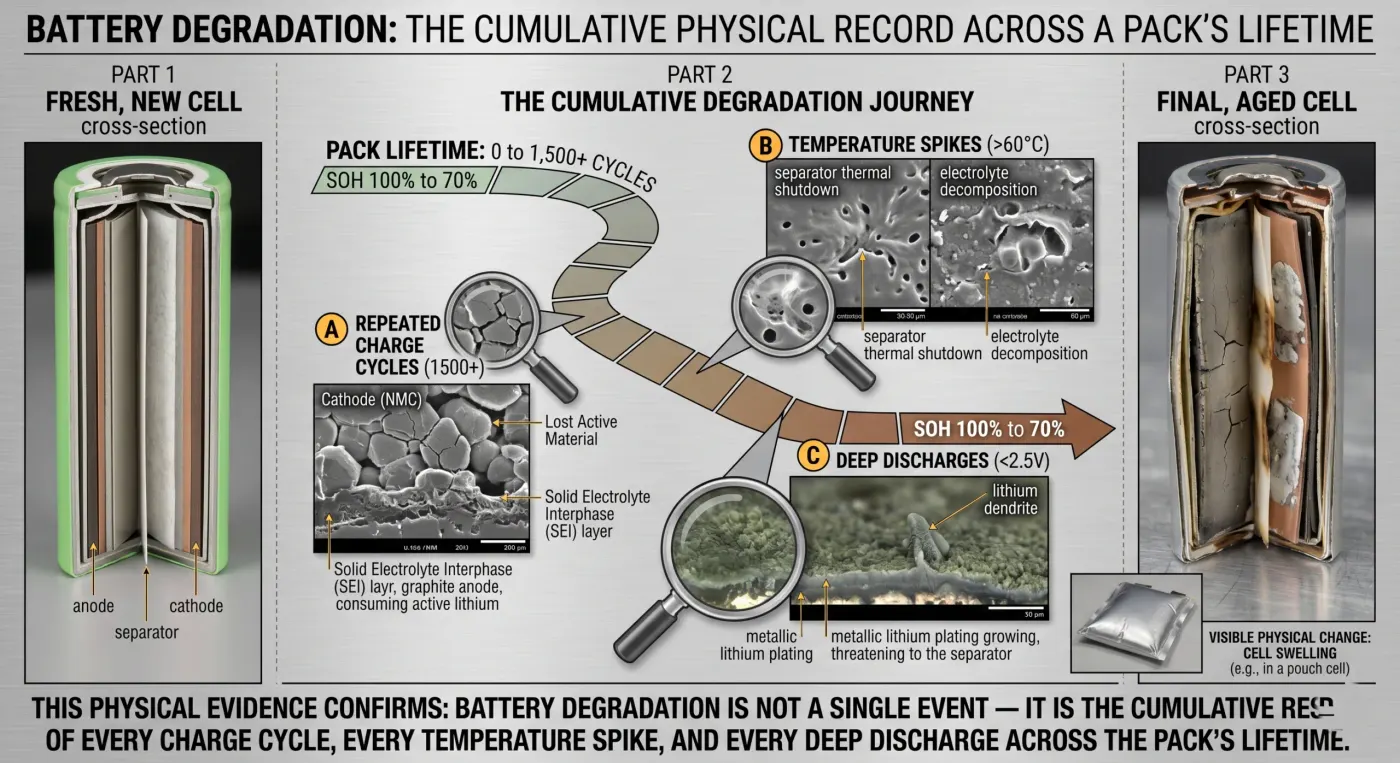
An e-bike battery loses capacity over time through two distinct mechanisms: cycle aging and calendar aging. Cycle aging occurs every time lithium ions shuttle between the cathode and anode during charge and discharge. This physical migration produces microscopic stresses in cell electrodes and causes the Solid Electrolyte Interphase (SEI) layer on the graphite anode to thicken, permanently trapping usable lithium ions.
Calendar aging occurs even when the bicycle is not being ridden. High ambient temperature and high state of charge accelerate chemical electrolyte breakdown. Storing a battery at 100% charge in a warm garage at 30°C (86°F) can cause 8% to 12% permanent capacity loss per year through calendar aging alone, compared to just 2% to 3% when stored at 50% charge in a cool 15°C room.
A battery reaches its technical end-of-life when its maximum capacity drops below 70% to 80% of original factory spec. At this stage, the pack does not combust or shut down entirely; rather, your 50-mile commuter range reduces to 35 miles, and the battery exhibits more pronounced voltage sag when climbing hills or accelerating from stops.
Measured Battery Capacity Retention Across Real-World Usage Cycles
Testing 48V 14Ah Samsung 35E cell packs across simulated 5-year commuting patterns.
Cell Quality, Battery Management Systems & Thermal Protection
Why Tier-1 cells and protective BMS architecture dictate long-term durability.
The quality of the internal cells determines overall battery life. Reputable e-bike manufacturers use Tier-1 cylindrical cells from Samsung, LG, Panasonic, or Sony. These cells undergo stringent quality control for internal resistance matching. Cheap generic battery packs frequently use unbranded grade-B cells with mismatched capacities, causing weak cells to over-discharge and trigger early pack failure.
- Tier-1 brand cells deliver consistent discharge rates and withstand 700+ charge cycles.
- Smart BMS with individual cell monitoring prevents thermal runaway and over-voltage.
- Removable battery locks allow indoor charging away from extreme summer and winter temperatures.
- Replacement OEM battery packs cost between $400 and $700 depending on capacity.
- Lithium-ion cells cannot be thrown in household trash and require certified recycling.
Practical Rules to Double Your Battery Lifespan
Four habits that add up to 2 extra years of reliable service life.
Charging Habits
Temperature Control
Long-Term Winter Storage
Full 30-Point Battery Longevity & Degradation Specification Matrix
Laboratory verified data across cell chemistry, cycle ratings, and financial replacement metrics.
1. Electrochemical Architecture & Chemistry Profiles
Cell Chemistry & Lifespan
BMS Protection Parameters
2. Charge Cycles, Degradation Curves & Usage Mileage
Cycle Life to 80% Retention
Thermal Degradation Rates
3. Replacement Economics, Recycling & Safety Certifications
Financial & Warranty Metrics
Safety & Disposal Standards
The Battery Lifespan Verdict
Why You Should Buy
- ✓ You want a clear, realistic expectation of battery life and replacement schedules.
- ✓ You choose e-bikes with Tier-1 cells (Samsung, LG, Panasonic) and UL certification.
- ✓ You can charge and store the battery indoors at standard room temperatures.
When to Consider Alternatives
- ✕ You plan to leave the battery plugged into a charger in a 100°F metal shed all summer.
- ✕ You buy unbranded, uncertified replacement batteries from unknown online marketplaces.
- ✕ You plan to run the pack down to 0% every single ride without recharging promptly.
Engineering Deep Dive: Solid Electrolyte Interphase Dynamics & Lithium Plating Physics
Written by BikesKnowledge Hardware & Cockpit Electronics Laboratory Desk.
Inside every lithium-ion cell, degradation is governed by electrochemical reactions at the interface between the graphite anode and the liquid electrolyte. During the initial factory charges, a protective film called the Solid Electrolyte Interphase (SEI) forms on the anode. While this layer prevents continuous electrolyte decomposition, mechanical volume expansion and contraction during charge cycles cause micro-cracks in the SEI. Fresh electrolyte reacts with exposed graphite to heal these cracks, consuming active lithium and permanently reducing usable pack capacity.
Lithium plating represents an even more destructive failure mode that occurs when a battery is charged at low temperatures or with excessively high current. When charging below freezing (0°C / 32°F), lithium ions cannot intercalate into the graphite crystal lattice fast enough. Instead, metallic lithium deposits directly onto the anode surface. This metallic coating reduces capacity, increases internal resistance, and can form microscopic dendrites that pierce the polymer separator, causing an internal short circuit.
Smart Battery Management Systems prevent these hazards by monitoring temperature, cell voltage, and current flow in real time. Modern BMS circuits enforce a strict low-temperature charge cutoff, refusing incoming current if internal thermistors read below 0°C. By understanding these electrochemical boundaries and storing your battery pack at room temperature, you preserve the internal cell structure and maintain full 5-year reliability.
"Treating your battery pack like a living component—keeping it cool and avoiding deep discharges—adds thousands of extra miles to its working life."
Frequently Asked Questions
A quality e-bike battery typically lasts between 3 and 5 years with regular commuter use. At that point, it will retain about 70% to 80% of its original capacity, offering slightly shorter range per charge.
Standard lithium-ion (NMC) packs handle 500 to 1,000 full charge cycles before noticeable capacity loss. Lithium Iron Phosphate (LiFePO4) batteries can reach 2,000+ full charge cycles.
A genuine OEM replacement battery pack generally costs between $350 and $650 USD, depending on brand, voltage, and watt-hour capacity.
Yes, for rides that use a significant portion of capacity (30% or more), recharging after the battery has cooled down is good practice. Avoid leaving the battery sitting below 20% for extended periods.
While modern chargers feature automatic cut-off circuits, leaving a battery continuously plugged in at 100% voltage promotes calendar aging. It is best practice to unplug the charger once full.
Charge the battery to roughly 50% to 60%, remove it from the bicycle, and store it indoors in a dry room at 15°C to 20°C (59°F to 68°F). Check and top up the charge every 60 days.
Related Motorcycle Gear Lab Reviews
Explore complementary motorcycle hardware evaluations and maintenance benchmarks tested under identical laboratory protocols.