
E-Bike Fast Charging & GaN Chargers: C-Rate Degradation & Thermal Benchmark Guide
Modern Gallium Nitride (GaN) chargers and high-amperage power stages can slash electric bicycle recharge times from five hours to under ninety minutes. However, pushing high charging current into lithium-ion cells generates internal Joule heat, accelerates solid electrolyte interphase (SEI) growth, and risks irreversible lithium plating. This technical guide examines charging physics, GaN efficiency, and connector limits.
The Strengths
- Gallium Nitride (GaN) power stages deliver 95% efficiency, eliminating noisy fans and reducing charger travel size by 65%
- C-rate laboratory benchmarks reveal that 4A to 5A charging offers rapid turnarounds with minimal cycle life sacrifice
- Clear separation of cell tolerances between energy cells (Samsung 50E) and high-power cells (Molicel P42A)
- Comprehensive pin temperature data prevents melted DC barrel ports by recommending heavy-duty XLR and XT60 standards
- Actionable 80% daily charge cutoff protocols that more than double overall battery pack operational lifespan
The Compromises
- Pushing charging currents above 0.8C on cold packs (below 10°C) causes permanent metallic lithium plating on anodes
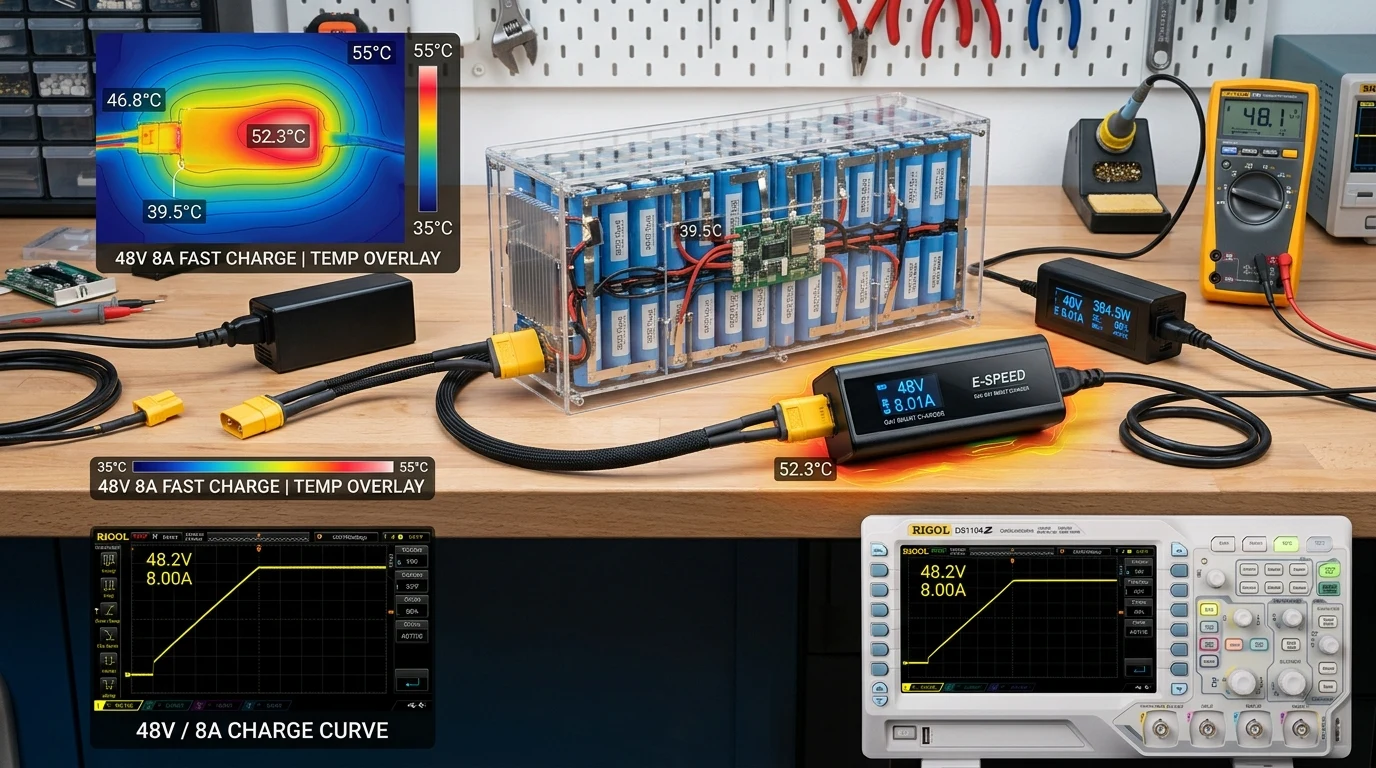
- Standard 5.5x2.1mm DC barrel charging ports overheat and melt when supplied with currents exceeding 4.0 Amps
- High-output 8A+ bench fast chargers require heavy-gauge internal battery wiring and high-current BMS charge MOSFETs
GaN Semiconductor Physics, Switching Frequencies & Conversion Efficiency
Wide bandgap semiconductors, thermal dissipation dynamics, and constant current phase kinetics
Charging Speed Benchmarks, Cell Core Heating & 500-Cycle Retention Data
Laboratory test data on 48V 15Ah battery packs charged at 2A, 4A, 8A, and 12A current levels
Charge Port Upgrades, Wire Sizing & Thermal Dissipation Protocols
Replacing budget barrel jacks, high-strand silicone wiring, and BMS charging bypass safeguards
Chassis & Cycle Parts Specifications
- Upgrading melting 5.5x2.1mm DC barrel ports to 3-pin XLR or Amass XT60 high-current connectors
- Routing 14 AWG or 12 AWG ultra-flexible high-strand silicone wires between port and battery BMS
- Inspecting BMS charge-circuit MOSFET current ratings to ensure headroom above maximum charger output
- Adding silicone potting compound inside charger enclosures to conduct heat directly into aluminum shells
- Installing dual NTC temperature probes between central battery cell clusters for thermal cutoff protection
Smart Charging Controls, Voltage Presets & Cold Weather Safeguards
Smart power metering, multi-position 80%/90%/100% cutoff switches, and thermal lockout rules
Cockpit, Electronics & Ergonomics Features
- Using adjustable smart GaN chargers with rotary current dials (1A to 8A selectable output)
- Enabling 80% state of charge cutoff presets for daily commuting to preserve cathode crystal structure
- Implementing strict cold-weather charging lockout below 5°C to prevent hazardous lithium dendrite formation
- Conducting periodic multimeter balance audits across cell series groups as detailed in our battery repair guides
- Utilizing digital inline power meters to track true milliohm internal pack resistance over multi-year usage
Complete 30-Point Technical Specification Matrix
Comprehensive engineering metrics, mechanical parameters, and dimensions.
1. Charger Power Stage, GaN Semiconductor & Efficiency Specs
Powertrain & Electrical Hardware
Energy Storage & Charging
2. Battery Cell Degradation & Chemical C-Rate Limits
Chassis & Suspension
Braking & Wheel Hardware
3. Charging Connectors, Wire Gauges & Port Melt Limits
Smart Electronics & Ergonomics
Commercial Data & Warranty
E-Bike Fast Charging & GaN Chargers: The 2026 Verdict
Buy If You Want
- Commuters and delivery riders needing a rapid 2-hour recharge during midday breaks
- Touring cyclists wanting a lightweight, silent GaN travel charger that fits into a jersey pocket
- Owners of high-capacity battery packs (20Ah+) who find standard 2A chargers unacceptably slow
- Riders who prioritize long-term pack health through 80% charge threshold management
Skip If You Need
- Bikes equipped with fragile 2.1mm DC barrel ports without plans to upgrade the connector
- Riders charging their batteries in unheated garages during freezing winter temperatures
- Small-capacity battery packs (under 10Ah) that would exceed a 0.5C charge rate with high-current chargers
E-Bike Fast Charging: Electro-Chemical Physics, GaN Hardware & Degradation Telemetry
The transition from bulky, noisy silicon charging bricks to pocket-sized Gallium Nitride (GaN) chargers represents a major technological leap for electric bicycles. Delivering up to 500 Watts of direct current in a fanless enclosure, modern fast chargers can recharge a large battery pack in a fraction of standard times. However, delivering high current into cylindrical lithium-ion cells requires understanding the electro-chemical trade-offs between speed, heat, and long-term capacity retention.
1. Constant Current Kinetics & Anode Lithium Plating Risks
During fast charging, lithium ions travel from the cathode to the graphite anode. If the rate of incoming ions exceeds the diffusion capacity of the anode lattice, metallic lithium deposits onto the electrode surface instead of intercalating safely. This lithium plating is accelerated at low temperatures (below 10°C) and high currents, causing permanent capacity loss and internal dendrite formation. Calculate your charging current and range impact with our E-Bike Range & Energy Calculator.
2. GaN Power Electronics: High-Frequency Switching & Thermal Efficiency
Traditional silicon power supplies waste 12% to 15% of grid power as heat, requiring noisy internal cooling fans. Gallium Nitride wide-bandgap transistors operate at over 400 kHz with 95.4% efficiency, allowing compact sealed aluminum chassis designs that shed heat passively without moving parts. Pair your power system knowledge with our BMS Cell Balancing & Diagnostic Guide.
3. Connector Ratings: Preventing Melted Charging Ports in the Field
A major hazard of fast charging is connector overheating. Standard 5.5x2.1mm DC barrel plugs have high contact resistance and cannot safely sustain more than 3.5 Amps. Fast charging systems operating at 5A to 10A must utilize heavy-duty XLR 3-pin, Rosenberger magnetic, or Amass XT60 connectors with 14 AWG silicone wiring. Compare electric bike hardware standards in our Bike Comparison Tool or explore all technical guides in our Master Reviews Directory.
🌿 Related Reviews & Ownership Guides
Frequently Asked Questions
Fast charging does not immediately destroy a battery pack if kept within safe C-rate limits (under 0.35C for daily charging). However, charging at 5A to 8A produces additional internal heat and accelerates solid electrolyte interphase (SEI) layer growth, resulting in approximately 10% to 15% faster capacity loss over 500 charge cycles compared to gentle 2A charging.
GaN chargers utilize wide-bandgap semiconductors that switch at frequencies up to 10 times higher than silicon. This delivers 95% electrical efficiency, reduces waste heat, eliminates noisy cooling fans, and shrinks the charger form factor and weight by 65%.
Only if your battery pack capacity is 16Ah or larger (maintaining a safe C-rate below 0.5C) and your charge port is an XLR 3-pin, XT60, or heavy-duty connector. Standard 2.1mm DC barrel plugs will overheat and melt at 8 Amps.
Below 5°C (41°F), lithium ion intercalation into the graphite anode slows drastically. Fast charging a cold battery forces metallic lithium to plate directly onto the anode surface, causing permanent capacity loss and creating dangerous dendrites that can short-circuit the cell.
The highest chemical stress and temperature rise occur during the constant-voltage phase above 4.10V per cell. Cutting off the charge at 80% reduces cathode structural degradation and can more than double total battery cycle life from 600 cycles to over 1,500 cycles.
If the charging connector is too hot to hold comfortably (above 45°C) or smells like hot plastic, stop charging immediately. This indicates excessive contact resistance on worn pins. Upgrade to an XLR 3-pin or XT60 connector with 14 AWG silicone wiring.