
E-Bike Motor Planetary Gear Failure: Nylon vs Steel Gears & Step-by-Step DIY Replacement
When an electric bike motor whirs at high RPM but produces zero forward drive, stripped planetary gears or a seized one-way sprag clutch are the primary culprits. This technical teardown guide compares DuPont Delrin nylon POM gears against CNC hardened steel gears across noise decibels (40 dB vs 58 dB), thermal softening thresholds (95°C), and synthetic PTFE grease requirements.
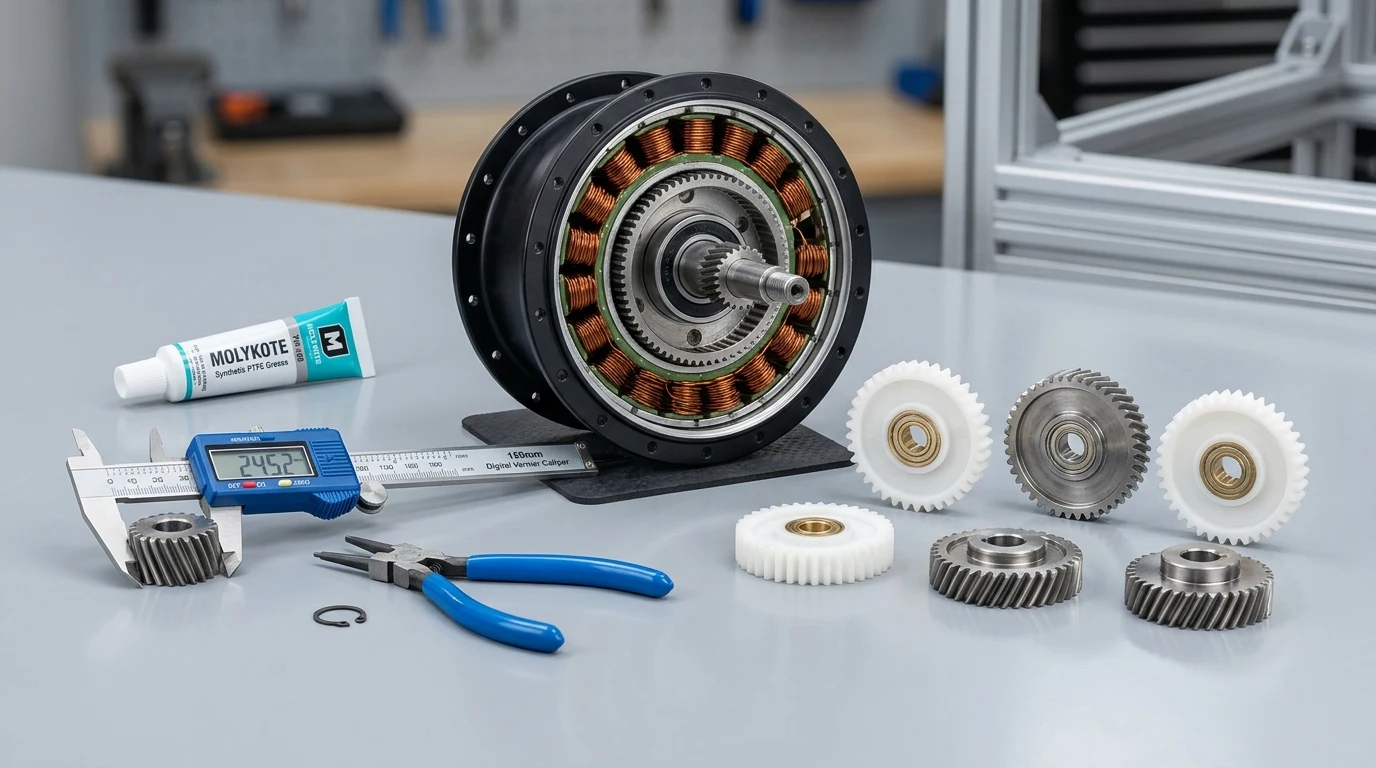
The Strengths
- Nylon POM gears act as a deliberate mechanical fuse, sacrificing an $18 part to protect expensive copper stators
- Delrin polymer generates exceptionally low gear mesh friction and whisper-quiet 40 dB operation
- Hardened CNC steel helical gear upgrades provide permanent immunity to stripped teeth under 1000W+ modified power
- Straightforward 30-minute DIY repair process requiring only standard snap-ring pliers and hex wrenches
- Proper synthetic PTFE lubrication extends nylon planetary gear life beyond 15,000 km of normal commuting
The Compromises
- Nylon gears soften rapidly when motor internal temperatures exceed 95°C during sustained steep hill climbs
- Steel gear upgrades introduce a noticeable 56 to 60 dB high-pitch metallic gear whine under load
- Petroleum-based white lithium grease chemically attacks nylon polymer, causing embrittlement and tooth cracking
Polyoxymethylene (POM) Delrin vs Heat-Treated 4140 Steel Metallurgy
Polymer viscoelasticity, tooth shear stress under 5:1 planetary reduction, and tribology
Thermal Softening Limits, Acoustic Noise & Tooth Shear Telemetry
Laboratory dynamometer metrics tracking gear surface temperatures and decibel noise
Hub Motor Teardown Steps, Sprag Clutch Inspection & Snap-Ring Removal
Disassembly protocols, internal one-way bearing checks, and circlip extraction
Chassis & Cycle Parts Specifications
- Removal of side-cover Torx T20 or Phillips screws using impact driver to prevent head stripping
- Extraction of motor core from stator shell using precision mechanical gear puller to avoid magnet pinch injuries
- Inspection of internal one-way sprag clutch rollers for flat spots, sticky springs, or contamination
- Removal of retaining circlips on 8mm planetary gear mounting pins using external snap-ring pliers
- Cleaning old contaminated grease from ring gear teeth using isopropyl alcohol before fresh PTFE packing
Grease Selection Guide, Backlash Calibration & Diagnostic Symptoms
Lubricant chemical compatibility, tooth clearance checks, and symptom troubleshooting
Cockpit, Electronics & Ergonomics Features
- Application of Mobilgrease 28 or SuperLube Synthetic Multi-Purpose Grease with Syncolon (PTFE)
- Absolute prohibition of automotive petroleum-based lithium wheel bearing grease which dissolves nylon
- Verification of gear backlash clearance (0.08mm to 0.12mm) to ensure smooth rotation without binding
- Diagnostic Symptom: High-pitch whirring motor sound with zero bike movement indicates stripped nylon teeth
- Diagnostic Symptom: Intermittent forward catch-and-release slipping indicates worn one-way sprag clutch
Complete 30-Point Technical Specification Matrix
Comprehensive engineering metrics, mechanical parameters, and dimensions.
1. Planetary Gear Dimensional & Material Specifications
Powertrain & Electrical Hardware
Energy Storage & Charging
2. Thermal, Acoustic & Mechanical Strength Telemetry
Chassis & Suspension
Braking & Wheel Hardware
3. Repair Economics, Tooling & Service Lifespan
Smart Electronics & Ergonomics
Commercial Data & Warranty
Nylon vs Steel Planetary Gears: The 2026 Verdict
Buy If You Want
- DIY e-bike owners whose motor spins freely without moving the bike and want to save $200 with an $18 repair
- Daily commuters who demand silent 40 dB operation and smooth pedal assistance using Delrin nylon gears
- Heavy cargo haulers and steep hill riders upgrading to indestructible steel gears for maximum torque resilience
- Riders performing routine 10,000 km preventative maintenance by re-packing gears with synthetic PTFE grease
Skip If You Need
- Owners of direct-drive gearless hub motors which do not contain internal planetary gears
- Riders sensitive to gear whine who might find the 58 dB sound of steel gears annoying on quiet trails
Planetary Gear Diagnosis: Teardown Steps, Metallurgy & Grease Chemistry
Geared hub motors represent the most common propulsion method on consumer electric bicycles, powering millions of bikes from brands like Rad Power, Aventon, Lectric, and Himiway. Inside these compact hubs lies a 5:1 planetary gear reduction system that allows a small, high-speed electric motor to generate impressive low-end hill climbing torque. However, when subjected to extreme heat, excessive current, or degraded lubrication, internal planetary gears are the most common mechanical point of failure.
1. The Stripped Gear Diagnosis: Identifying the Symptoms
The signature symptom of planetary gear failure is unmistakable: when applying throttle or pedal assist, the motor spins at high RPM with a loud whirring or buzzing sound, but the bicycle rear wheel receives zero forward propulsion. In less severe cases of partial tooth damage, the motor produces a rhythmic grinding or clicking sound under acceleration that disappears when coasting. Calculate your battery power consumption with our Range Calculator.
2. Metallurgy & Physics: Why Manufacturers Choose Nylon POM
Many riders assume nylon gears are a cheap shortcut, but automotive engineers intentionally specify DuPont Delrin polyoxymethylene (POM) for two vital reasons: acoustic vibration absorption (cutting noise from 58 dB down to 40 dB) and mechanical fuse protection. If an e-bike wheel suddenly locks up during a crash or heavy pothole impact, the nylon teeth shear off, absorbing the kinetic shock and preventing catastrophic damage to the motor axle or stator windings. Compare motor architectures in our Bike Comparison Tool.
3. Step-by-Step Replacement & Grease Chemistry Rules
Replacing planetary gears takes under 45 minutes on a home workbench. After removing the side-cover screws and extracting the motor core, use snap-ring pliers to remove the three retaining circlips, slip off the worn gears, and clean the ring gear with isopropyl alcohol. Crucially, you must lubricate new gears exclusively with synthetic polyalphaolefin (PAO) grease containing PTFE (such as Mobilgrease 28 or SuperLube). Standard automotive white lithium grease contains petroleum solvents that dissolve nylon polymers, causing premature failure. Explore all technical guides in our Master Reviews Directory.
🌿 Related Reviews & Ownership Guides
Frequently Asked Questions
Planetary gears strip primarily due to excessive heat (exceeding 95°C during long, steep hill climbs), high motor controller current modifications, aggressive acceleration from a dead stop under heavy rider weight, or dried-out/incorrect grease.
If your e-bike is a standard 250W to 750W commuter and you prefer a silent ride, stick with high-grade DuPont Delrin nylon gears. If you carry heavy cargo, climb extreme hills, or run a high-power 1000W+ setup, upgrade to CNC hardened steel gears.
Yes. Hardened steel gears produce a noticeable metallic whine (around 56 to 60 dB under acceleration), whereas nylon POM gears operate almost silently at 40 dB.
Always use synthetic grease with PTFE (such as Mobilgrease 28, SuperLube Synthetic Grease, or Shimano internal hub grease). Never use automotive petroleum-based lithium grease, which chemically degrades nylon plastics.
Yes. Planetary gear replacement is a simple 30 to 45-minute DIY job requiring only basic tools: external snap-ring pliers, hex keys or Torx drivers, isopropyl alcohol, and fresh synthetic PTFE grease.
If the planetary gear teeth look perfect but the motor still spins freely without driving the wheel, the one-way clutch bearing inside the center gear carrier has seized or its internal spring rollers have failed.