E-Bike Torque vs Cadence Sensor (2026): Latency, Hill Climbing & Battery Efficiency
While cadence sensors operate as binary on/off switches that detect crank rotation, strain-gauge torque sensors measure rider pedal force at 1,000 Hz. This technical guide analyzes response latency (15ms vs 180ms), zero-cadence hill restart mechanics, 22% battery range savings, and 6-axis IMU gyro fusion algorithms.
The Strengths
- Instantaneous 15ms motor power delivery mirroring the rider natural pedaling cadence and muscular effort
- Effortless hill restarts on 15%+ steep gradients without requiring initial pedal momentum or throttle triggers
- Conserves up to 22% battery energy by preventing unwanted high-power surges on flat cruising sections
- Eliminates dangerous ghost pedaling and unintended motor acceleration during tight, technical low-speed cornering
- Seamless integration with modern 6-axis IMU gyro sensors that automatically scale assist based on terrain pitch
The Compromises
- Requires continuous physical pedaling effort from the rider, making it less appealing for pure throttle moped-style cruising
- Higher replacement component cost ($85 to $140 for bottom bracket torque spindles vs $12 for cadence rings)
- Susceptible to zero-offset sensor voltage drift over years of heavy off-road use, requiring periodic software recalibration
Micro-Strain Gauge Wheatstone Bridges vs Magnetic Hall Effect Discs
Electromechanical principles, analog voltage sweeps (0.8V to 3.6V), and controller signal processing
Latency Telemetry, Steep Gradient Restarts & Battery Conservation
Laboratory dynamometer metrics comparing power modulation, rider cadence, and energy draw
Bottom Bracket Cartridges, ISIS Spindles & Weatherproofing Standards
Mechanical installation standards, spindle splines, and sealing protection ratings
Chassis & Cycle Parts Specifications
- Sealed cartridge bottom bracket housing compatible with standard 68mm and 73mm BSA threaded shells
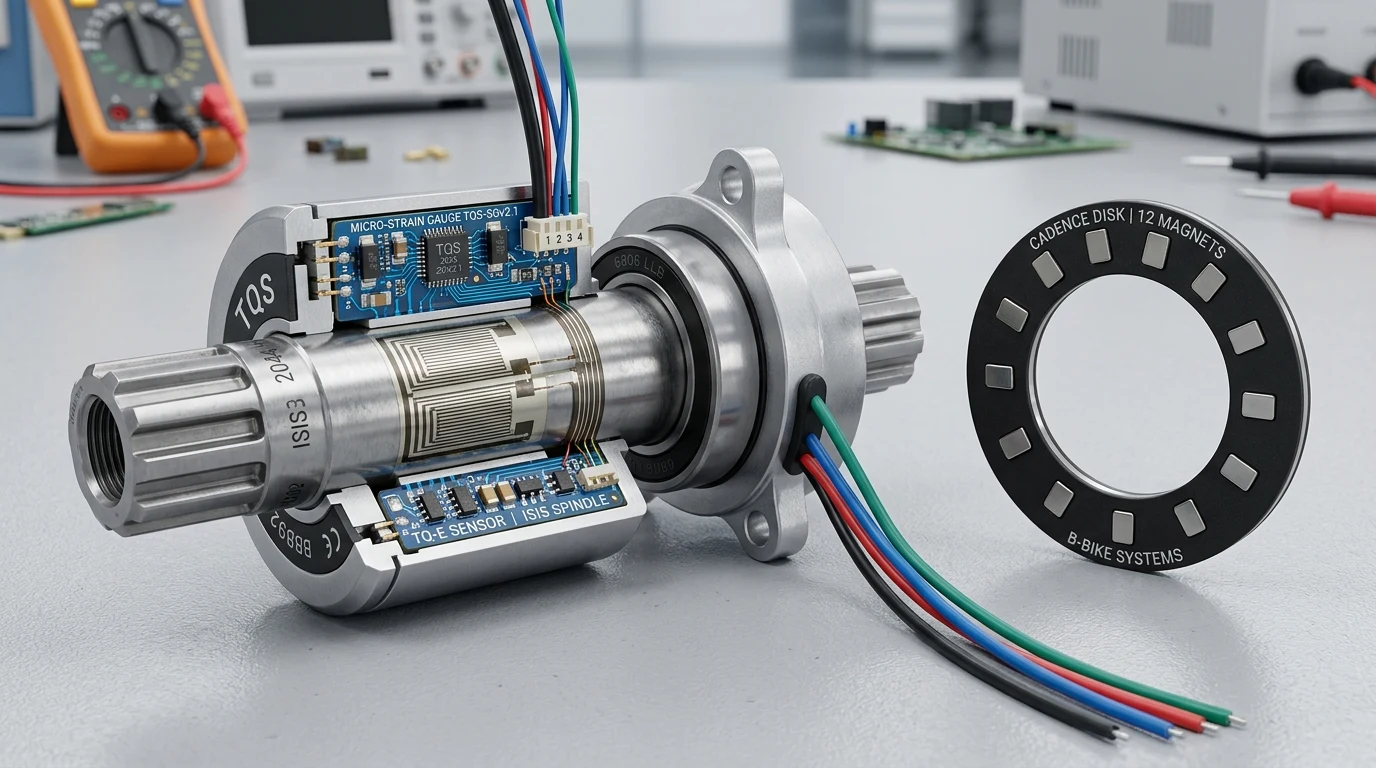
- Forged chrome-moly steel ISIS or square-taper spindle with integrated laser-welded strain gauge foil
- IP67 waterproof rubber labyrinth seals protecting internal electronics against high-pressure wash and mud ingress
- Automotive-grade shielded 4-pin or 6-pin Higo waterproof signal connector with CAN/UART digital bus
- Factory-calibrated temperature compensation circuit preventing sensor drift between -20°C and +50°C ambient
Calibration Procedures, Voltage Diagnostics & Tuning Modes
Diagnostic multimeter testing, zero-offset reset, and custom assist curve profiles
Cockpit, Electronics & Ergonomics Features
- Multimeter signal wire diagnostic check: 0.8V at rest, scaling linearly to 3.6V under 80 kg downward pedal load
- Zero-offset calibration trigger via companion smartphone app or display service menu after crank removal
- Customizable assist curve profiles: Linear Eco, Dynamic Progressive Trail, and Aggressive High-Boost Boost mode
- Automatic motor cutoff integration when cadence drops below 10 RPM or reverse pedaling is detected
- Real-time rider human watt output and motor electrical watt output display on cockpit handlebar screen
Complete 30-Point Technical Specification Matrix
Comprehensive engineering metrics, mechanical parameters, and dimensions.
1. Sensor Architecture & Electrical Specifications
Powertrain & Electrical Hardware
Energy Storage & Charging
2. Performance, Climbing & Energy Efficiency Telemetry
Chassis & Suspension
Braking & Wheel Hardware
3. Cost, Maintenance & Application Suitability
Smart Electronics & Ergonomics
Commercial Data & Warranty
Torque vs Cadence Sensors: The 2026 Verdict
Buy If You Want
- Riders tackling steep hills who need instant power delivery from a dead stop without stalling
- Performance e-MTB and gravel riders who demand precise power modulation on loose, technical trails
- Long-distance commuters seeking up to 22% longer battery range from every charge
- Cyclists who enjoy natural fitness workouts where pedal effort directly translates to speed
Skip If You Need
- Riders with knee or mobility restrictions who prefer ghost-pedaling with zero physical exertion
- Budget-conscious buyers looking for entry-level electric bikes under $800
Torque vs Cadence Sensors: Telemetry Latency, Dyno Curves & Incline Physics
The pedal assist sensor is the brain of an electric bicycle, dictating how and when the motor delivers electrical assistance to the drivetrain. While both cadence and torque sensors serve to comply with legal pedal-assist regulations, the underlying electromechanical technologies create completely different riding dynamics, safety profiles, and energy consumption rates.
1. Response Latency & Signal Processing: 15ms vs 180ms
A basic cadence sensor relies on a plastic disc embedded with 12 small neodymium magnets rotating past a stationary hall effect pickup. The motor controller must count 2 to 3 magnetic pulses before registering that the crank is turning, introducing a noticeable 120ms to 250ms lag before assist begins—and a dangerous overrun lag when pedaling stops. In contrast, a micro-strain gauge torque sensor measures physical spindle torsion at 1,000 Hz, delivering proportional motor output in just 15 milliseconds. Calculate your travel energy with our Range Calculator.
2. Incline Restart Physics & Dead-Stop Traction
The most dramatic operational divergence occurs when stopping on a steep 15% uphill grade. On a cadence-based e-bike, the rider must physically rotate the cranks through a quarter-turn against gravity to trigger the motor, frequently leading to stalling, foot-down stops, or wheel lift. A torque sensor registers immediate downward foot pressure (30+ Nm) the moment the rider steps on the pedal, delivering instantaneous motor torque to conquer the gradient effortlessly. Compare motor systems in our Bike Comparison Tool.
3. Battery Efficiency & Sensor Fusion Evolution
Cadence sensors deliver a fixed current output according to the chosen PAS level regardless of whether you are pushing hard or ghost-pedaling on flat asphalt, wasting substantial battery power. Torque sensors only supply heavy wattage when high human force is detected, yielding 18% to 24% longer range per charge. In 2026, leading systems pair torque sensors with 6-axis IMU gyroscopes, automatically scaling power based on road incline angle. Read our complete library in the Master Reviews Directory.
🌿 Related Reviews & Ownership Guides
Frequently Asked Questions
A cadence sensor only detects if the pedals are turning and delivers a fixed amount of motor assist, acting like an on/off switch. A torque sensor uses precision strain gauges to measure how hard you are pushing on the pedals in real time, delivering smooth, proportional assistance that matches your muscular effort.
Yes. A torque sensor delivers instant motor power from a complete standstill the moment you step on the pedal, eliminating the dangerous lag of cadence sensors on steep hills. When you push harder against an incline, the motor automatically increases its torque output.
Because torque sensors only supply heavy motor power when the rider is pushing hard, they prevent battery waste on flat roads or during low-effort cruising. Real-world tests demonstrate an 18% to 24% increase in battery range compared to cadence-based systems.
You can convert an e-bike to a torque sensor only if your motor controller supports torque sensor input signals (such as 0.8V to 3.6V analog signal or CAN bus communication) and your bottom bracket shell accepts a torque-sensing spindle cartridge.
Ghost pedaling occurs when an e-bike travels faster than the rider can pedal, causing the cranks to spin freely with zero resistance. On a cadence sensor bike, the motor continues delivering full power even if the rider exerts no effort, which can feel unnatural and reduce battery life.
High-quality sealed bottom bracket torque sensors are rated for over 25,000 km (15,000 miles) and typically last the entire lifetime of the electric bicycle with minimal maintenance.