
Pinion MGU vs Enviolo AutomatiQ vs Rohloff (2026): Gear Range, Dyno Efficiency & Maintenance
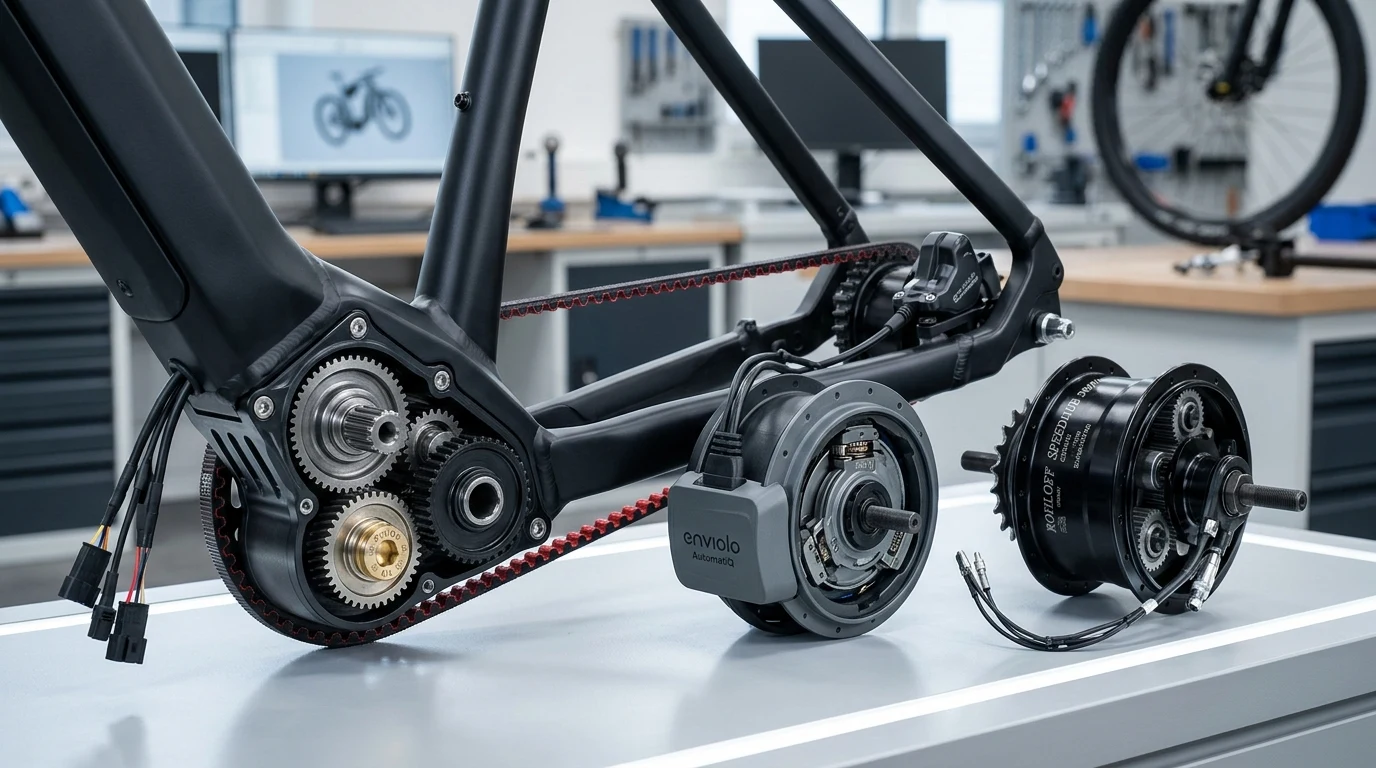
Integrated electronic gearboxes eliminate fragile external rear derailleurs and exposed chains on high-torque electric bikes. This technical shootout compares the 12-speed Pinion MGU E1.12 integrated motor-gearbox, the stepless Enviolo AutomatiQ, and the 14-speed Rohloff Speedhub 500/14 across 600% ratio range, shift-under-load telemetry, and 10,000 km oil service.
The Strengths
- Total elimination of bent derailleur hangers, chain drop, and grit-induced cassette wear
- Pinion MGU centralizes motor and 12-speed transmission weight low and central in the bottom bracket
- Electronic Smart.Shift allows lightning-fast gear changes while standing still or pedaling under full motor torque
- Gates Carbon Drive CDX belt integration delivers a completely clean, oil-free, whisper-silent drivetrain
- Sealed magnesium-alloy gearbox housing is 100% impervious to mud, rock strikes, snow, and stream crossings
The Compromises
- Pinion MGU requires a dedicated, proprietary frame cradle standard and cannot be retrofitted to standard frames
- High upfront purchase investment ($1,800 to $2,800 complete system cost) restricts deployment to premium bikes
- Enviolo stepless planetary balls experience 4% to 8% higher frictional drag compared to fixed gear teeth
Bottom-Bracket Integrated MGU vs Rear Planetary Hub Architectures
Spur gear trains, traction fluid traction drives, and planetary sun-gear kinematics
Dyno Efficiency Curves, Shift Latency & Ratio Spread Telemetry
Laboratory dynamometer metrics comparing power transfer, cadence step sizing, and shift torque
Frame Integration, Rear Wheel Unsprung Mass & Belt Line Geometry
Chassis dynamics, rear suspension performance, and sealed oil enclosure engineering
Chassis & Cycle Parts Specifications
- Proprietary forged bottom-bracket frame interface securing Pinion MGU with six high-tensile steel bolts
- Ultra-light rear wheel assembly (standard singlespeed hub) reduces unsprung weight by 1.8 kg, improving rear suspension tracking
- Straight, unchanging belt line geometry that eliminates derailleur chain bounce and premature belt wear
- Sealed internal oil chamber (60 ml synthetic lubricant) providing continuous hydro-lubrication of all gear teeth
- IP67 submersible sealing with dual-lip labyrinth shaft seals protecting all internal drive mechanisms
Electronic Shifters, Automatic Cadence Profiling & Smartphone Diagnostics
Electronic handlebar triggers, auto-downshift on stop, and app customization
Cockpit, Electronics & Ergonomics Features
- Wireless Bluetooth electronic handlebar trigger shifters with tactile micro-switch tactile feedback
- Pre.Select automatic downshift: Automatically shifts to a customizable low starting gear when stopping at red lights
- Start.Select automatic cadence targeting on Enviolo AutomatiQ maintaining a rider chosen 75 RPM pedal cadence
- Companion smartphone app for adjusting shift speed, motor assistance profiles, and viewing odometer oil countdowns
- Integrated cockpit display showing current gear ratio number, cadence RPM, and remaining battery percentage
Complete 30-Point Technical Specification Matrix
Comprehensive engineering metrics, mechanical parameters, and dimensions.
1. Gear Ratio, Speed Steps & Mechanical Specifications
Powertrain & Electrical Hardware
Energy Storage & Charging
2. Efficiency, Torque Ratings & Operating Dynamics
Chassis & Suspension
Braking & Wheel Hardware
3. Weight, Maintenance Schedules & Total Cost of Ownership
Smart Electronics & Ergonomics
Commercial Data & Warranty
Pinion MGU vs Enviolo vs Rohloff: The 2026 Verdict
Buy If You Want
- All-weather commuters and bikepackers who demand zero derailleur maintenance over 10,000 km intervals
- Enduro and trail e-MTB riders seeking low center of gravity and lightweight rear wheels for superior suspension tracking
- Riders who want instantaneous electronic gear shifts while stationary at red lights or climbing steep ascents
- Cyclists pairing internal transmissions with clean, oil-free Gates Carbon Drive CDX belts
Skip If You Need
- Budget-minded e-bike shoppers looking for standard consumer bikes under $2,500
- Riders who want to customize and swap different third-party aftermarket motor units on standard frames
E-Bike Gearboxes: Dyno Efficiency, Ratio Physics & 10,000 km Long-Term Test
Traditional bicycle derailleurs were designed for 70-kilogram human riders generating 200 watts of leg power. When subjected to modern electric mid-drive motors delivering 85 to 120 Nm of torque and 750 watts of continuous electrical power, external chains and delicate aluminum derailleur hangers experience catastrophic wear, frequent bending, and chain-drop failures. The emergence of internal gearboxes and integrated motor-gearbox units (MGUs) solves this mechanical vulnerability permanently.
1. Pinion MGU E1.12: The Centralized Powertrain Revolution
The Pinion MGU integrates a brushless motor and a 12-speed automotive-grade spur gearbox into a single magnesium enclosure weighing 4.1 kg. Delivering an immense 600% ratio spread, it provides lower climbing gears and higher cruising gears than any 12-speed 10-52T cassette on the market. Crucially, removing the transmission from the rear wheel hub reduces unsprung rear wheel mass by 1.8 kg, allowing full-suspension e-MTBs to track terrain with unprecedented sensitivity. Calculate your travel energy with our Range Calculator.
2. Enviolo AutomatiQ vs Rohloff Speedhub: Planetary Dyno Shootout
Comparing the two leading rear-hub internal systems reveals distinct operational personalities. The Rohloff Speedhub 500/14 uses precision triple-planetary gears in a sealed oil bath to achieve an outstanding 96.2% mechanical efficiency across 14 distinct speeds (526% spread). The Enviolo AutomatiQ uses rotating steel spheres and proprietary traction fluid to provide infinitely variable stepless shifting. While Enviolo incurs a modest 7% efficiency penalty due to fluid shear, its ability to automatically maintain a rider chosen cadence (e.g. 75 RPM) without ever shifting gears makes it unmatched for urban ease. Compare transmission setups in our Bike Comparison Tool.
3. Electronic Smart.Shift & 10,000 km Maintenance Reality
Modern electronic shifting eliminates mechanical cable stretch entirely. Pinion Smart.Shift executes gear changes in 20 milliseconds by momentarily modulating motor stator fields for imperceptible shifts under full 85 Nm pedal torque. Maintenance is virtually non-existent: a single 60 ml synthetic oil change every 10,000 km (or once annually) is the only required service. Paired with a Gates CDX belt, the drivetrain delivers a completely silent, grease-free 30,000 km service life. Read our full technical index in the Master Reviews Directory.
🌿 Related Reviews & Ownership Guides
Frequently Asked Questions
The Pinion MGU (Motor-Gearbox Unit) is an integrated bottom-bracket powertrain that combines a high-torque electric motor and a 12-speed internal electronic gearbox in a single sealed magnesium enclosure. It eliminates external derailleurs, cassettes, and rear hub gears.
Yes. The Pinion Smart.Shift and Rohloff E-14 electronic systems communicate directly with the motor controller to momentarily modulate stator torque for a split-second (under 20 ms), allowing smooth, instant gear changes under full pedal and motor load.
Internal gearboxes are sealed inside oil-bath enclosures, protecting gears from mud, rocks, and water. They eliminate fragile derailleur hangers, prevent chain drop, allow shifting while stationary, and pair with clean Gates belt drives for over 20,000 km of maintenance-free riding.
A Pinion MGU requires an oil change once every 10,000 km (6,200 miles) or once a year. The process takes less than 10 minutes and uses 60 ml of Pinion synthetic transmission fluid.
Enviolo AutomatiQ is a stepless, continuously variable transmission that uses rotating steel balls rather than fixed gear teeth. It has no individual gears and automatically adjusts the ratio in real time to keep your pedaling cadence constant at your preferred RPM.
No. The Pinion MGU requires a dedicated, proprietary frame cradle and mounting interface engineered directly into the bicycle frame by the manufacturer during production.