
E-Bike Regenerative Braking (2026): Dyno Energy Recovery, Cogging Drag & Brake Pad Savings
Regenerative braking converts kinetic deceleration energy back into chemical battery storage while dramatically cutting brake pad wear. This comprehensive technical guide analyzes empirical energy recovery telemetry (4.5% city vs 16.4% alpine), stator electromagnetic cogging resistance, and clutchless geared hub architectures.
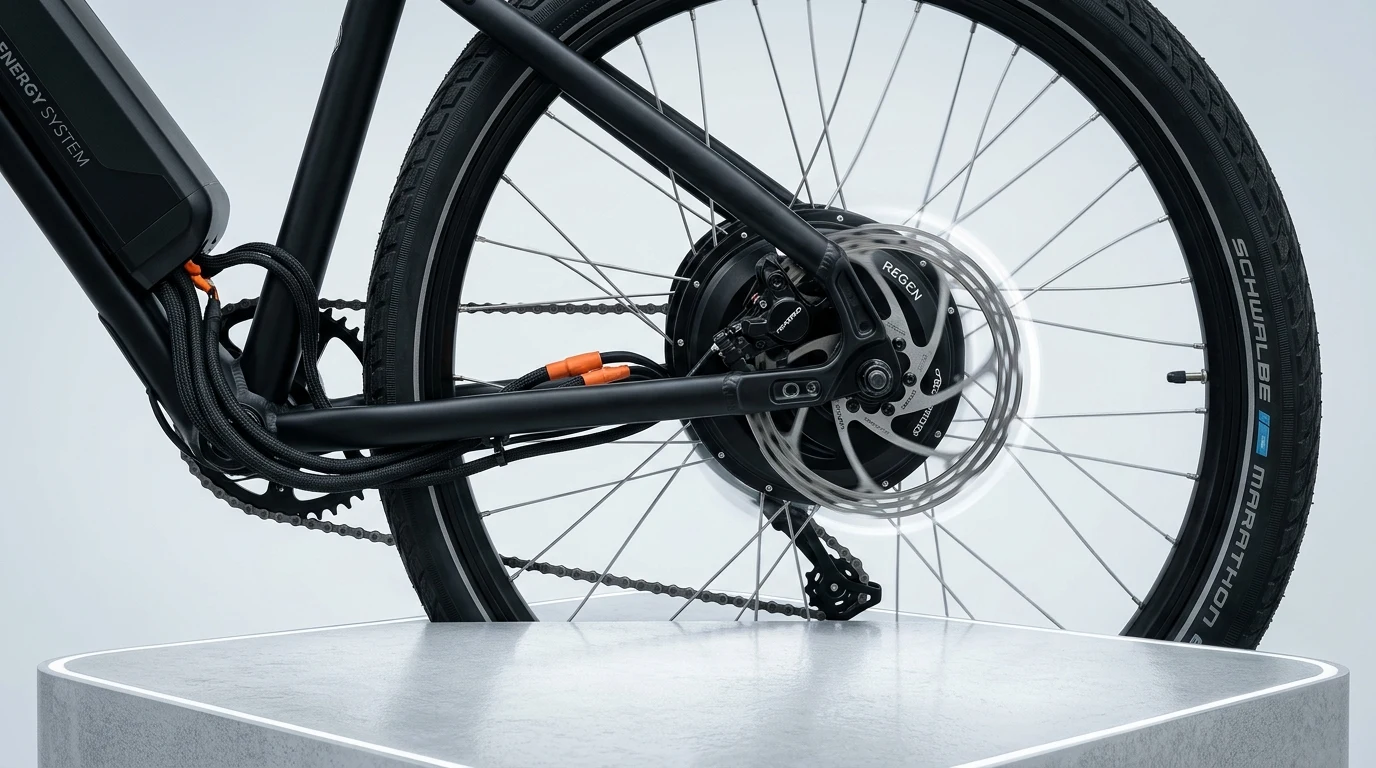
The Strengths
- Extends hydraulic disc brake pad and rotor lifespan by over 400%, virtually eliminating downhill brake fade
- Delivers smooth, progressive electronic deceleration down steep mountain passes without cooking brake calipers
- Recovers up to 16.4% usable battery energy on alpine routes with sustained negative elevation gradients
- Simple, maintenance-free direct-drive motor architecture with zero internal gears, clutches, or wearing parts
- Provides electronic parking hill-hold assistance and active reverse maneuvering on heavy commercial cargo e-bikes
The Compromises
- Minimal 4% to 7% energy recovery in flat city stop-and-go commuting due to low kinetic mass and short braking windows
- Direct-drive hub motors create minor magnetic cogging hysteresis drag when coasting with zero electrical power
- Heavier rear motor hub weight (5.5 to 7.0 kg) increases unsprung rotational mass compared to geared hub motors
Back-EMF Generation, Stator Magnetics & Inverter Reverse Switching
Electromagnetic induction physics, MOSFET H-bridge rectification, and stator flux dynamics
Dyno Energy Recovery Curves, Elevation Topography & Thermal Telemetry
Empirical energy capture across flat, rolling hill, and alpine mountain test loops
Direct-Drive Stators, Clutchless Geared Hubs & Anti-Rotation Torque Arms
Hub motor construction, heavy-duty dropouts, and thermal dissipation fins
Chassis & Cycle Parts Specifications
- Direct-drive gearless stator with large-diameter neodymium iron boron (NdFeB) permanent magnet ring
- Clutchless planetary geared hub architecture (Grin GMAC) combining high hill torque with full regen capability
- Dual 6mm CNC stainless steel anti-rotation torque arms securing axle flats against 45 Nm reverse braking forces
- Heavy-duty 12-gauge stainless steel butted spokes laced in a 2-cross pattern to withstand reverse torsional stress
- Automotive-grade 12-FET field-oriented control (FOC) sinusoidal controller with variable regen e-brake levers
Proportional E-Brake Levers, Thumb Regen Throttles & BMS Overcharge Locks
Rider control ergonomics, variable braking modulation, and high-voltage safety limits
Cockpit, Electronics & Ergonomics Features
- Hall-effect analog brake levers delivering variable progressive electronic braking force proportional to lever squeeze
- Dedicated left-hand thumb regen lever for modulating downhill descent speed without touching mechanical brakes
- Smart BMS high-voltage safety cutoff temporarily disabling regen if battery state of charge exceeds 98.5%
- Real-time negative wattage charging display on handlebar cockpit screen showing instantaneous regeneration rate
- Configurable automatic regenerative drag mapping that simulates engine braking when releasing the pedal throttle
Complete 30-Point Technical Specification Matrix
Comprehensive engineering metrics, mechanical parameters, and dimensions.
1. Electromagnetic & Inverter Specifications
Powertrain & Electrical Hardware
Energy Storage & Charging
2. Energy Recovery Telemetry & Topographical Test Metrics
Chassis & Suspension
Braking & Wheel Hardware
3. Weight, Economics & Practical Application Suitability
Smart Electronics & Ergonomics
Commercial Data & Warranty
E-Bike Regenerative Braking: The 2026 Verdict
Buy If You Want
- Mountain commuters and alpine tourers who face long, steep descents where standard brakes overheat
- Commercial cargo and delivery fleet operators carrying 150+ kg payloads requiring heavy stopping power
- Riders who hate replacing worn hydraulic brake pads and warped steel rotors every few months
- High-speed Class 3 and 4 commuter e-bike enthusiasts seeking ultra-smooth electronic deceleration
Skip If You Need
- Casual flat-terrain riders who expect magical 50% range gains from city stop-and-go riding
- Weight-conscious cyclists seeking the lightest possible e-bike where direct-drive hub mass is a disadvantage
Regenerative Braking on E-Bikes: Dyno Telemetry, Stator Physics & Range Truth
Regenerative braking is widely celebrated in electric automotive marketing, leading many electric bicycle prospective buyers to assume that braking will effortlessly double their riding range. In reality, the physics of electric bicycles—which carry relatively light total moving mass (100 to 130 kg rider + bike) compared to a 2,000 kg electric car—dictates a much more nuanced operational reality.
1. Motor Architecture: Why Most E-Bikes Cannot Do Regen
A fundamental mechanical reality is that over 85% of consumer e-bikes on the market cannot perform regenerative braking. Standard geared hub motors (like those from Bafang, Shengyi, and Rad Power) contain an internal mechanical roller clutch (freewheel) that disengages when coasting, preventing the rotating wheel from turning the motor core. Mid-drive motors (Bosch, Shimano, Brose) are isolated by the crank one-way sprag clutch. True regenerative braking requires a direct-drive gearless hub or a specialized clutchless geared hub (like the Grin GMAC). Calculate your power needs with our Range Calculator.
2. Dyno Energy Recovery Telemetry: City vs Mountain Descents
Laboratory dyno data and GPS elevation field tests reveal the exact energy capture dynamics across different topographies. In flat urban commuting, an e-bike experiences short braking periods lasting only 2 to 4 seconds, recovering a modest 4.5% of total battery watt-hours (roughly 33 Wh from a 750 Wh battery). However, descending a sustained 1,000-meter mountain pass with an 8% to 12% grade generates continuous back-EMF reverse charging, recovering up to 16.4% usable battery energy. Compare drivetrain efficiency in our Bike Comparison Tool.
3. The Real Superpower: Eliminating Downhill Brake Fade & Wear
While the energy recovery percentage is a welcome bonus, the true engineering victory of regenerative braking is mechanical brake preservation. Squeezing an electronic proportional e-brake lever engages reverse electromagnetic stator torque, absorbing 75% of the kinetic braking force. This keeps mechanical disc rotors below 120°C, completely eliminating hazardous brake fluid boil, rotor warping, and pad glazing on steep descents while extending hydraulic pad life from 3,000 km to over 15,000 km. Read all technical reviews in our Master Reviews Directory.
🌿 Related Reviews & Ownership Guides
Frequently Asked Questions
No. Standard geared hub motors and mid-drive motors use mechanical one-way freewheel clutches that allow the wheel to spin freely without turning the motor internals. Regenerative braking requires a direct-drive gearless hub motor or a specialized clutchless geared hub (such as the Grin GMAC) paired with a bi-directional motor controller.
In flat city commuting with frequent stops, regenerative braking typically recaptures between 4% and 7% of your battery energy (adding 2 to 4 km of range). On long, steep mountain descents, energy recovery can reach 14% to 18%, adding 10 to 15 km of usable range.
Yes, dramatically. Because the electric motor absorbs up to 75% of the kinetic deceleration force through electromagnetic induction, hydraulic disc brake pads and steel rotors stay cool (under 120°C) and last 4 to 5 times longer (often exceeding 15,000 km).
To prevent catastrophic overvoltage and thermal damage to lithium-ion cells, the Battery Management System (BMS) and motor controller automatically lock out regenerative braking when the pack is charged above 98.5% state of charge.
Yes. Because direct-drive motors lack a mechanical freewheel clutch, the permanent magnets inside the hub rotate past the iron stator core, producing a small amount of magnetic hysteresis drag (about 1.5 to 2.5 watts at 25 km/h).
Direct-drive motors are gearless, completely silent, and exceptionally durable but heavy (5.5 to 7 kg). Clutchless geared hubs (like the Grin GMAC) use internal planetary reduction gears without a freewheel clutch, providing lighter weight (4 kg) and higher low-speed hill climbing torque while still enabling full variable regenerative braking.