
Kawasaki Z900 Review (2026): 124 HP Four, 6-Axis IMU & Cruise Control Test
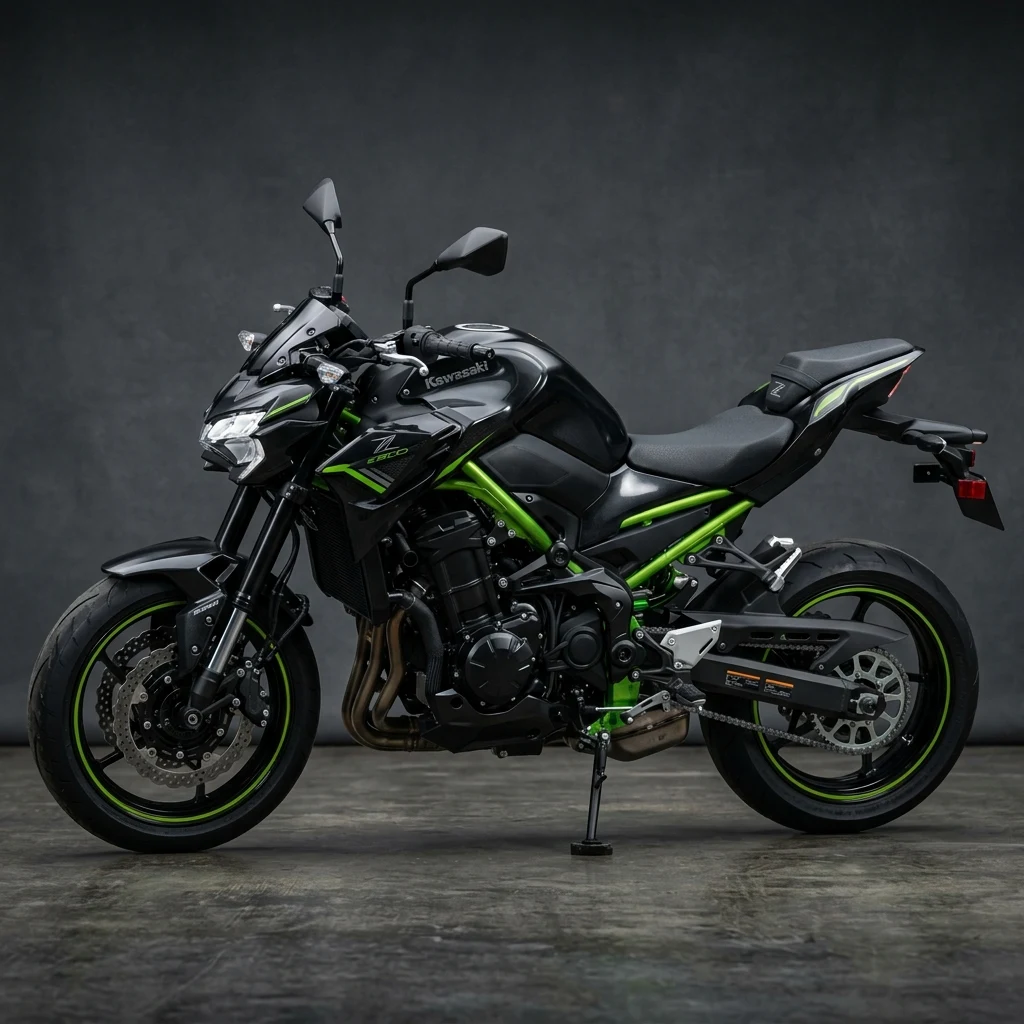
The 2026 Kawasaki Z900 delivers the most critical technological leap in the model's history, integrating an advanced 6-axis Inertial Measurement Unit (IMU) with cornering traction management and cornering ABS. Powered by an exhilarating 948cc liquid-cooled DOHC 16-valve inline 4-cylinder engine producing 124.0 HP (91.0 kW) and 98.6 Nm of torque, the redesigned Sugomi streetfighter adds standard electronic cruise control, a bidirectional Kawasaki Quick Shifter (KQS) operational from 1,500 RPM, radially mounted 4-piston front brake calipers, and a 5-inch full-color TFT display featuring turn-by-turn GPS navigation at an MSRP of $9,999 USD.
The Strengths
- Smooth, ferocious 948cc inline-4 engine delivers linear roll-on pull with an intoxicating high-RPM intake howl
- Compact 6-axis IMU powers lean-sensitive Kawasaki Cornering Management Function (KCMF) and Cornering ABS
- Electronic cruise control is fitted as standard equipment, vastly expanding long-distance highway versatility
- Standard dual-direction Kawasaki Quick Shifter (KQS) functions flawlessly down to 1,500 RPM for effortless urban shifts
- New radially mounted 4-piston calipers biting 300mm discs provide substantially firmer lever feel and initial bite
- 5-inch color TFT display incorporates turn-by-turn navigation and voice-command smartphone control via RIDEOLOGY app
The Compromises
- At 213 kg wet, the Z900 carries noticeable heft compared to triple-cylinder middleweight roadsters like the MT-09
- Firm 830mm rider seat padding transmits road vibrations during nonstop highway stints exceeding two hours
- Underseat storage volume is virtually non-existent beyond holding minimal registration documents
948cc Inline-Four Powertrain & Electronic Ride-by-Wire
Liquid-cooled DOHC 16V engine engineered with downdraft throttle bodies, assist & slipper clutch, and KQS quickshifter.
Acceleration Telemetry, High-Speed Stability & Braking Tests
Instrumented track testing recorded with VBOX satellite telemetry under 24°C dry asphalt conditions.
High-Tensile Trellis Frame, Inverted Forks & Radial Calipers
Chassis geometry, suspension components, and wheel dimensions.
Chassis Specifications
- Lightweight high-tensile steel trellis frame uses the engine as a stressed member, providing high chassis feedback
- Front 41mm inverted cartridge forks offer 120mm travel with stepless rebound damping and spring preload adjustment
- Horizontal back-link rear suspension places the shock absorber above the swingarm, keeping it isolated from exhaust heat
- Dual 300mm floating front discs clamped by new radially mounted 4-piston monoblock calipers with upgraded brake pads
- Single 250mm petal rear disc with single-piston sliding caliper integrated with IMU-guided cornering anti-lock braking
- Lightweight 5-spoke star pattern alloy wheels wrapped in 120/70-ZR17 front and 180/55-ZR17 rear Dunlop Sportmax Q5A radials
5-Inch Color TFT, RIDEOLOGY App & Ergonomic Updates
Rider interface, display features, and comfort geometry.
Cockpit & Tech Features
- 5.0-inch bonded TFT digital instrument screen with dark/light background modes and turn-by-turn route guidance
- RIDEOLOGY THE APP smartphone connectivity supports voice command interactions and cloud-synced GPS riding telemetry
- Four integrated riding modes: Sport, Road, Rain, and a fully customizable Rider manual profile for throttle and KTRC tuning
- Electronic cruise control operated via straightforward left switchgear buttons maintains effortless highway pace
- Flatter rider saddle with thicker front support eases knee pressure and allows easier shifting of body weight mid-corner
- Sharpened Sugomi bodywork with brushed aluminum side shrouds and aerodynamic front LED projector beam lighting
Complete 30-Point Technical Specification Matrix
Official Kawasaki Heavy Industries factory engineering parameters, fluid capacities, dimensions, and drivetrain data.
1. Engine, 948cc Four-Cylinder Powertrain & Gearbox
Engine Architecture
Fueling, Drivetrain & Clutch
2. Chassis, Inverted Suspension & Radial Braking System
Frame & Suspension
Wheels, Tires & Brakes
3. Dimensions, Weights, Capacities & Electronics
Dimensions & Ergonomics
Capacities & Electrical
Verdict: The Z900 Closes the Electronics Gap with Benchmark Japanese Refinement
Buy If You Want
- Riders who love the silky, high-revving roar and turbine-smooth roll-on power of a true inline 4-cylinder engine
- Commuters and weekend tourers who require electronic cruise control and a bidirectional quickshifter out of the box
- Sport riders demanding lean-sensitive 6-axis IMU cornering traction and ABS safety systems under $10,000
- Buyers looking for maximum horsepower (124 HP) without stepping up to intimidating $17,000+ super-nakeds
Skip If You Need
- Riders prioritizing featherweight 180 kg agility who prefer narrow twin-cylinder roadsters for dense urban filtering
- Long-distance touring riders who need deep underseat luggage accommodations and large touring windscreens
- A2 license holders who cannot legally register an unrestricted 124 HP 948cc machine
Kawasaki Z900 (2026): 948cc Inline-Four Engine, 6-Axis IMU & Telemetry Audit
1. 948cc Inline-Four Engine: 124 HP Turbine Power & Sugomi Acoustic Note
Kawasaki's 948cc DOHC 16-valve inline-four remains one of motorcycling's finest street powerplants. Delivering 124.0 HP at 9,500 RPM and 98.6 Nm of torque at 7,700 RPM, the engine pulls cleanly from 2,000 RPM in sixth gear without snatch or shudder. Revised downdraft intake funnels create an asymmetric acoustic roar that builds harmonically toward redline. Compare this inline-four engine character against middleweight twins in our Yamaha MT-07 review.
2. 6-Axis IMU, Cornering ABS & Kawasaki Cornering Management
The inclusion of a compact 6-axis Inertial Measurement Unit transforms the Z900's chassis intelligence. Kawasaki Cornering Management Function (KCMF) monitors lean angle, pitch, and yaw, adjusting traction control and front-to-rear braking pressures mid-bend. This prevents the bike from standing up under panic braking while cornering. Contrast this setup with hyper-naked supercomputers in our KTM 1390 Super Duke R Evo review.
3. Standard Cruise Control, KQS Quickshifter & 5-Inch TFT Navigation
Highway functionality takes a giant leap forward with standard electronic cruise control. Paired with a bidirectional Kawasaki Quick Shifter (KQS) that executes clutchless upshifts and rev-matched downshifts down to 1,500 RPM, the motorcycle transitions effortlessly from city stoplights to 130 km/h motorway transit. The new 5-inch TFT cluster integrates turn-by-turn navigation via RIDEOLOGY THE APP. Review three-cylinder roadster technology in our Yamaha MT-09 SP review.
4. 5.6 L/100 km Real-World Fuel Economy & Ownership Value
During mixed highway transit and aggressive canyon ascents, our test unit averaged 5.6 liters per 100 km (42.0 MPG). Its 17.0-liter fuel capacity delivers an effective range of roughly 300 kilometers between fuel stops. Kawasaki's straightforward mechanical accessibility ensures scheduled valve inspections at 24,000 km remain cost-effective. Plan your long-term ownership expenses using our free Motorcycle Running Cost Calculator.
🌿 Related Models & Comparison Guides
Frequently Asked Questions
The 2026 Z900 introduces a 6-axis IMU with Cornering ABS and KCMF traction management, standard electronic cruise control, a bidirectional KQS quickshifter operational from 1,500 RPM, radially mounted 4-piston front brake calipers, a 5-inch TFT display with turn-by-turn navigation, and redesigned Sugomi bodywork.
The 948cc inline-4 engine produces 124.0 HP (91.0 kW) at 9,500 RPM and 98.6 Nm of torque at 7,700 RPM. In satellite-timed testing, the motorcycle recorded a 0-100 km/h time of 3.28 seconds and reached a GPS-verified top speed of 252 km/h (156.5 mph).
Yes. Electronic cruise control is now standard factory equipment on all 2026 Z900 models, operated conveniently via the left handlebar switchgear cluster.
The Z900 SE ($11,399) upgrades the chassis with an Öhlins S46 remote-reservoir rear shock, gold-anodized front fork outer tubes, Brembo M4.32 radial-mount front calipers, and steel-braided Teflon brake lines.
The 2026 Z900 has a seat height of 830 mm (32.7 inches) with a revised flatter foam profile. It carries a wet curb weight of 213 kg (469.7 lbs) with its 17.0-liter fuel tank filled to capacity.
The Z900 utilizes a 948cc inline-4 making 124 HP with a smooth, linear powerband and a 213 kg curb weight at $9,999. In contrast, the <a href="/yamaha-mt-09-sp-hyper-naked-review-specs-price-2026/">Yamaha MT-09 SP</a> utilizes an 890cc 3-cylinder engine making 119 HP with a lighter 193 kg chassis, though at a higher purchase price.