
Legislative Framework: Motor Vehicles Taxation Act and 2026 Fee Slabs
Motorcycle taxation and registration in Punjab operate under the statutory provisions of the Punjab Motor Vehicles Taxation Act of 1958, updated through periodic Finance Acts. The provincial government structured two-wheeler dues into transparent engine capacity slabs to prevent arbitrary assessments by local excise taxation officers.
For standard commuters with displacements up to 100cc, the base registration fee is PKR 1,000. Motorcycles between 101cc and 125cc incur PKR 1,500, while 126cc to 150cc engines pay PKR 2,500. Motorcycles above 150cc are subject to a 2.0% ad valorem duty calculated on the vehicle manufacturer's invoice value. Under the prevailing regulatory schedule, registration charges remain linked to the certified manufacturer invoice value and factory cubic capacity recorded on the Form F delivery certificate. Dealerships must upload this documentation directly to the provincial motor transport management information system before releasing the physical motorcycle to the retail buyer. To cross-reference vehicle registration rules with subsidized provincial fleet initiatives, review our guide on the Punjab CM E-Bike Scheme Phase 3 online application portal.
Lifetime Token Tax Mechanics: Permanent Exemption for Bikes Under 150cc
Historically, motorcycle owners in Pakistan endured annual visits to excise branch offices or post offices to purchase paper token tax tax stamps. This cumbersome annual process encouraged widespread tax evasion and generated massive administrative overhead.
To eliminate this bottleneck, the Punjab government instituted a mandatory, one-time lifetime token tax of PKR 1,500 for all motorcycles with engine displacements up to 150cc. This single payment remains permanently tied to the vehicle chassis record across all subsequent ownership transfers. Once paid, the motorcycle remains tax-cleared for its entire operational lifespan. Explore provincial green mobility fleet expansions in our breakdown of the Punjab CM E-Bike Scheme 125,000 expansion and zero down payment guide.
The 7-Step ePay Punjab Process: Generating the 17-Digit PSID
The Punjab Information Technology Board (PITB) transformed vehicle revenue collection through the ePay Punjab portal. The process eliminates physical cash transactions at excise offices through seven sequential steps:
1. Portal Access: Download the ePay Punjab smartphone application or visit the web portal.
2. Department Selection: Navigate to 'Excise & Taxation Department' and select 'Motor Vehicle Registration'.
3. Data Input: Enter the motorcycle's chassis number, engine number, sale invoice date, and buyer CNIC.
4. PSID Generation: The portal calculates exact statutory dues and generates an instant 17-digit Payment System Identifier (PSID).
5. Electronic Settlement: Pay the PSID via 1Link using any banking mobile app, ATM, EasyPaisa, or JazzCash.
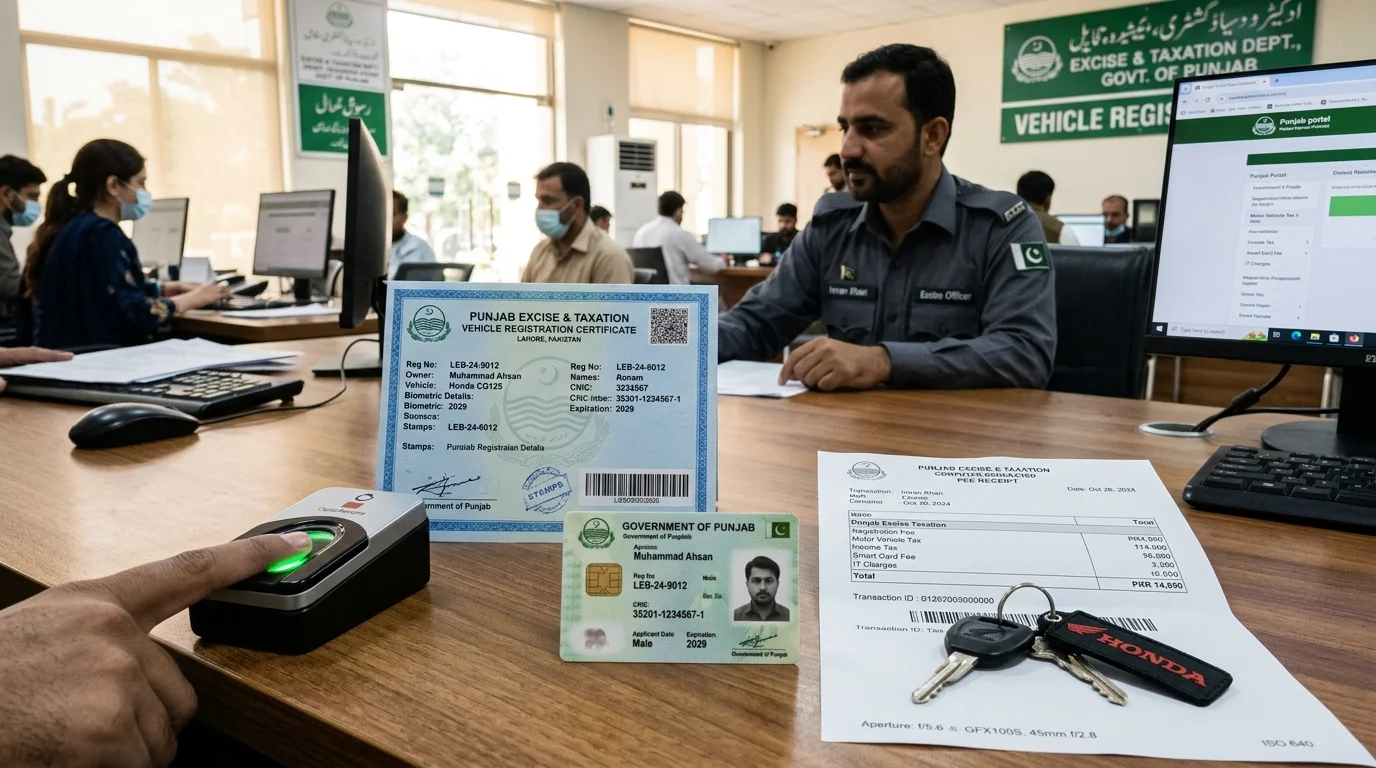
6. Biometric Verification: Within 30 days of payment, both parties visit a NADRA e-Sahulat center for fingerprint scanning.
7. Smart Card Dispatch: The excise system updates vehicle records to active status and triggers card printing. For eligibility terms on provincial EV schemes, review our Punjab CM E-Bike Scheme Phase 2 apply online and installment guide.
Motorcycle buyers should record the 17-digit PSID carefully upon generation. The code remains active across interbank 1Link settlement switches for 30 calendar days. If payment fails to process during peak banking settlement hours, users can verify status on the MTMIS vehicle verification portal using the chassis number before attempting duplicate fee generation.
NADRA e-Sahulat Biometric Integration: Fingerprint Verification Rules
To eradicate vehicle theft, forgery, and the use of fictitious identities in automobile sales, Punjab implemented mandatory NADRA biometric verification. Whenever a new registration or ownership transfer fee is settled on ePay Punjab, the system locks the application in a 'Bio-Pending' status.
The applicant has a strict 30-day window to complete biometric verification. Applicants can visit any of the 35,000+ NADRA e-Sahulat retail franchisees or use the NADRA Pak ID smartphone mobile biometric verification tool. The franchise operator inputs the application tracking code, takes live optical fingerprint scans, and transmits the biometric verification hash directly to the excise database. For installment calculations on provincial programs, consult our Punjab Electric Bike Scheme Phase 2 installment calculator.
Vehicle Ownership Transfer: Used Motorcycle Fees and Legal Protection
Transferring the title of a pre-owned motorcycle follows an equally rigorous digital path. Operating an automobile on an open transfer letter or deceased owner record is strictly prohibited and subject to immediate impoundment under Section 31 of the Motor Vehicles Ordinance.
The base ownership transfer fee in Punjab is fixed at PKR 500, supplemented by the PKR 1,300 smart card fee. Both the registered seller and the purchasing buyer must provide biometric fingerprint authentication to formalize the title transfer. Because the lifetime token tax transfers with the chassis, the buyer is exempt from paying token taxes unless transferring an engine exceeding 150cc. When purchasing an out-of-district vehicle within Punjab, the title transfer can now be completed at any regional excise office or e-Khidmat Markaz without requiring physical travel to the issuing district. The centralized database synchronizes records across Lahore, Rawalpindi, Multan, and Faisalabad within minutes of biometric authorization. To review EV models eligible for official government programs, read our list of PAVE scheme eligible electric bikes in Pakistan.
Number Plate Regulations and Smart Card Courier Tracking
Vehicle owners must understand current provincial policy regarding physical number plates. The Excise Department discontinued centralized distribution of metal number plates. Instead, vehicle owners must procure standardized embossed reflective plates from authorized private makers that match provincial typeface and optical security guidelines.
The vehicle registration smart card incorporates an encrypted microchip encoding vehicle ownership records and tax history. Once printed, the card is handed to Pakistan Post under a dedicated registered courier tracking barcode. The owner receives an automated SMS containing the tracking number to monitor delivery to their home address.