
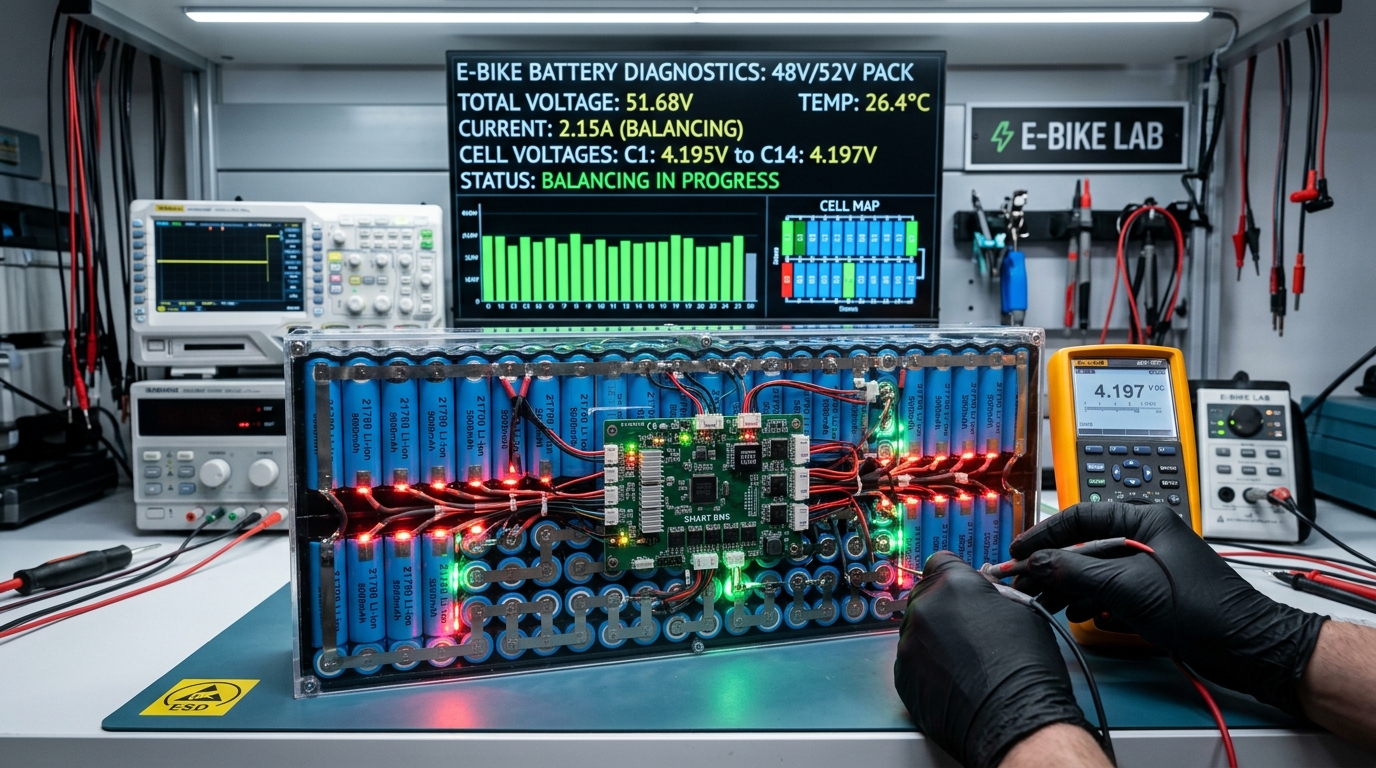
The lithium-ion battery pack is the single most valuable component on an electric bicycle, accounting for 35% to 50% of the vehicle's total cost. Understanding battery chemistry, Depth of Discharge (DoD) management, and Battery Management System (BMS) diagnostics is essential to maximizing lifespan and ensuring fire safety.
Lithium-ion cells (such as Samsung, LG, and Panasonic 21700 or 18650 formats) experience mechanical stress when held at maximum voltage (4.20V per cell) or deep discharge (below 3.00V per cell). Adopting the 20% to 80% charging protocol significantly reduces cathode cracking and solid electrolyte interphase (SEI) growth. This extends cycle life from approximately 500 full cycles to over 1,500 cycles. For riders evaluating fast-charging touring setups, consult our Amflow TL Carbon 12A GaN charging review and the DJI Avinox & Amflow PL review.
When an e-bike battery fails to turn on or refuses to accept charge, the integrated BMS has typically entered a protective sleep or fault lockout mode. A hard reset can be performed by removing the pack, pressing and holding the power button for 20 seconds to drain residual capacitor charge, and plugging in the OEM charger for 10 seconds to deliver a waking voltage pulse. For maintenance comparison across motor platforms, read our Bosch CX Gen 5 review, the Gazelle Ultimate C380+ review, and the Lectric ONE review.
During seasonal winter storage, store packs at 50% to 60% state of charge (3.70V to 3.85V per cell) in a dry environment between 15°C and 20°C. Never attempt to charge a frozen battery pack below 0°C, as lithium ions cannot intercalate into the graphite anode quickly enough, causing dangerous lithium metal plating. For comprehensive e-bike brand evaluations, consult our top electric bike brands guide, compute battery ROI with our motorcycle and e-bike EMI calculator, compare models using our bike comparison tool, and track battery safety updates in our industry news hub.
Frequently Asked Questions (FAQs)
How do you reset a locked e-bike Battery Management System (BMS)? +
To reset an e-bike BMS: 1) Disconnect the battery from the bike, 2) Hold the battery power button for 20 seconds, 3) Plug in the original manufacturer AC charger for 5 seconds to send a wake-up voltage pulse, 4) Verify all LED indicator lights sequence properly.
What is the best state of charge for e-bike battery longevity? +
Maintaining your battery between 20% and 80% state of charge during regular daily use can double or triple its usable lifespan from 500 cycles to over 1,200 to 1,500 cycles.
How should an e-bike battery be stored during winter? +
Store the battery indoors at room temperature (15°C to 20°C / 59°F to 68°F) charged to approximately 50% to 60% capacity. Check voltage every 60 days to prevent deep discharge below cutoff thresholds.