
Ather Rizta vs TVS iQube: Which Family Scooter Reigns Supreme?
Choosing a family electric scooter isn’t just about top speed—it’s about pillion comfort, real-world range under load, and avoiding massive repair bills. We pit India’s top two family EVs against each other based on real owner data.
If you are in the market for a family-oriented electric scooter in 2026, your search has likely narrowed down to two massive contenders: the Ather Rizta (by Ather Energy) and the TVS iQube (by TVS Motor). When analyzing the Ather Rizta vs TVS iQube, it’s clear both scooters target the exact same demographic—riders who want comfort, ample storage for groceries, and a traditional, non-aggressive design.
However, beneath the body panels, these two machines are engineered completely differently. The Rizta relies on a mid-drive PMS motor with a belt drive, while the iQube utilizes a direct BLDC hub motor.[1] Furthermore, real-world user reviews reveal that the glossy brochure numbers hide some frustrating ownership realities.[1]
Table of Contents
Ather Rizta vs TVS iQube: Direct Spec Comparison
Let’s look at the raw data before diving into the real-world performance.[1]
| Feature | Ather Rizta | TVS iQube |
|---|---|---|
| Avg. Starting Price | ₹ 1,15,435 | ₹ 1,13,245 |
| Motor Type | PMS Mid-Drive Motor | BLDC Hub-Mounted Motor |
| Max Power & Torque | 4.3 kW | 22 Nm | 4.4 kW | 140 Nm Peak |
| Claimed Range | 123 km – 160 km | 94 km – 212 km |
| Under-Seat Storage | 34 Litres | 30 to 32 Litres |
| Gradeability (Hill Climb) | 15 Degrees | 10 Degrees |
1. Ather Rizta: The Modern Tech Marvel
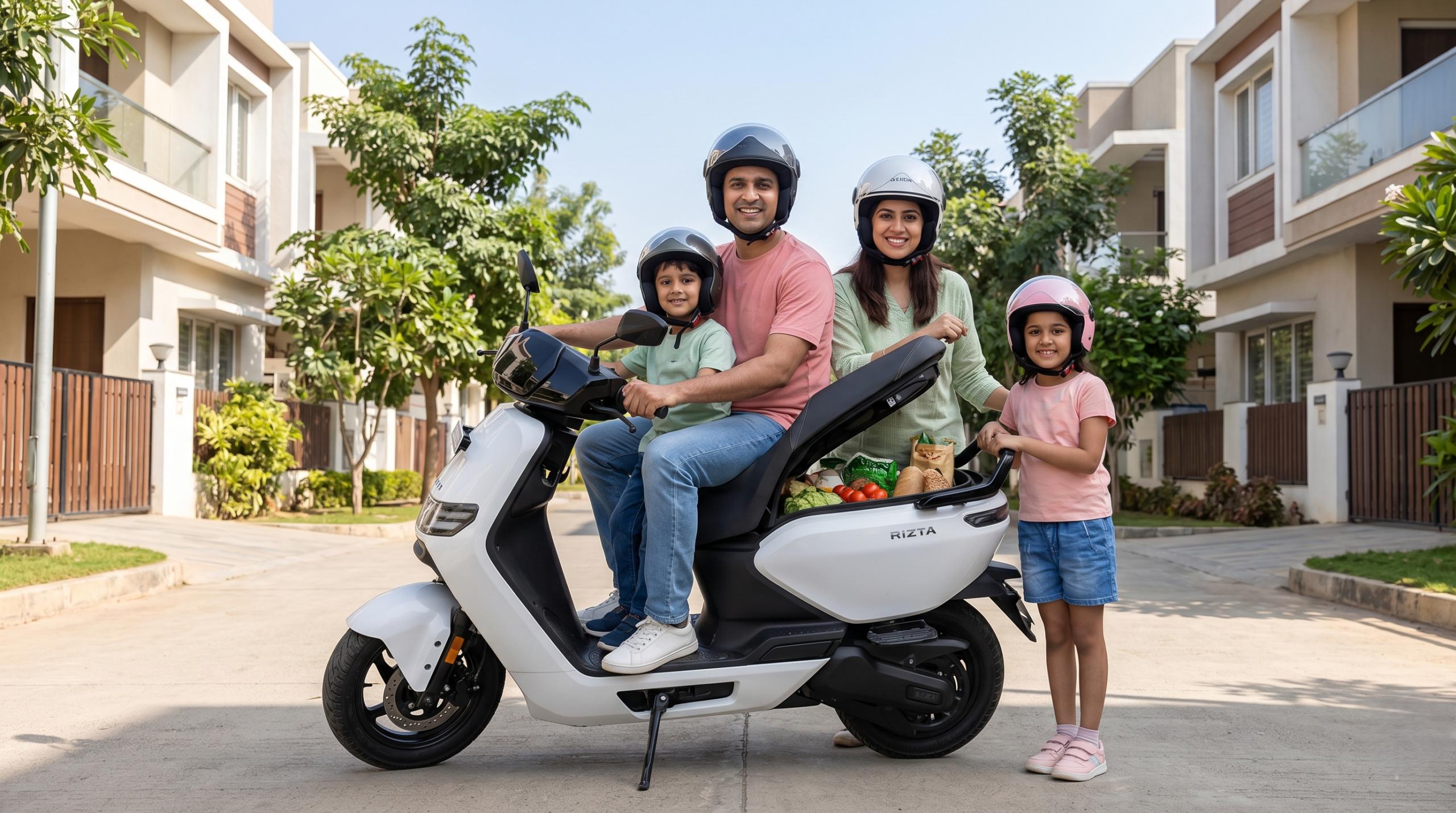
The Ather Rizta (starting at ₹ 1,15,435) was built specifically to address the complaints that previous Ather models were too small for families.[1] It boasts an enormous, flat seat designed comfortably for two adults, and massive 34-litre under-seat storage that can easily swallow two helmets or a week’s worth of groceries.[1]
Because it uses a PMS motor (4.3 kW), the weight distribution is excellent. Features like “SkidControl” and “Magic Twist” regenerative braking make it an absolute joy to ride in start-stop traffic.[1]
Pros
- Incredible seat size and pillion comfort [1]
- Largest-in-class 34L storage capacity [1]
- Advanced safety tech (FallSafe, SkidControl) [1]
Cons
- High extra costs for the mandatory “Pro Pack” [1]
- Heavy users report range drops to 60-70 km [1]
- Drive belt replacements are expensive [1]
2. TVS iQube: The Traditional Workhorse
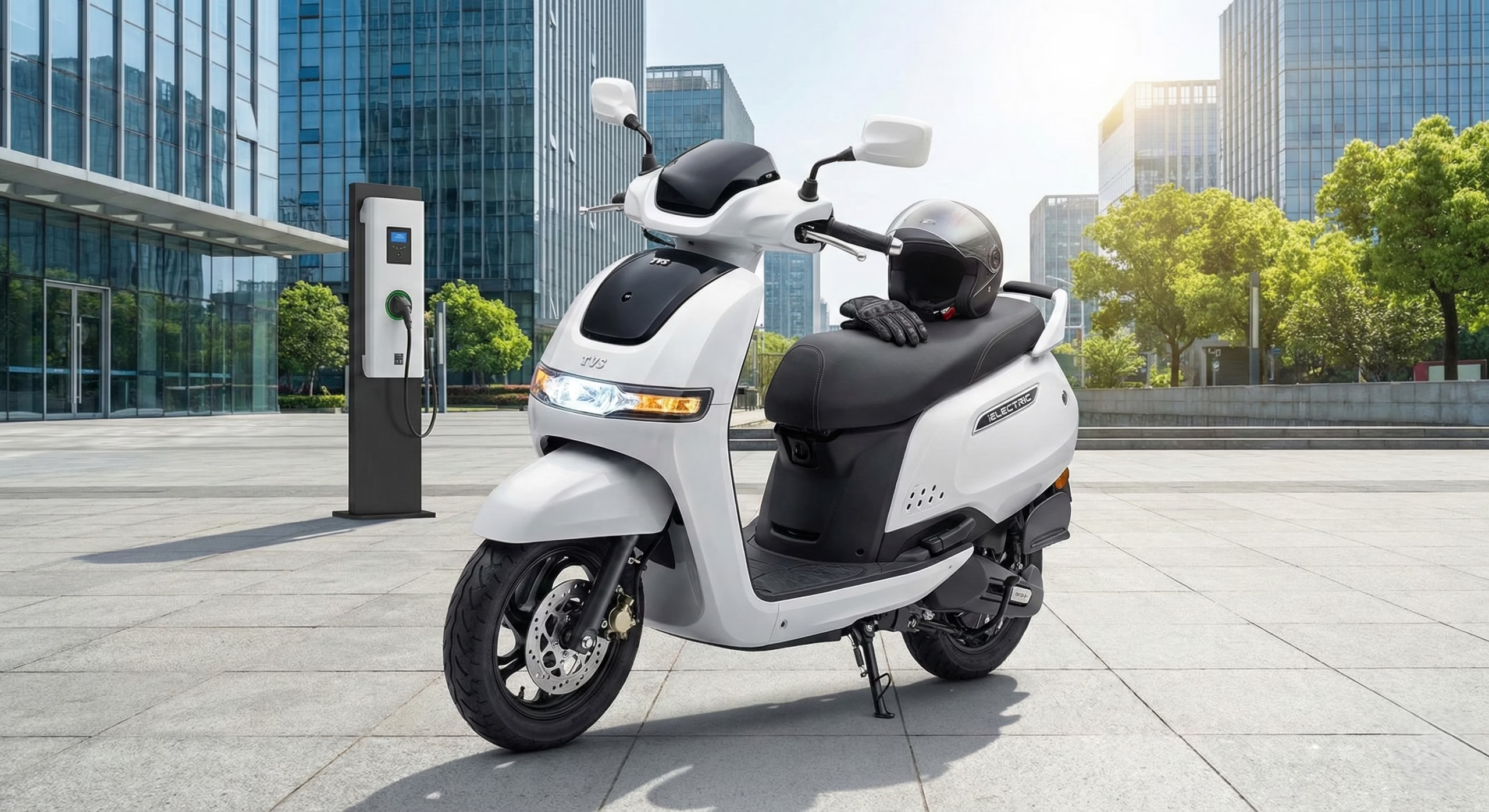
The TVS iQube (starting at ₹ 1,13,245) feels exactly like riding a traditional petrol scooter, which is a massive compliment.[1] It utilizes a 4.4 kW BLDC hub motor that is practically silent.[1]
What sets the iQube apart is its sheer pulling power. With a massive 140 Nm of peak torque, it never struggles off the line, even with a heavy pillion rider.[1] TVS also offers a wide array of battery choices, ranging from a budget 2.2 kWh pack up to a massive 5.3 kWh ST variant that claims 212 km of range.[1]
Pros
- Familiar, sturdy traditional scooter design [1]
- Massive 140 Nm peak torque for heavy loads [1]
- Very silent and smooth hub motor operation [1]
Cons
- Severely slow charging (up to 7 hours) [1]
- Notorious for Error Code 34 (BMS handshake failure) [2]
- Low 10-degree gradeability on steep hills [1]
The Dark Side: Real Owner Complaints
When comparing the Ather Rizta vs TVS iQube, marketing numbers mean nothing if the scooter fails on your way to work. Here is what real owners on forums and review platforms are actually experiencing with these two models:
The TVS iQube’s “Load Penalty”
While TVS claims a strong range, owners report that the iQube suffers heavily under load. User Pratham Goenka reported that while riding alone, he achieved 50 km per charge, but with a pillion passenger, his real-world range plummeted to just 35 km.[1] Furthermore, users frequently face the dreaded Error Code 34 (a BMS handshake failure), which triggers a solid red charger light and prevents the scooter from charging entirely.[2]
The Ather Rizta’s Service and Belt Issues
Ather’s mid-drive system requires a physical drive belt to turn the rear wheel. User Mohammed Hamid warned buyers that his Rizta’s belt snapped at just 1,891 km, leaving him stranded.[1] Additionally, multiple owners (like Meiyazhagan K) reported a frustrating software safety feature: if the battery drops below 25%, the Rizta automatically shuts off “ZIP” mode, drastically cutting your speed.[1] Service center arrogance and “hidden clauses” regarding paid services after 5,000 km are also common complaints.[1]
Final Verdict: Which Should You Buy?
The ultimate winner in the battle of Ather Rizta vs TVS iQube depends heavily on your specific needs. Both scooters are excellent machines, but they serve different types of families.
- Buy the Ather Rizta if: You prioritize massive storage space, cutting-edge dashboard technology (like Google Maps and WhatsApp integration), and you live in a hilly area where its 15-degree gradeability outperforms the iQube.[1]
- Buy the TVS iQube if: You want a scooter that feels exactly like an Activa or Jupiter, you frequently carry heavy loads (thanks to its 140 Nm torque), and you want a smooth, absolutely silent ride without the maintenance hassle of a drive belt.[1]
Frequently Asked Questions
Which is better for a family, Ather Rizta or TVS iQube?
What is the real world range of TVS iQube with a pillion?
What is the BMS Error Code 34 on TVS iQube?
Is the Ather Rizta drive belt prone to snapping?
More EV Guides on BikesKnowledge
- Top 5 Best Electric Scooters in India
- Metro T9 Review: Real Range and Specs
- Top 10 Electric Bikes in Pakistan
- Electric Bike Prices in Pakistan (Latest Updates)
- Best 8 Electric Scooty for Students
- Best Fuel Average Bikes in Pakistan
- Best 125cc Bikes in Pakistan
- Honda CD70 vs Yamaha YB125Z Comparison
- Electric Bike vs Petrol Bike in Pakistan
- Best Scooty in Pakistan Under 1.5 Lakh
One thought on “Ather Rizta vs TVS iQube : Who Wins?”