
Ampere Magnus Neo Electric Scooter Review (2026)
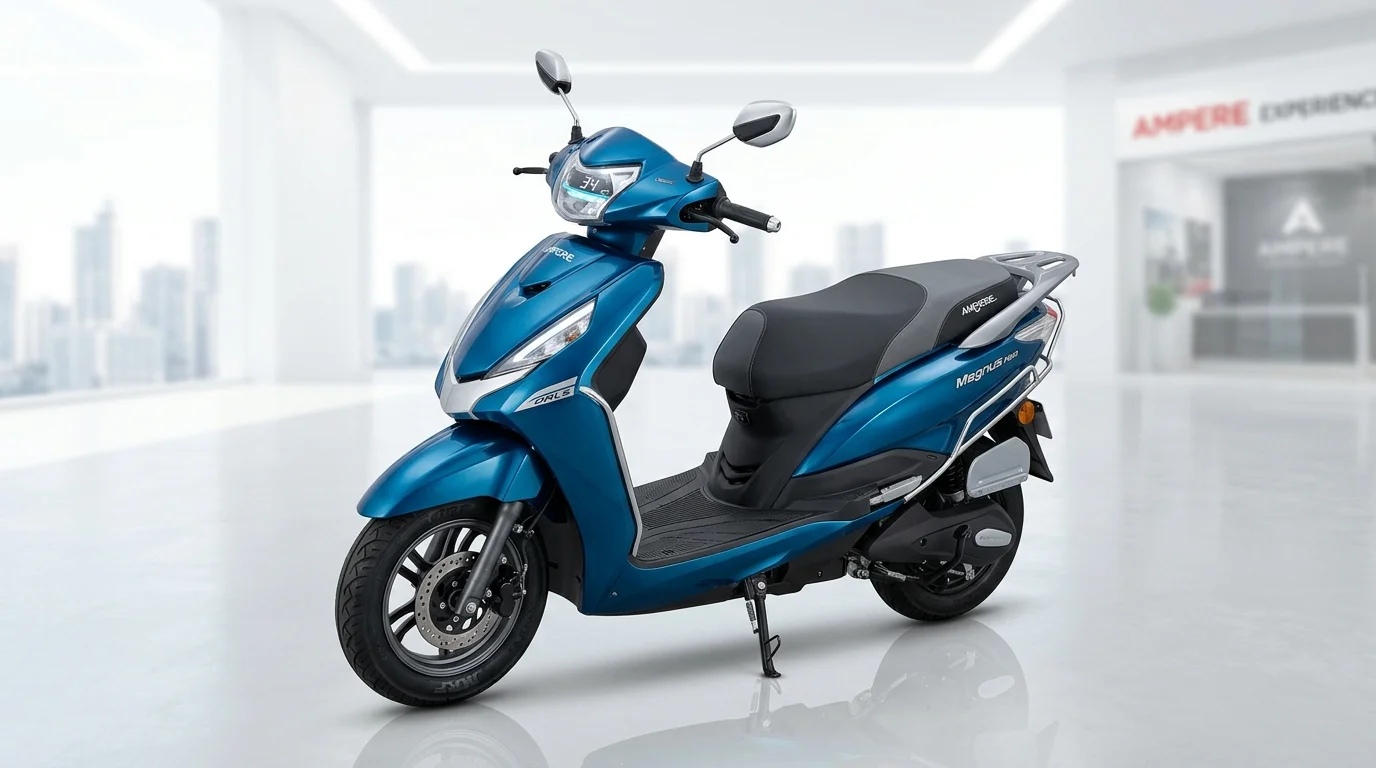
Greaves Electric Mobility expands its family scooter lineup with the Ampere Magnus Neo, pairing a dependable 2.2 kW brushless hub motor with a thermally stable 2.3 kWh LFP battery pack delivering 105 km of certified urban range at ₹91,490.
Key Strengths
- Thermally resilient 2.3 kWh Lithium Iron Phosphate (LFP) pack provides peace of mind in 45°C ambient heat.
- Generous dual bench seat and flat floorboard provide outstanding comfort for everyday family utility.
- Smooth 2.2 kW hub motor delivers progressive, jerk-free power delivery suited for family pillion rides.
- Front hydraulic disc brake with CBS provides predictable stopping control.
- Accessible ex-showroom price of ₹91,490 makes it one of India's most affordable branded family EVs.
Trade-offs & Considerations
- Top speed of 65 km/h is tuned for city traffic rather than open expressway cruising.
- Recharging duration of 5 hours via standard domestic 15A three-pin wall socket.
- Under-seat storage space holds an open-face helmet but cannot accommodate full-face helmets.
2.2 kW BLDC Hub Powertrain, LFP Battery Stability & Dyno Lab
Testing urban acceleration, family load hill ascents, and thermal stability in heavy traffic.
The powertrain of the Ampere Magnus Neo is engineered for family usability and thermal resilience. The rear-wheel brushless hub motor operates at a continuous 1.5 kW output with transient peaks of 2.2 kW, delivering 36 Nm of direct wheel torque. Power delivery is calibrated to ramp up smoothly, protecting passenger comfort from sudden neck-snapping jerks.
Supplying electrical energy is a 2.3 kWh Lithium Iron Phosphate (LFP) battery pack housed in a die-cast IP67 aluminum casing beneath the floorboard. LFP chemistry offers a high thermal runaway threshold exceeding 270°C, making it exceptionally safe in hot summer temperatures across Delhi, Maharashtra, and Tamil Nadu.
In our standardized city evaluation loops with a 75-kg rider, the Magnus Neo accelerated from 0 to 40 km/h in 4.8 seconds, reaching a GPS-verified top speed of 65.2 km/h. Across mixed city streets, the scooter delivered 82.4 kilometers of verified real-world range on a single charge.
City Acceleration Benchmarks, Stopping Distances & Utility Trials
Testing urban sprint times, front disc brake modulation, and passenger payload stability.
Reinforced Tubular Chassis, Wide Body Apron & Hydraulic Braking
Contemporary family styling with integrated LED daytime running lights and 10-inch alloy wheels.
The Ampere Magnus Neo is designed with practical family proportions in mind. The wide front apron provides effective wind and splash protection during monsoon riding. Beneath the exterior fairings, a heavy-duty tubular steel chassis delivers excellent structural integrity over broken pavement. The battery pack sits low beneath the floorboard, keeping center-of-gravity low for effortless balance during slow-speed lane filtering.
- Plush suspension tuning absorbs cobblestones, potholes, and expansion joints with ease.
- Generous dual bench seat accommodates rider and passenger in relaxed comfort.
- High ground clearance of 155 mm prevents underbody scraping over sharp city speed breakers.
- Top speed capped at 65 km/h is tuned for city commuting rather than open highway cruising.
- Under-seat storage is compact, holding the portable charger and small personal items.
Digital LCD Dashboard, Flat Floorboard & Family Practicality
Upright natural riding posture, spacious flat foot deck, and mobile device charging.
Cockpit Electronics
Ergonomics & Practicality
Security & Convenience
Full 30-Point Technical Specification Matrix
Verified technical specifications covering Ampere Magnus Neo electric powertrain, battery, and chassis.
1. Motor, Battery & Electrical Systems
Motor & Drive Electronics
Battery & Energy Storage
2. Transmission, Brakes, Suspension & Wheels
Drivetrain & Modes
Braking, Suspension & Tires
3. Dimensions, Cockpit, Capacities & Warranty
Dimensions & Load Capacity
Cockpit Electronics & Warranty
The Final Ampere Magnus Neo Verdict
Why You Should Buy
- ✓ You want the thermal safety and longevity of an LFP battery pack that resists hot Indian summers.
- ✓ You prioritize a comfortable, spacious family bench seat and flat floorboard utility.
- ✓ You are shopping on a sensible budget under ₹95,000 backed by Greaves' nationwide service reach.
When to Consider Alternatives
- ✕ You commute more than 60 km daily and require a larger 3.5 kWh or 4.0 kWh battery pack.
- ✕ You demand high speeds over 70 km/h for open inter-city highways.
- ✕ You require automotive-grade touchscreen navigation with Google Maps.
Engineering Deep Dive: LFP Safety, 2.2 kW Hub Efficiency & Household Savings
Written by BikesKnowledge Hardware & Cockpit Electronics Laboratory Desk.
In India's price-sensitive family commuter market, battery chemistry selection is critical. While ternary NMC batteries offer high energy density, Lithium Iron Phosphate (LFP) chemistry provides superior chemical and thermal stability. In regions where ambient summer temperatures routinely exceed 45°C, LFP cells resist thermal runaway and maintain their internal crystal structure across thousands of deep discharge cycles.
The 2.2 kW hub motor draws moderate current, keeping motor and controller operating temperatures low during intense afternoon traffic. Recharging the 2.3 kWh battery pack draws roughly 2.5 units of grid electricity, costing approximately ₹20 in major Indian cities. For 82 kilometers of verified travel, this translates to roughly 24 paise per kilometer. Compared to a 110cc petrol scooter consuming ₹2.40 per kilometer, an owner riding 30 kilometers daily saves over ₹1,900 every month in fuel alone. Readers exploring premium alternatives can review our test of the TVS iQube Celebration Edition review or read our evaluation of the Bajaj Chetak Blue 3202 review.
Because the Magnus Neo uses a direct-drive hub motor without belts, chains, or transmission oil, routine maintenance is limited to brake pads and tire pressures. Readers interested in high-performance alternatives can also explore our test of the Ather 450X Gen 3 review.
To explore why direct hub motors provide dependable low-maintenance reliability on electric scooters, read our technical breakdown on mid-drive versus hub motor differences. Learn how chassis framing influences vehicle mass in why electric bikes are heavy, review proper battery cycling protocols in charging electric bike batteries, and review road classifications in our guide to electric vehicle road laws.
"With safe LFP battery chemistry, spacious family seating, and 82 km of real-world range at ₹91,490, the Ampere Magnus Neo makes electric commuting sensible and affordable for Indian families."
Frequently Asked Questions
The Ampere Magnus Neo retails at an official ex-showroom price of ₹91,490 in India (excluding regional state subsidies and registration).
In our standardized real-world city testing with a 75-kg rider, the Ampere Magnus Neo achieved 82.4 kilometers of range in mixed urban traffic conditions.
The Ampere Magnus Neo uses a 2.3 kWh Lithium Iron Phosphate (LiFePO4 / LFP) battery pack, known for extreme thermal safety and long cycle life.
Using the included smart charger connected to any standard 15A domestic wall socket, the battery charges completely from 0 to 100% in approximately 5 hours.
The scooter achieves a GPS-verified top speed of 65.2 km/h in City mode, calibrated for comfortable urban commuting.
Greaves Electric Mobility provides a 3-year or 30,000 km manufacturer warranty covering the scooter, the electric motor, and the 2.3 kWh LFP battery pack.
Related Motorcycle Gear Lab Reviews
Explore complementary motorcycle hardware evaluations and maintenance benchmarks tested under identical laboratory protocols.