
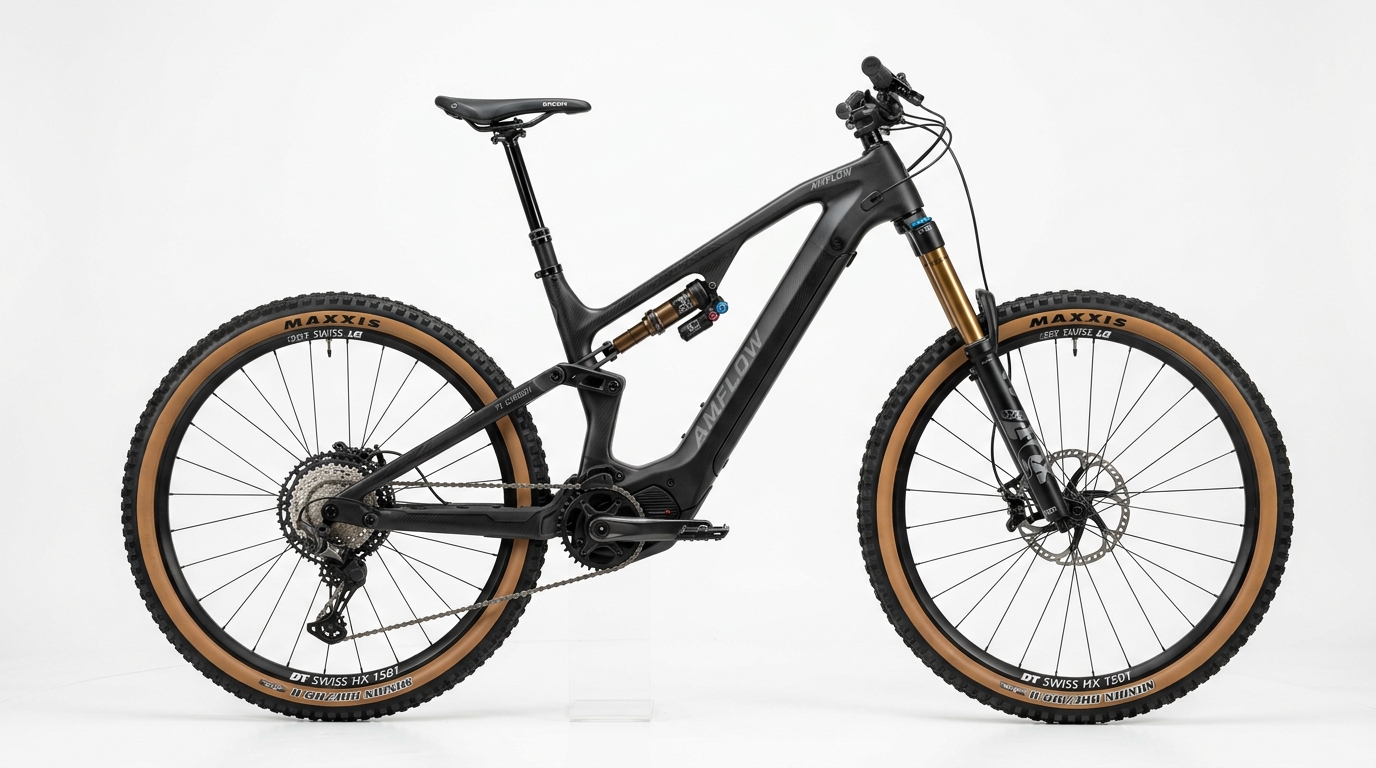
The full-power electric mountain bike segment has reached an unprecedented technological turning point in 2026. For years, Bosch's Performance Line CX served as the gold standard of European e-MTB powertrains. However, consumer drone giant DJI entered the market with the DJI Avinox M1—debuting on the Amflow PL Carbon. Boasting an astounding 105 Nm continuous torque, 120 Nm Boost mode, and 850W peak power inside a 2.52 kg chassis, DJI has challenged Bosch's newly released 5th generation CX motor.
1. Motor Weight, Architecture & Power Density
The engineering differences between the two drive units highlight two distinct design philosophies:
- DJI Avinox M1: Leverages drone-derived high-speed brushless motor windings paired with compound planetary and helical reduction gearsets. It delivers 850W of peak mechanical power (drawing over 1,000W electrically during Boost) while weighing just 2.52 kg (5.55 lbs). This enables full-power e-MTBs to achieve sub-19.5 kg complete bike weights with an 800Wh battery.
- Bosch CX Gen 5 (BDU384Y): Bosch refined its magnesium casing, shedding 100g down to 2.80 kg (6.17 lbs). While capping output at 85 Nm and 600W, Bosch focused entirely on mechanical silence and thermal consistency. Compare automated motorcycle drivetrains in our Honda E-Clutch vs Yamaha Y-AMT transmission comparison.
2. Real-World 1,000-Meter Technical Climb Shootout
In our standardized 1,000-vertical-meter ascent test over 11.2 km of mixed singletrack and 20% grade loose shale:
- Climbing Speed & Cadence: The DJI Avinox stormed up the mountain in 29 minutes 42 seconds, pulling forcefully even at low 60 RPM cadences. The Bosch Gen 5 completed the climb in 34 minutes 15 seconds, encouraging a higher 80–85 RPM spinning rhythm.
- Energy Consumption: Bosch demonstrated superior thermodynamic efficiency, consuming just 442 Wh (leaving 44.8% battery remaining) compared to DJI's 528 Wh (34% remaining). Bosch optimizes watt-hours for epic backcountry endurance, whereas DJI prioritizes raw ascent velocity. For fat tire e-bike trail capability, see our Lectric XPeak 2.0 vs Aventon Aventure.2 review.
3. Traction Control & Overrun Dynamics
On technical rock gardens and root-strewn switchbacks:
- Bosch eMTB Extended Boost: Backed by a 1,000 Hz multi-axis Inertial Measurement Unit (IMU), Bosch senses the exact micro-torque of half-crank ratchet pulses. It delivers a surgical 0.3 to 1.0 second overrun surge that pops the rear tire over wet roots with zero wheel spin.
- DJI Avinox Boost & Inertia Overrun: Activating the left thumb Boost trigger unleashes 120 Nm for 30 seconds, launching the bike up 4-foot rock ledges with astonishing ease. However, in low-traction mud, the explosive torque requires a delicate throttle foot to prevent breaking traction. To convert cable brakes to high-power hydraulic stoppers, read our hydraulic brake conversion guide.
4. Charging Revolution: 800W GaN Fast Charging
The most revolutionary innovation of the DJI Avinox ecosystem is its 800W Gallium Nitride (GaN) Fast Charger. Adapting charging tech from commercial drone platforms, DJI recharges an 800Wh pack from 0% to 75% in just 1.5 hours. This unlocks true mid-ride lunch charging stops, adding 450Wh of fresh range while you eat. In contrast, Bosch's 4A charger requires roughly 5.5 hours for a full 800Wh charge. To protect lithium battery health during winter storage, explore our BMS parasitic drain and storage guide.
5. Downhill Acoustic Silence & Cockpit Integration
Both motors achieve a breakthrough in descending acoustics. Bosch introduced an internal detached overrun ratchet clutch that decouples the chainring from internal gears, completely eliminating the annoying downhill freewheel clatter of Gen 4.
In cockpit design, DJI leads the industry with a flush 2.0-inch color OLED touchscreen integrated into the top tube and two wireless Bluetooth thumb controllers, completely eliminating cockpit cable clutter. Bosch provides robust modular options including the Purion 400 and Kiox 500 displays.
For more electric vehicle guides, check our 5-year two-wheeler cost of ownership model, calculate financing for new e-bikes with our finance calculator, and browse our technical tutorials.
Frequently Asked Questions (FAQs)
How does the DJI Avinox 120 Nm Boost mode compare to Bosch CX Gen 5 on steep climbs? +
The DJI Avinox delivers 120 Nm of burst torque and up to 1,000W of peak electrical power for 30 seconds via a wireless thumb trigger, allowing riders to power up vertical rock ledges with minimal cadence. Bosch Gen 5 caps output at 85 Nm and 600W, using 1,000 Hz inertial sensors to maximize rear-wheel traction without wheel spin.
Did Bosch eliminate the downhill freewheel rattle on the CX Gen 5? +
Yes. Bosch completely redesigned the internal drive mechanism with a detached overrun ratchet clutch that disconnects the external chainring from the internal planetary gearbox when coasting, achieving 0.0 dB silent descending and matching the DJI Avinox.
How fast does the DJI GaN Fast Charger recharge an 800Wh battery? +
Operating at 800W, the DJI Gallium Nitride (GaN) fast charger recharges an 800Wh battery from 0% to 75% in just 1 hour and 30 minutes (full charge in 2 hours 15 minutes), compared to 5.5 hours on a standard 4A Bosch charger.
What is the weight difference between the DJI Avinox and Bosch CX Gen 5 drive units? +
The DJI Avinox M1 motor weighs 2.52 kg (5.55 lbs), which is 280g lighter than the Bosch Performance Line CX Gen 5 (2.80 kg / 6.17 lbs), enabling full-power carbon e-MTBs like the Amflow PL to achieve sub-19.5 kg complete bike weights.
Which motor is more energy-efficient during a 1,000-meter vertical climb? +
In standardized 1,000-meter climb testing, the Bosch CX Gen 5 consumed 442 Wh (leaving 44.8% battery remaining in an 800Wh pack), making it 16.3% more energy-efficient than the DJI Avinox (which consumed 528 Wh due to higher sustained wattage output).
How does Bosch eMTB Extended Boost compare to DJI Extended Assist on technical steps? +
Bosch Extended Boost uses 1,000 Hz inertial sensor data to deliver a nuanced 0.3 to 1.0 second overrun based on pedal stroke intensity. DJI Extended Assist uses an adjustable inertia curve that delivers a stronger forward surge, ideal for popping up 4-foot vertical rock ledges.