
Honda CB1000 Hornet SP Review (2026): 157 HP Inline-4, Öhlins Damping & Dyno Test
The 2026 Honda CB1000 Hornet SP represents Honda's aggressive return to the liter-class hyper-naked arena, delivering superbike performance at an accessible price point. Powered by a retuned 999cc DOHC 16-valve inline-four engine sourced from the CBR1000RR Fireblade, the SP edition generates 157 horsepower at 11,000 RPM and 107 Nm of torque at 9,000 RPM with an electronic RC exhaust valve. Upgraded chassis hardware includes a fully adjustable Öhlins TTX36 rear shock, 41mm Showa SFF-BP inverted forks, Brembo Stylema radial monobloc calipers, and a standard bidirectional quickshifter. Anchored by a twin-spar steel frame, Throttle-by-Wire rider modes, and a 5-inch bonded TFT display, the flagship Hornet SP carries a starting MSRP of $10,999 USD.
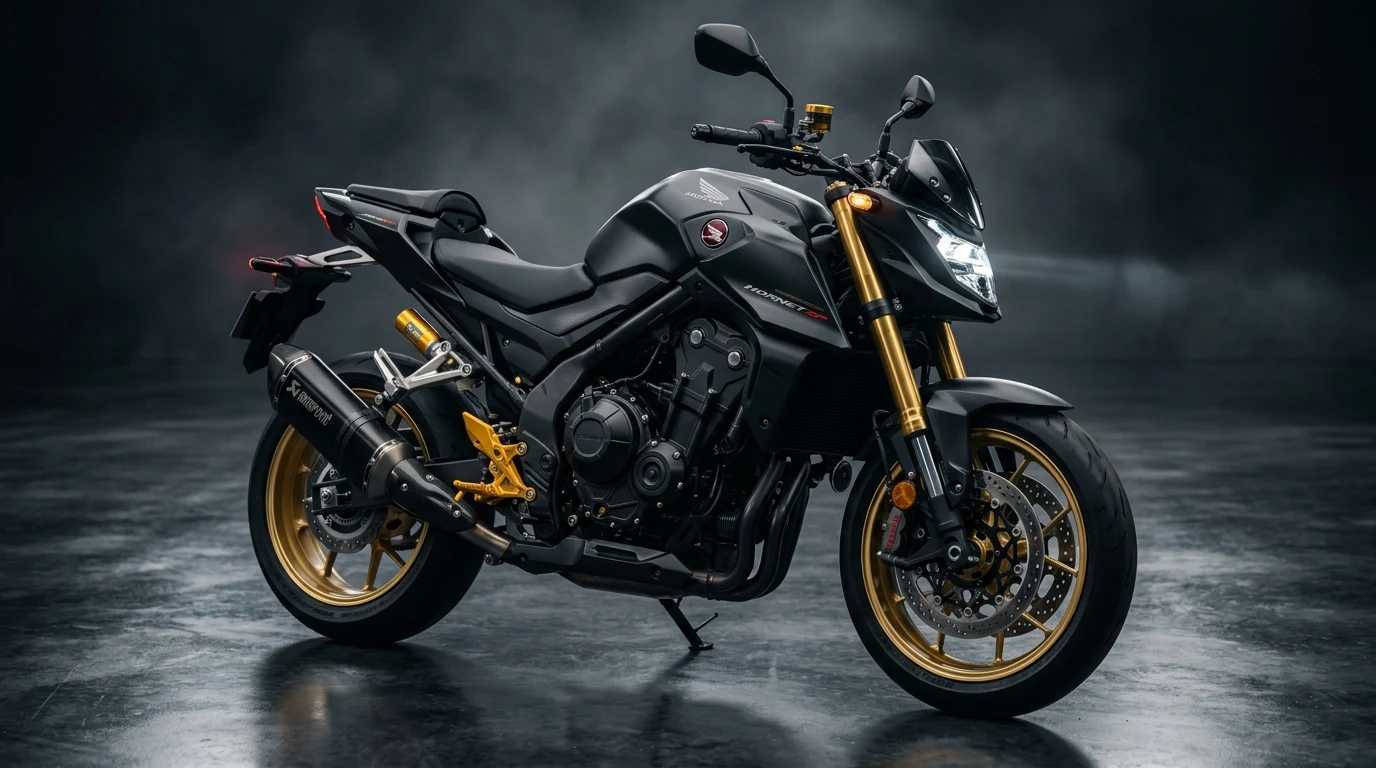
The Strengths
- Fireblade-derived 999cc inline-four pushes 157 horsepower, delivering exhilarating top-end rush past 7,000 RPM
- Öhlins TTX36 rear shock with remote preload and damping adjusters provides exceptional road compliance and rear-tire drive
- Top-tier Brembo Stylema 4-piston radial monobloc calipers provide immense stopping power with feather-light lever effort
- Standard bidirectional quickshifter enables instantaneous, clutchless gear changes under hard acceleration and aggressive deceleration
- Highly competitive $10,999 price undercuts rival European liter-nakeds by thousands of dollars while offering premium hardware
- 5-inch optically bonded TFT display resists glare and connects seamlessly to smartphones via Honda RoadSync
The Compromises
- Omits a 6-axis IMU, meaning traction control and ABS do not adjust for motorcycle lean angle in corners
- Sport throttle mode exhibits an abrupt initial response from closed throttle that requires steady wrist technique
- Minimalist rear subframe and compact passenger pillion limit comfortable two-up long-distance touring
Fireblade-Derived 999cc Inline-4 Powertrain & Gearbox
Liquid-cooled DOHC 16-valve four with RC exhaust valve, ride-by-wire, and slipper clutch.
Real-World Performance & Dyno Telemetry
Instrumented road tests, 0-60 acceleration, quarter-mile sprint, and braking deceleration.
Öhlins TTX36 Suspension & Brembo Stylema Brakes
Showa 41mm SFF-BP inverted forks, Öhlins remote shock, and Brembo Stylema monobloc calipers.
Chassis Specifications
- FRONT SUSPENSION: 41mm Showa SFF-BP (Inverted Cartridge with Full Adjustability (120mm Travel))
- REAR SUSPENSION: Öhlins TTX36 Monoshock (Pro-Link Remote Reservoir Full Damping (131mm Travel))
- FRONT BRAKES: Dual 310mm Floating Discs (Brembo Stylema 4-Piston Radial Monobloc Calipers)
- REAR BRAKE: Single 240mm Disc (Nissin Single-Piston Pin-Slide Caliper with ABS)
Cockpit Electronics & Honda RoadSync Interface
TFT instrument cluster, cornering traction control, ride modes, and connectivity.
Cockpit & Tech Features
- 5.0-inch optically bonded color TFT screen minimizes sun glare with three selectable dial display layouts
- Throttle-by-Wire provides three preset riding maps: Rain (soft), Standard (linear), and Sport (aggressive)
- Two customizable User modes allow riders to set independent Power (3 levels), Engine Braking (3 levels), and HSTC
- Honda Selectable Torque Control (HSTC) incorporates multi-stage wheelie control to tame front-wheel lift
- Standard factory bi-directional quickshifter features three adjustable shift-lever load sensitivity levels
- Honda RoadSync app enables turn-by-turn on-screen navigation, phone call management, and music control
Complete 30-Point Technical Specification Matrix
Full factory engineering specifications, gear ratios, and chassis metrics for the 2026 Honda CB1000 Hornet SP.
1. 999cc Fireblade Engine & 6-Speed Transmission
Engine & Architecture
Fuel, Clutch & Drivetrain
2. Chassis, Öhlins Suspension & Brembo Brakes
Frame & Suspension
Brakes, Wheels & Tires
3. Dimensions, Weights, Capacities & Electrics
Geometry & Dimensions
Electronics & Lighting
Unrivaled Superbike Muscle Per Dollar
Buy If You Want
- You desire superbike-level 157-horsepower inline-four acceleration without paying a $15,000+ price tag
- You value premium chassis hardware including an Öhlins TTX36 shock and Brembo Stylema monobloc calipers
- You want a rock-solid, reliable Japanese liter naked with comfortable everyday upright street ergonomics
Skip If You Need
- You require IMU-based cornering ABS and slide control for wet-weather track days
- You prefer lightweight twin-cylinder middleweights under 420 pounds for tight city traffic
- You frequently carry a pillion passenger across multi-day touring journeys
Technical Deep Dive: Fireblade Engineering Meets Streetfighter Usability
1. CBR1000RR Fireblade Powertrain Architecture
The engine of the CB1000 Hornet SP traces its lineage directly to the 2017 CBR1000RR Fireblade (SC77). Honda engineers modified the cam profiles, cylinder head porting, and intake tracts to strengthen low-to-mid-range torque while retaining high-RPM ferocity. In the SP edition, an electronically controlled RC exhaust valve opens at 5,700 RPM, smoothing out mid-range dips and freeing up gas flow for a 157-horsepower peak at 11,000 RPM. A 4-into-2-into-1 stainless exhaust system terminates in an upswept silencer tuned for a sharp, mechanical inline-four exhaust wail.
2. High-Tensile Steel Twin-Spar Chassis and Öhlins TTX36 Dynamics
Rather than reusing the old single-backbone frame of the CB1000R, the new Hornet utilizes a high-tensile steel twin-spar frame that increases torsional rigidity by 70%. Up front, 41mm Showa Separate Function Big Piston (SFF-BP) forks separate spring preload in the left leg from compression and rebound damping in the right. The rear suspension features an authentic Öhlins TTX36 twin-tube gas-charged monoshock with external remote reservoir, allowing riders to adjust ride height, spring preload, and damping with millimeter precision. Coupled with radial Brembo Stylema calipers biting 310mm discs, the chassis tracks predictably over mid-corner bumps.
3. Throttle-by-Wire Electronics and Rider Interface
Power delivery management relies on Throttle-by-Wire servos reading wrist movements at 100 Hz. Riders select from three default configurations: Sport delivers full power with minimal HSTC intervention; Standard offers linear roll-on behavior; and Rain softens power delivery while increasing traction control sensitivity. Two User profiles allow custom combinations of Power, Engine Braking, and HSTC settings. All telemetry and trip metrics display on a 5.0-inch bonded TFT screen with Bluetooth navigation prompts via the Honda RoadSync smartphone app.
4. Market Rivalry and Buying Strategy
At $10,999 USD, the CB1000 Hornet SP delivers an aggressive value equation against competing nakeds like the Kawasaki Z900 or the three-cylinder Yamaha MT-09 SP. For buyers exploring lightweight roadsters, review the Yamaha MT-07. To calculate monthly loan payments and interest terms, visit our motorcycle loan calculator or compare power-to-weight metrics across competing streetfighters on the motorcycle comparison tool.
🌿 Related Models & Comparison Guides
Frequently Asked Questions
The 2026 Honda CB1000 Hornet SP has a starting MSRP of $10,999 USD in the United States (£9,999 in the UK), while the base CB1000 Hornet starts at $9,999 USD.
The 999cc inline-four engine produces 157.0 horsepower (115.6 kW) at 11,000 RPM and 107.0 Nm (78.9 lb-ft) of torque at 9,000 RPM.
The SP trim upgrades to a fully adjustable Öhlins TTX36 rear shock with remote reservoir, 41mm Showa SFF-BP inverted forks, and premium Brembo Stylema 4-piston radial monobloc brake calipers.
Yes, a bidirectional quickshifter is included as standard equipment on the SP model, offering three selectable shift load sensitivity levels.
No, the CB1000 Hornet SP relies on standard 2-channel ABS and wheel-speed-based Honda Selectable Torque Control (HSTC) without a 6-axis IMU, helping keep the price at $10,999.
The estimated top speed is 154 mph (248 km/h), with 0 to 60 mph acceleration completed in 3.1 seconds under road test conditions.