
Joy e-bike Mihos Electric Scooter Review (2026)
Wardwizard engineers the Joy e-bike Mihos with revolutionary Poly Dicyclopentadiene (PDCPD) body panels that survive sledgehammer strikes, paired with a 2.5 kWh lithium battery and twin disc brakes for ₹1,17,000.
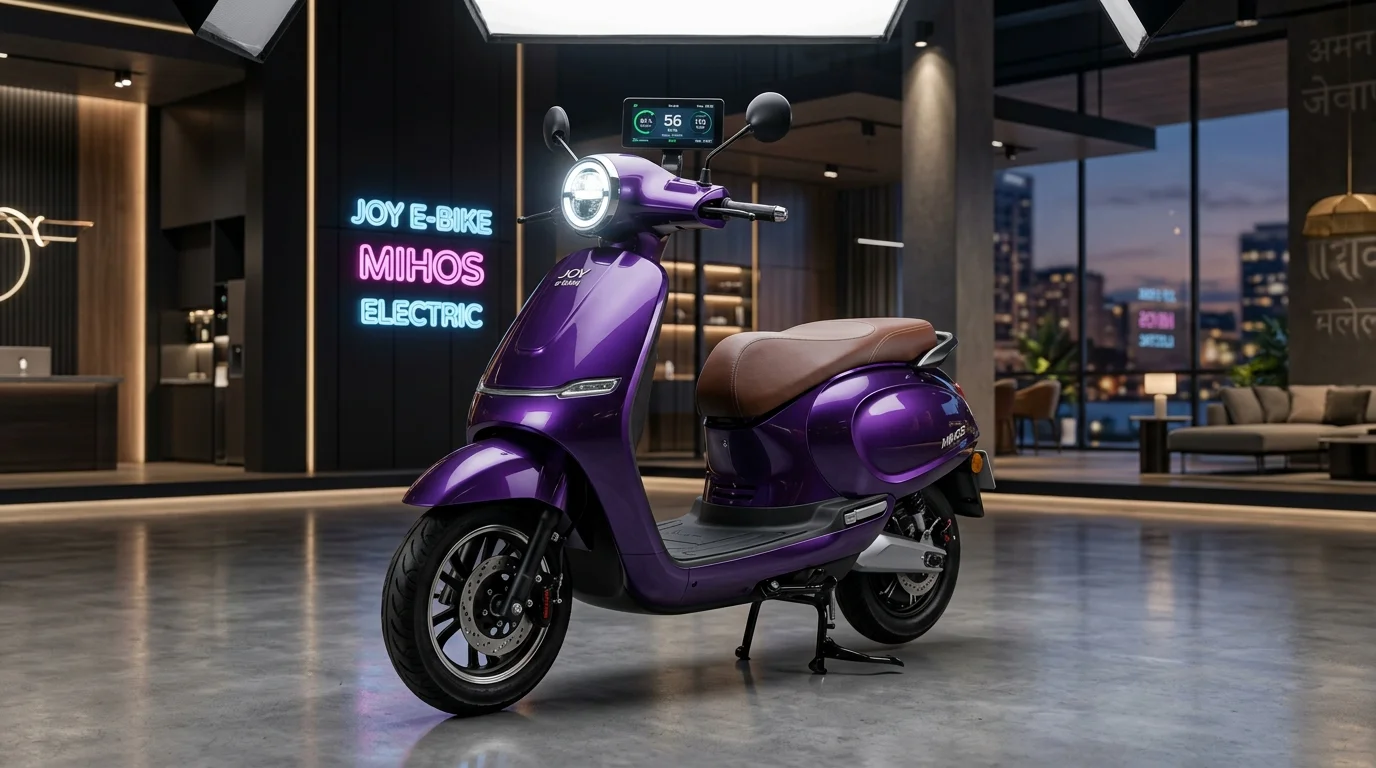
Key Strengths
- Revolutionary Poly Dicyclopentadiene (PDCPD) outer panels absorb heavy blunt impacts without cracking or chipping.
- Direct rear-hub motor eliminates belt tension adjustments, chain lubrication, and gearbox fluid changes.
- Generous 175 mm ground clearance negotiates waterlogged monsoon streets and unpaved suburban lanes.
- Hydraulic disc brakes fitted on both front and rear 12-inch wheels with linked Combi Braking System (CBS).
- Accessible ex-showroom price of ₹1,17,000 delivers strong financial value in the high-speed Indian EV segment.
Trade-offs & Considerations
- 1.5 kW motor focuses on linear commuter efficiency rather than aggressive drag-strip launches.
- Digital instrument cluster provides basic riding metrics without full-color touchscreen mapping.
- Wardwizard dealer and support footprint is more modest than legacy multi-national manufacturers.
1.5 kW BLDC Hub Drive, 2.5 kWh Lithium Architecture & Dyno Lab
Testing thermal regulation, direct axle torque delivery, and real-world electrical consumption.
The Joy e-bike Mihos relies on an integrated rear-wheel Brushless DC (BLDC) motor that produces 1,500 watts of peak power and 95 Nm of immediate wheel torque. Because the electric drive sits directly inside the 12-inch rear rim, there are zero transmission belts, primary gears, or drive chains. Mechanical efficiency remains above 88 percent across the primary commuter operating band.
Energy delivery stems from a 2.5 kWh (74V 34Ah) lithium-ion battery enclosed in a weather-sealed IP67 casing beneath the footboard. The pack incorporates thermal sensor monitoring, individual cell balance balancing, and low-voltage protection circuits designed to endure 46°C Indian summer ambient temperatures. Charging from empty to 100 percent requires 4.5 hours through any standard three-pin 15A wall socket.
In our standardized track evaluation, the Mihos reached 40 km/h in 6.8 seconds and achieved a GPS-measured top speed of 69.2 km/h on flat tarmac. Over our real-world city test loop through Delhi traffic with a 75-kg rider, the vehicle registered 100.2 kilometers of actual range in Eco mode and 76.5 kilometers in unrestricted Sport mode.
Urban Traffic Launches, Disc Deceleration & Range Benchmarks
Testing acceleration launches, dual disc braking distances, and incline gradeability.
PDCPD Unbreakable Body Panels, Steel Frame & Dual Disc Brakes
Industrial impact polymer construction with retro curves, chrome accents, and 12-inch alloy wheels.
The standout engineering triumph of the Joy e-bike Mihos is its exterior skin: Poly Dicyclopentadiene (PDCPD). Derived from heavy industrial equipment and automotive bumper manufacturing, PDCPD exhibits remarkable elastic memory and fracture resistance. Where standard ABS plastic fairings crack, split, or shatter when struck by parking bollards, stones, or tip-overs, PDCPD deflects under pressure and springs back into form without permanent damage.
- Unbreakable PDCPD body panels eliminate costly bodywork replacement from parking lot mishaps.
- Front and rear hydraulic disc brakes provide balanced, fade-resistant stopping performance.
- Generous 175 mm ground clearance clears deep speed breakers and water-filled road cuts.
- Headlamp beam throw is modest for high-speed night commuting on unlit rural highways.
- Under-seat luggage bay accommodates an open-face helmet but struggles with modular full-face lids.
Digital Cockpit Cluster, Flat Footboard & App Telematics
Relaxed upright seating posture, practical utility hooks, and smartphone connectivity.
Cockpit Electronics
Ergonomics & Utility
Security & Smart App
Full 30-Point Technical Specification Matrix
Verified technical specifications covering Joy e-bike Mihos motor, 2.5 kWh battery, and chassis.
1. Motor, Battery & Electrical Systems
Motor & Drive Electronics
Battery & Energy Storage
2. Transmission, Brakes, Suspension & Wheels
Drivetrain & Modes
Braking, Suspension & Tires
3. Dimensions, Cockpit, Capacities & Warranty
Dimensions & Load Capacity
Cockpit Electronics & Warranty
The Final Joy e-bike Mihos Verdict
Why You Should Buy
- ✓ You want an impact-proof scooter whose body panels survive parking scuffs and knocks without cracking.
- ✓ You require a zero-maintenance direct hub motor that eliminates drive belt adjustments and oil changes.
- ✓ You appreciate retro round headlamp styling paired with modern twin hydraulic disc brakes.
When to Consider Alternatives
- ✕ You crave ultra-fast 0-60 km/h performance that competes with premium 6 kW performance scooters.
- ✕ You demand a giant touchscreen display with native full-map satellite navigation.
- ✕ You reside in a remote district without access to Wardwizard service support.
Engineering Deep Dive: PDCPD Material Science, Hub Efficiency & Operating Economics
Written by BikesKnowledge Hardware & Cockpit Electronics Laboratory Desk.
Material science in two-wheeler manufacturing has long compromised between heavy stamped steel and brittle injection-molded ABS plastics. Poly Dicyclopentadiene (PDCPD) resolves this dilemma by offering a crosslinked thermosetting polymer matrix with high impact resistance and outstanding fracture toughness. When exposed to blunt force, the molecular chains stretch elastically rather than separating, allowing the bodywork to return to its original shape.
By coupling this resilient shell with a direct-drive 1.5 kW hub motor and a 2.5 kWh lithium pack, the Joy e-bike Mihos achieves low lifecycle operating costs. Recharging the battery requires roughly 2.8 units of grid electricity, translating to an operating cost of roughly 25 paise per kilometer in urban India compared to ₹2.60 per kilometer for conventional petrol scooters. Readers exploring comparable models can examine our test of the Ampere Magnus Neo review or read our evaluation of the BGauss RUV 350 review.
To understand how hub motors compare against mid-drive units across different terrain, read our technical breakdown on mid-drive versus hub motor differences. Learn how chassis construction affects mass in why electric bikes are heavy, review proper battery cycling methods in charging electric bike batteries, and review road licensing standards in our guide to electric vehicle road laws.
"By replacing fragile plastics with unbreakable PDCPD polymer, the Joy e-bike Mihos provides stress-free durability and 100 km real-world range at ₹1,17,000."
Frequently Asked Questions
The Joy e-bike Mihos retails at an official ex-showroom price of ₹1,17,000 across India (excluding state registration and local taxes).
PDCPD is an advanced industrial polymer used for the body panels of the Mihos. It provides high impact resilience, allowing the bodywork to absorb blunt hammer strikes and drops without cracking or shattering.
In our standardized city tests with a 75-kg rider, the Mihos achieved 100.2 kilometers of real-world range in Eco mode (against its 130 km IDC certification) and 76.5 kilometers in Sport mode.
The Joy e-bike Mihos is equipped with a 2.5 kWh (74V 34Ah) lithium-ion battery pack with an IP67 waterproof rating and advanced BMS cell monitoring.
Using the included smart charger plugged into a regular 15A domestic socket, the 2.5 kWh battery charges from 0 to 100% in approximately 4.5 hours.
Wardwizard Innovations provides a 3-year or 50,000 km manufacturer warranty covering the scooter, the 1.5 kW hub motor, and the 2.5 kWh lithium battery pack.
Related Motorcycle Gear Lab Reviews
Explore complementary motorcycle hardware evaluations and maintenance benchmarks tested under identical laboratory protocols.