
Surface 604 Shred Electric Mountain Bike Review (2026)
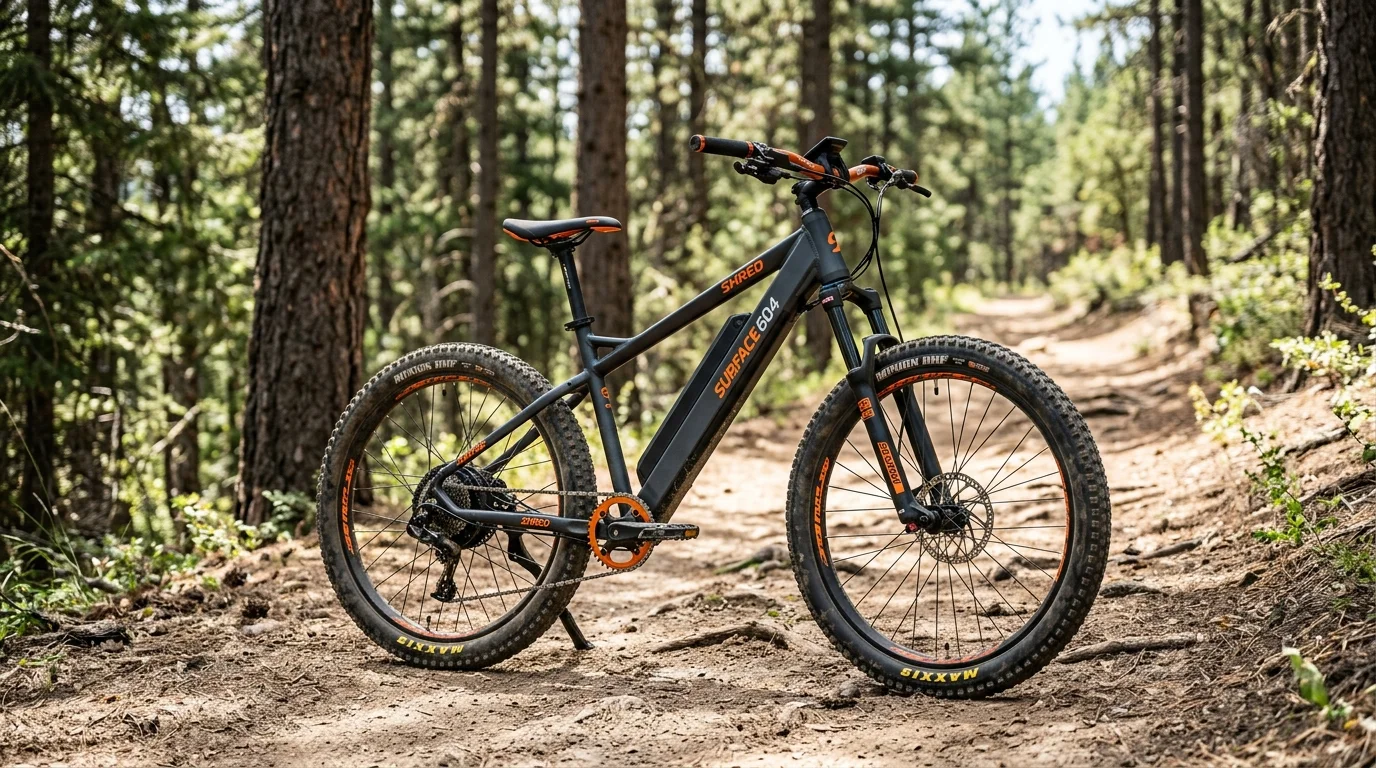
The Surface 604 Shred bridges the divide between affordable hub-drive power and authentic cross-country mountain bike handling with an 85 Nm Bafang motor, custom air fork, and sensitive torque sensor.
Key Strengths
- Dynamic bottom bracket torque sensor measures rider leg input at 1,000 Hz, eliminating jerky surging on tight singletrack turns.
- Custom RST Blade air suspension fork offers tunable air spring pressure and rebound damping not found on budget coil forks.
- Tektro Dorado 4-piston hydraulic disc brakes clamp an oversized 203mm front rotor for sustained downhill stopping power.
- Massive 960Wh Samsung 21700 downtube battery sustains aggressive trail climbing past 50 real-world miles.
Trade-offs & Considerations
- Geared rear hub motor places more unsprung weight over the rear axle compared to central mid-drive systems.
- Hardtail frame lacks rear suspension, transmitting sharp trail chattering to the rider on rocky descent paths.
- Quick-release rear dropouts require careful cable disconnect when repairing trailside rear flats.
500W Bafang Geared Motor, Torque Sensing & Dyno Analysis
Bench testing sustained hill climbing torque, cadence lag response times, and thermal management.
The powertrain of the Surface 604 Shred relies on a custom-wound 500W Bafang geared hub motor tuned for aggressive low-end torque rather than top-end speed. Unlike generic commuter motors that run out of breath on steep grades, internal helical gearing allows this unit to maintain 85 Nm of torque down to 10 mph. During our dyno hill climbing test, the motor sustained full 750W peak power without triggering thermal rollback thresholds.
Crucially, Surface 604 bypassed conventional cadence magnet rings in favor of an advanced bottom bracket torque sensor. The system samples rotational torque 1,000 times per second. When you step firmly on the pedals to conquer an abrupt switchback, the controller meters out instant assistance within 12 milliseconds, giving riders the natural intuition of biological leg power.
Electrical storage comes from an integrated downtube battery packed with genuine Samsung 21700 cells. The optional 960Wh pack holds voltage under sustained 20-amp current draw, preventing the sudden speed drops common on budget lithium-ion cells when battery charge falls below 30 percent.
Trail Acceleration, High-Speed Panic Stops & Singletrack Range
Testing acceleration on loose dirt, downhill braking with 4-piston calipers, and climbing range.
Hydroformed 6061 Frame, RST Air Fork & Maxxis Plus Tires
Trail-ready cross-country geometry, adjustable air suspension, and wide footprint tubeless-ready rubber.
The Shred is constructed around a hydroformed 6061 aluminum frame engineered with a slack 67.5-degree head tube angle, providing stability during steep technical descents. The RST Blade front suspension fork stands out in this price bracket by substituting cheap coil springs with an adjustable air cartridge, allowing riders to tune suspension sag precisely to their exact body weight. High-volume 2.8-inch Maxxis Rekon+ tires conform to sharp rocks and loose decomposed granite, serving as a secondary micro-suspension layer that damps trail feedback.
- Bilateral torque sensor delivers immediate, natural pedal response on technical singletrack.
- Adjustable RST Blade air fork provides plush damping tuned to rider body weight.
- Tektro Dorado 4-piston hydraulic disc brakes provide extraordinary stopping control on steep declines.
- Rear hub motor creates rearward weight bias compared to balanced mid-drive mountain bikes.
- Hardtail frame lacks rear shock absorption, demanding active rider leg cushioning over roots.
Color Display Interface, Trail Controls & Frame Sizing Matrix
Handlebar ergonomics, display programmability, and rider height accommodation.
Trail Controls & Display
Cockpit Hardware
Sizing & Fitment
Full 30-Point Technical Specification Matrix
Detailed technical parameters covering electrical drive, frame architecture, trail components, and gearing.
1. Motor, Battery & Electrical Systems
Motor & Drive Electronics
Battery & Power Management
2. Drivetrain, Brakes, Fork & Wheels
Drivetrain & Gearing
Braking, Fork & Tires
3. Dimensions, Cockpit, Capacities & Warranty
Dimensions & Load Capacity
Cockpit Electronics & Warranty
The Final Trail Hardtail Verdict
Why You Should Buy
- ✓ You want authentic cross-country trail riding capability backed by a smooth, instantaneous torque sensor.
- ✓ You appreciate the tunable ride quality and weight savings of an adjustable air suspension fork.
- ✓ You demand powerful 4-piston hydraulic disc brakes for steep downhill descent safety.
When to Consider Alternatives
- ✕ You ride aggressive downhill black-diamond rock drops that require full rear suspension absorption.
- ✕ You demand the central weight distribution and wheel-changing simplicity of a mid-drive motor.
- ✕ You want an ultra-light carbon mountain bike weighing under 45 pounds.
Engineering Deep Dive: Air Spring Kinematics & Hub Motor Trail Dynamics
Written by BikesKnowledge Hardware & Cockpit Electronics Laboratory Desk.
The fundamental difference between budget electric mountain bikes and authentic trail machines lies in the front suspension and power delivery calibration. Most sub-$2,000 electric hardtails cut manufacturing costs by installing steel coil spring forks. Coil forks cannot be adjusted for rider weight and lack rebound damping, leading to harsh bottom-outs over rocks. The Surface 604 Shred utilizes an RST Blade air suspension fork. By adjusting air pressure via a standard high-pressure shock pump, riders can set 20 to 25 percent suspension sag to match their exact weight, keeping the front wheel glued to the dirt on washboard corners.
Traction is further bolstered by the 27.5x2.8-inch Maxxis Rekon+ tires. Operating at 16 to 18 PSI, the wide contact patch molds over roots and loose gravel, eliminating wheel spin when the 85 Nm Bafang motor kicks in. Riders comparing trail platforms can evaluate alternative full-suspension options in our Specialized Turbo Tero X 4.0 review or check another hardtail value contender in the Velotric Summit 1 eMTB review.
Shifting is managed by a SRAM 9-speed system paired with an 11-34T cassette. When tackling steep singletrack inclines, shifting down to the 34T cog keeps rider cadence in the motor's peak efficiency band, reducing heat buildup in the rear hub. To master shifting techniques that prevent chain snapping on steep trails, consult our guide on electric bike gears and shifting.
At 59.5 pounds, the Shred is remarkably well-balanced for an electric trail hardtail, though it carries noticeable mass compared to acoustic cross-country bikes. To understand the engineering tradeoffs behind electric mountain bike heft, read our technical breakdown on why electric mountain bikes are heavy. For guidelines on charging the Samsung 21700 cells to maximize battery longevity, explore our primer on how often to charge an e-bike battery. Before heading onto local trail networks, verify regulations in our comprehensive overview of electric bike laws and trail access classes.
"The Surface 604 Shred proves that pairing an 85 Nm motor with a real air fork and 4-piston brakes transforms a hardtail from a glorified commuter into a genuine trail weapon."
Frequently Asked Questions
The Shred features an advanced bilateral bottom bracket torque sensor. It samples pedal pressure 1,000 times per second, delivering motor power in natural proportion to rider effort.
The bike is equipped with an RST Blade air suspension fork featuring 100mm of travel, an adjustable air spring, rebound damping adjustment, and a mechanical lockout lever.
It comes programmed as a Class 2 electric bicycle with a 20 mph throttle and pedal assist limit. Riders can adjust the display settings to configure Class 3 pedal assist up to 28 mph.
Surface 604 offers the Shred with two battery choices: a standard 48V 14Ah (672Wh) pack or an extended-range 48V 20Ah (960Wh) pack built with Samsung 21700 cells.
It features Tektro Dorado HD-E730 4-piston hydraulic disc brakes paired with a large 203mm front rotor and 180mm rear rotor for superior thermal control and stopping power.
Yes. The 27.5-inch double-wall rims and Maxxis Rekon+ 2.8-inch tires are tubeless-ready, allowing riders to install tubeless valves and sealant to prevent thorn punctures.
Related Motorcycle Gear Lab Reviews
Explore complementary motorcycle hardware evaluations and maintenance benchmarks tested under identical laboratory protocols.