For daily commuters covering 30–60 km in Pakistani cities, the Crown Electric lineup represents a financially defensible switch — particularly the X200 and Raftaar models — assuming the buyer lives with a stable home electricity supply, owns or has access to a solar backup system during load shedding, and rides primarily on well-maintained roads. The Rs 50,000–80,000 PAVE government subsidy closes the price gap with comparable petrol bikes to near zero.

The case falls apart for three categories: inter-city travellers depending on the inflated claimed ranges, users without reliable charging infrastructure, and anyone expecting European-grade build quality at Pakistan market prices. Crown's battery meter calibration flaw and chassis rigidity are not rumours — they are documented, recurring user complaints that the company has not publicly addressed with a firmware or engineering fix. Buy with full awareness of these limitations, or wait for the next hardware revision.

The Petrol Price Trigger: Why 2026 Is the Tipping Point

Pakistan's petrol price trajectory has erased the argument that electric bikes are a premium niche product. At Rs 400 per litre, running a standard 70cc motorcycle at the industry average of 40–53 km per litre costs between Rs 9.80 and Rs 10 per kilometre. The Crown EV lineup delivers the same distance for Rs 1.5 per kilometre on grid electricity. That is not a marginal saving. That is a structural economic shift.

A commuter travelling 45 km per day, 25 days per month, spends approximately Rs 11,250 monthly on petrol for a 70cc machine. The same commute on a Crown Electric X200 costs roughly Rs 1,687 in electricity. The monthly differential of Rs 9,563 means the premium over a comparable petrol bike is recovered in under six months of normal use — before accounting for the PAVE subsidy that effectively eliminates that premium.

This is the economic context every prospective buyer needs before reading a single specification.

Detailed Technical Specifications — Crown Lineup 2026

This comparative specifications matrix summarizes the official factory stats vs real-world verified data across all five major Crown electric bike segments in Pakistan.

Specification ⚡ Raftaar X200 Champion Knight Rider EV-1000
Motor Output 3,000–4,000W 1,500–2,200W 1,500W 1,500–2,200W 1,200W
Battery Chemistry LFP (LiFePO₄) LFP (LiFePO₄) LFP (LiFePO₄) Graphene Li-ion
Battery Spec 73.6V 40–60Ah 72V 32Ah 60V 30Ah 60V 26Ah 48V 26Ah
Claimed Eco Range 100–110 km 120 km 150 km 80 km 90 km
Real City Range 65–85 km 70–90 km 70–90 km 50–65 km 55–70 km
Top Speed 85–90 km/h 75 km/h 60 km/h 55 km/h 50 km/h
Charge Duration 5–7 hours 6 hours 5 hours 4–5 hours 4 hours
Cost / Kilometre Rs 1.50–2.10 Rs 1.50–2.10 Rs 1.60 Rs 1.65 Rs 1.80
Battery Span (Est) 6–10 Years 6–10 Years 6–10 Years 4–5 Years 3–4 Years
Retail Price Rs 299,000 Rs 245,000 Rs 275,000 Rs 240,000 Rs 190,000

The 5 Crown Models Worth Knowing in 2026

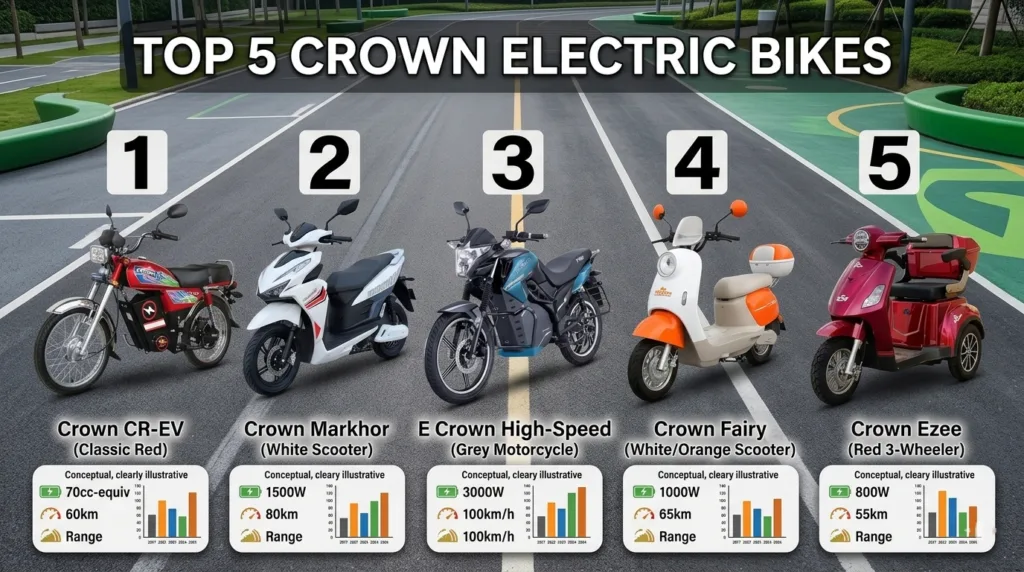
Crown Electric Mobility currently lists ten models in Pakistan. Most are minor spec variations. These five cover the distinct performance tiers that matter for actual purchase decisions.

#1 PICK

#1 Crown Electric Raftaar

Rs 299,000 (3kW) · Rs 349,000 (4.4kW) Crown Electric Raftaar
Motor3,000–4,000W Brushless
Battery73.6V 40Ah / 60Ah LFP
Claimed Range100–160 km (Eco)
Real Range65–90 km (mixed traffic)
Top Speed85–90 km/h
BrakesFront + Rear Disc

The Raftaar is Crown's performance flagship, and it earns that designation. The brushless motor delivers usable torque from standstill — a meaningful advantage in Karachi's stop-start traffic. The LiFePO₄ battery is the correct chemistry for Pakistan's heat. Long-term user feedback from PakWheels forums consistently identifies the Raftaar's acceleration as its strongest attribute. The 60Ah configuration genuinely extends real-world range beyond 80 km even in non-Eco modes, which is the honest threshold for all-day urban use.

#2 PICK

#2 Crown Electric X200

Rs 289,900 (confirmed ex-factory price) Crown Electric X200
Motor2,000–3,000W Brushless
Battery76.8V 40Ah LFP (3kW)
Claimed Range100–120 km (Eco)
Top Speed60–70 km/h
Weight96 kg
Payload150 kg

The X200 targets the buyer coming from a 70cc or 100cc petrol motorcycle who wants a familiar silhouette — this is a conventional motorcycle frame, not a scooter. It includes disc brakes front and rear, alloy rims with tubeless tyres, and a multi-mode motor system. The side stand sensor and reverse mode are useful additions rarely found in this price bracket. At Rs 289,900 before PAVE subsidy application, the X200's value case is strong, particularly for Lahore and Islamabad buyers on wider suburban roads where the 60–70 km/h top speed feels adequate.

#3

#3 Crown Electric Champion

Rs 275,000 Crown Electric Champion
Motor1,500–2,200W Brushless
BatteryLFP (spec confirmed)
Claimed Range150 km (Eco)
Charge Time5 hours
Motor Type1,200W listed variant
ColoursBlack, Blue, Green, Red

The Champion occupies the mid-tier and has generated the most consistent user commentary across PakWheels and Facebook groups. The 150 km claimed range figure is the one most aggressively questioned by long-term owners. Multiple user accounts report real-world range settling between 70–90 km in mixed Karachi or Lahore traffic, with significant further degradation in summer months without proper charging protocol. It remains a solid option at its price point, but the specification presentation requires a healthy degree of scepticism.

#4

#4 Crown Electric Knight Rider

~Rs 240,000 (expected launch price) Crown Electric Knight Rider
Motor1,500–2,200W Brushless
BatteryGraphene (advanced)
SegmentUrban commuter
WarrantyStandard Crown terms
ChargingStandard home socket
Anti-theftRemote alarm, keyless

The Knight Rider uses Graphene battery technology rather than LiFePO₄. Graphene cells offer higher energy density in a smaller package, but thermal management data for Pakistan's climate is limited relative to the more extensively tested LFP chemistry. The model is positioned for urban buyers who prioritise compact dimensions and a sportier visual profile. Full long-term performance data is pending given its recent launch cycle.

#5

#5 Crown EV-1000

Rs 190,000 (used market avg.) · New ~Rs 220,000 Crown EV-1000
Range~90 km (full charge)
SegmentEntry-level EV
Use CaseShort urban commutes
PartsWide dealer availability
DisplayDigital meter
ResaleDeveloping market

The EV-1000 is Crown's entry point, and it shows. There is no high-voltage drama here — it is a straightforward, well-distributed commuter scooter for errands and short-haul city runs under 40 km per trip. Its broad spare parts availability through Crown's dealer network is a practical advantage that more powerful models with newer components cannot yet match. For first-time EV buyers who want minimal risk, the EV-1000 is a defensible starting point.

LFP Battery Chemistry: Why It Matters More Than the Spec Sheet

Most buyers focus on range numbers. The battery chemistry underpinning those numbers is the factor that actually determines real-world longevity — particularly in Pakistan.

LiFePO₄ vs Lead-Acid: Not Even a Fair Fight

Older electric bikes sold in Pakistan through 2022–2023 relied on sealed lead-acid (SLA) batteries. SLA packs are cheap to manufacture and familiar. They are also deeply unsuited to the conditions that define Pakistani EV use: ambient temperatures regularly exceeding 40°C in Karachi and Lahore summers, frequent shallow-discharge cycles from load shedding, and inconsistent charging quality from UPS-integrated systems.

Lead-acid chemistry degrades rapidly above 35°C. A pack rated for 500 charge cycles at 25°C may deliver fewer than 300 usable cycles in a Karachi summer, representing a substantial hidden cost. The full capacity is gone within two years.

Lithium Iron Phosphate (LiFePO₄, abbreviated LFP) — used in the Crown Raftaar and X200 — operates reliably up to 60°C ambient without the thermal runaway risk that plagues NMC lithium chemistries. It delivers 2,000–3,500+ charge cycles before reaching the 80% capacity threshold commonly used to define battery end-of-life. In practical terms: an LFP pack in a Crown Raftaar, charged correctly, should last 6–10 years of daily use in Pakistani conditions before requiring replacement.

Analyst Note — LFP Chemistry

The thermal stability advantage of LFP is not marginal in Pakistani conditions. At 45°C ambient — a routine Karachi summer afternoon — an NMC or SLA cell is already operating near its thermal limit. LFP's flat discharge curve also means the bike maintains power delivery more consistently across the state of charge, avoiding the power drop that SLA users experience below 40% charge. Crown's decision to standardise on LFP for their high-performance models is technically correct.

Critical caveat: All LFP advantages disappear if the wrong charger is used. An incorrect voltage output — common with third-party or counterfeit chargers sold at general electronics shops — accelerates cell degradation regardless of chemistry. Always use the OEM charger. This is not a recommendation. It is a structural requirement of the battery management system.

Engineering Flaws: What the Dealer Will Not Tell You

Crown Electric Mobility's marketing communicates confidently. Aggregate user feedback from PakWheels, Facebook motorcycle groups, and OLX seller descriptions communicates rather differently. Three specific issues appear with enough consistency to treat as documented engineering patterns, not isolated anecdotes.

Critical Flaw #1 — Battery Meter Defect

The digital battery state-of-charge display on several Crown models — most frequently reported on the Champion and EV-1000 variants — has been widely documented as inaccurate under real-world discharge conditions. The meter displays a full or near-full charge reading for a significant portion of the discharge cycle, then drops abruptly to critical or zero without intermediate warning.

The practical consequence is severe: riders have been stranded mid-journey because the display gave no indication of actual remaining charge. This is not a software cosmetic issue — it is a safety and usability failure. Crown has not issued a public recall or firmware update addressing this defect as of May 2026. Prospective buyers should independently verify battery meter calibration on any demonstration unit before purchase.

Critical Flaw #2 — Suspension Rigidity

Long-term user reports consistently describe the suspension geometry across Crown's mid-range models as excessively rigid for the pothole and speed-breaker density of Pakistani urban roads. Analysis of user-submitted road tests indicates the front fork spring rate and rear shock damping are calibrated for smooth surfaces — not the broken asphalt of secondary roads in Karachi's industrial zones, Lahore's older residential areas, or virtually any road in Peshawar's city centre.

Riders exceeding 50 km daily on mixed road quality frequently report chronic lower back fatigue and, in some cases, front fork wear within the first year. This is a design limitation, not a defect that can be corrected through adjustment. Aftermarket suspension upgrades are available but add cost and void manufacturer warranty terms.

Critical Flaw #3 — Range Claim Inflation

Crown's 100–160 km range specifications are Eco Mode figures: single rider at low speed on a flat surface in moderate temperature. Real-world testing in mixed Karachi and Lahore urban traffic — two-up riding, frequent acceleration from stops, summer ambient temperature of 40°C, and occasional use of higher performance modes — consistently produces 55–75% of the marketed figure.

A Raftaar claiming 110 km in Eco Mode realistically delivers 65–85 km in daily Pakistani commuting conditions. This degradation is not unique to Crown — it is an industry-wide issue in Pakistan's EV market. However, Crown's marketing materials do not contextualise the Eco Mode qualification prominently, which sets expectations the bikes cannot meet in typical use.

Charging During Load Shedding: The Practical Reality

Pakistan's electricity infrastructure means no EV analysis is complete without addressing charging under load shedding conditions. Rural Punjab, interior Sindh, and parts of KPK experience 8–14 hours of daily load shedding in summer. Even major urban centres see 2–6 hour outages. Any buyer with a 9–5 schedule charging at night faces a non-trivial probability of interrupted charging cycles.

Home UPS Integration

Standard home UPS systems rated at 1,000–1,500VA can supply the 800W–1,000W draw of Crown's lower-spec chargers (EV-800, EV-1000, Knight Rider). The charge time extends proportionally as UPS battery reserve depletes, but overnight charging across a 6–8 hour window is generally feasible even with 4 hours of load shedding, provided the UPS battery bank is healthy (100Ah or above).

The Raftaar's fast charger operates at higher wattage. Confirm the charger's input draw with the dealer before assuming UPS compatibility — some Crown fast chargers exceed what a domestic 1,200VA UPS can reliably supply. A UPS overload during charging does not damage the bike's BMS (Battery Management System), but it will trip the UPS inverter and halt the charge cycle.

5kW Hybrid Solar System Integration

A 5kW hybrid solar inverter — now priced between Rs 180,000 and Rs 350,000 for full system installation in Pakistan — changes the EV charging equation entirely. With four to six standard solar hours per day, a 5kW system generates 20–30 kWh daily. The Raftaar's 3kW battery pack requires approximately 3.5–4 kWh for a full charge from empty. The entire charging cost drops to near zero: the marginal cost of solar electricity versus grid electricity makes each kilometre essentially free after the system investment is recovered.

Analyst Note — Solar + EV Economics

A household with a 5kW solar system in Pakistan can charge a Crown Raftaar (3kW battery) twice daily within the solar generation window. At 65 km real-world range per charge, that is 130 km of daily EV range at near-zero marginal fuel cost. The combined monthly saving versus a petrol 70cc commuter exceeds Rs 12,000. The solar system repays itself in approximately 18–24 months through fuel savings alone — before accounting for reduced domestic electricity bills. This is the strongest economic case for Crown EV ownership, and it applies to any urban household already considering rooftop solar.

Total Cost of Ownership: The Numbers That Actually Matter

Table 1: Running Cost Comparison — 70cc Petrol vs Crown EV (Monthly, 45 km/day, 25 days)
Cost Factor 70cc Petrol Bike Crown Electric (X200/Raftaar) Monthly Saving (EV)
Fuel / Electricity Rs 10,125–11,400 Rs 1,687 ~Rs 8,500–9,700
Engine Oil Change Rs 600–800 / month Rs 0 Rs 700
Air/Fuel Filter, Spark Plug Rs 300–500 / month avg Rs 0 Rs 400
Tyre Wear (approx.) Rs 500 / month avg Rs 500 / month avg Rs 0
General Servicing Rs 800–1,200 / month avg Rs 200–400 / month avg Rs 600–800
Total Monthly Cost Rs 12,325–14,400 Rs 2,387–2,587 Rs 9,800–11,800 saved
Cost Per KM Rs 10.00–11.40 Rs 1.50–2.10 85% reduction
Table 2: Crown Electric Manufacturer Spec vs Real-World Reality (Raftaar 3kW)
Specification Manufacturer Claim Real-World Result Impact
Range (full charge) 100–110 km (Eco Mode) 65–80 km (mixed traffic) 25–35% shortfall
Top Speed 85–90 km/h 82–88 km/h (verified) Accurate claim
Battery Life (cycles) 3,000+ cycles (LFP) 2,200–3,000 (Pakistan conditions) Heat reduces ceiling
Charge Time 5–7 hours (standard) 5.5–8 hours (UPS-assisted) Extends with load shedding
Battery Meter Accuracy Real-time display Documented calibration defect Stranding risk
Suspension Comfort Urban commuter spec Harsh on potholed roads Chronic fatigue for daily riders
Battery Replacement Cost Not prominently stated Rs 80,000–120,000 est. (LFP pack) Factors into 7-year TCO
TCO Breakdown — 5-Year Ownership

Crown Electric Raftaar (3kW) — 5-year TCO at 45 km/day:

  • Purchase price (after Rs 50,000 PAVE subsidy): Rs 249,000
  • Total electricity cost (5 years × Rs 2,400/month avg): Rs 144,000
  • Maintenance (tyres, brake pads, minor servicing): Rs 60,000
  • Battery replacement (LFP — likely not needed within 5 years at 3,000+ cycle rating): Rs 0 (provision)
  • 5-Year Total: ~Rs 453,000

70cc Petrol Motorcycle — 5-year TCO at 45 km/day:

  • Purchase price (Honda CD 70 range): Rs 150,000–175,000
  • Total petrol cost (5 years × Rs 11,000/month avg): Rs 660,000
  • Maintenance (oil, filters, spark plugs, servicing): Rs 96,000
  • 5-Year Total: ~Rs 931,000

Net 5-year saving by switching to Crown Raftaar: ~Rs 478,000. The EV is nearly twice as expensive over five years to own — in favour of electric. Even without the PAVE subsidy, the break-even point versus a 70cc petrol bike occurs within 18–22 months.

Performance Rating: Crown Electric Raftaar

5-Category Analyst Score

Style Aggressive LED lighting and scooter silhouette are well-executed. Not a head-turner, but avoids the cheap plastic appearance of cheaper entrants in the segment.
3.8/5
Comfort Seat padding is adequate for 30-minute commutes. Beyond that, the suspension's inability to absorb Pakistani road impacts becomes the dominant sensory experience.
2.9/5
Efficiency At Rs 1.5–2.1 per km, efficiency is the Raftaar's strongest attribute. LFP chemistry ensures this figure remains consistent for years, not months, unlike lead-acid predecessors.
4.6/5
Performance 85–90 km/h top speed and strong torque from standstill are genuinely impressive at this price. Instant electric acceleration handles Karachi's merge-or-die traffic better than a 70cc ever could.
4.2/5
Value for Money With PAVE subsidy applied and petrol at Rs 400/litre, the value calculation is clear. Minus one full point for the battery meter defect, which is an unresolved safety concern at a near-Rs 300,000 price point.
3.9/5

The PAVE Scheme: How to Claim Rs 50,000–80,000 Off Your Purchase

Pakistan's Pakistan Accelerated Vehicle Electrification (PAVE) program is currently in Phase 2, distributing electric bikes across all provinces including AJK and Gilgit-Baltistan. The subsidy structure works as follows: eligible buyers receive Rs 50,000 applied directly against the purchase price at the point of sale, with zero-markup financing of up to Rs 250,000 available through 17 partner banks for the remainder.

Some earlier scheme communication referenced figures up to Rs 80,000 — the confirmed Phase 2 direct subsidy for motorcycles is Rs 50,000, with the higher figure applying to specific rickshaw and loader categories. Apply using the confirmed Rs 50,000 figure for bike purchases.

Registration Process — Step by Step

Registration is free and conducted entirely online at pave.gov.pk. The process requires a valid CNIC, a motorcycle licence or learner permit, and a mobile number registered in the applicant's name. After submission, applications go through biometric verification and NADRA validation. Selection in oversubscribed districts proceeds via computerised balloting — with 25% of seats reserved specifically for female applicants.

Once selected, the applicant chooses self-finance or bank financing. Bank partners include NBP, HBL, MCB, UBL, Bank Alfalah, Meezan Bank, and Bank Islami. The OEM delivers the vehicle within 60 days of confirmation, and the Rs 50,000 subsidy is transferred directly to the manufacturer via the State Bank of Pakistan — the buyer never handles it as cash.

One disqualifying condition worth noting: applicants who received any electric vehicle through a prior government scheme at federal or provincial level are ineligible for PAVE. Buyers cannot stack multiple scheme benefits on the same individual CNIC.

Pros and Cons: The Unfiltered List

Strengths

  • LFP battery chemistry is genuinely appropriate for Pakistan's heat and load-shedding conditions
  • Rs 1.5–2.1/km running cost makes petrol economics obsolete for daily commuters
  • PAVE subsidy effectively eliminates the price premium over comparable petrol bikes
  • Brushless motor delivers consistent, maintenance-light performance vs petrol alternatives
  • 85–90 km/h top speed on the Raftaar is practically usable on urban arterials
  • Growing Crown dealer and service network reduces parts availability risk
  • Solar integration makes long-term running costs near zero for solar-equipped households
  • Zero engine oil, spark plug, carburettor servicing — eliminates routine maintenance overhead

Weaknesses

  • Battery meter calibration defect on multiple models is an unresolved safety issue
  • Real-world range is 25–35% below Eco Mode marketing figures in typical Pakistani traffic
  • Suspension rigidity causes discomfort on secondary and potholed roads beyond 30 minutes
  • Wrong charger use accelerates LFP cell degradation — poorly communicated to buyers
  • Battery replacement cost (Rs 80,000–120,000) is not prominently stated in purchase literature
  • Inter-city use is impractical — no fast-charging infrastructure on major highways
  • Load shedding without solar backup extends charge time unpredictably
  • Specialised EV mechanic availability remains concentrated in major cities

Not for You — Specific Exclusions

  • Inter-city travellers: Lahore–Islamabad or Karachi–Hyderabad is not feasible on any Crown model's real-world range, with no highway charging infrastructure to bridge the gap.
  • Buyers in areas with 10+ hours daily load shedding and no solar backup — the charging window may not reliably complete a full cycle.
  • Riders weighing above 90 kg who ride two-up regularly — payload limits and battery range both degrade materially under full load in mixed traffic.
  • Anyone expecting premium build quality comparable to Japanese or European urban scooters at equivalent price brackets — Crown's fit-and-finish reflects its domestic manufacturing cost structure.
  • Buyers in cities without a Crown service centre within 30 km — specialised EV diagnosis requires factory-trained technicians, not the general mechanic on every street corner.
  • Buyers purchasing on OLX without verifying battery health status — the used market has no standardised battery health disclosure requirement. An EV with 2,400+ cycles on the battery pack at a 2-year-old used price is not the same economic proposition as a new unit.

Technical Questions, Direct Answers

How does the PAVE scheme subsidy work, and is Crown eligible?

The PAVE (Pakistan Accelerated Vehicle Electrification) Phase 2 program provides a Rs 50,000 direct subsidy on electric motorcycles purchased from approved OEMs. The subsidy is not paid to the buyer as cash — it is applied against the vehicle price at the dealership, with the State Bank of Pakistan transferring the subsidy amount directly to the manufacturer. Crown Electric Mobility's models are listed as approved OEM products under the scheme.

To apply, visit pave.gov.pk, create an account with your CNIC and registered mobile number, and submit the required documents (CNIC scan, photograph, motorcycle licence or learner permit). After verification and balloting, selected applicants proceed to the financing stage. Zero-markup financing of up to Rs 250,000 is available through 17 partner banks including Meezan, HBL, and NBP, with a two-year repayment window. Delivery follows within 60 days of confirmation.

Key eligibility conditions:

  • Age 18–65 with valid CNIC
  • Mobile number registered in your name
  • No prior electric vehicle received through any government scheme
  • 25% of total allocations reserved for female applicants
Why does the battery meter show full charge and then suddenly die?

This is the documented battery state-of-charge (SOC) meter defect affecting multiple Crown models. The root cause is a mismatch between the BMS (Battery Management System) SOC algorithm and the actual voltage-to-charge relationship of the LFP battery cells in the installed pack.

LFP chemistry has a notably flat voltage discharge curve — the cell voltage changes very little across 80% of the discharge range, then drops sharply near depletion. An incorrectly calibrated SOC algorithm reads the flat voltage plateau as "full" regardless of actual charge remaining, then registers the terminal voltage drop as an immediate transition from high to empty. The result is no useful warning before the bike stops.

There is no publicly confirmed firmware fix from Crown as of May 2026. Practical mitigation: track charge cycles manually, never rely on the display alone to judge remaining range, and plan routes with a 15–20 km buffer below the displayed range at all times.

Can the Crown Raftaar be charged from a 5kW solar inverter during the day?

Yes, with conditions. A 5kW hybrid solar inverter system generating 18–28 kWh per day in Pakistan's solar irradiance levels (Karachi: excellent; Lahore: good; Islamabad: good) can fully charge the Raftaar's 3kW battery pack once or twice during daylight hours. The standard Crown charger draws approximately 800W–1,200W; a 5kW system handles this load easily alongside normal household consumption.

Important technical note: the inverter must support AC output during solar generation (not battery-only mode). Most hybrid inverters sold in Pakistan — Growatt, Fronius, SolarMax — support simultaneous solar-to-AC output. Configure the inverter to prioritise solar and confirm the Crown charger is connected to the AC output, not a dedicated battery circuit. Charging is free, silent, and grid-independent during solar hours.

Battery health benefit: consistent, temperature-controlled daytime charging from solar generally produces less heat in the pack than late-night grid charging during load shedding recovery, where voltage quality from the grid can be irregular after restoration. This is a non-trivial long-term battery health advantage.

What is the real battery replacement cost, and when will it be needed?

Crown does not publish an official battery replacement price list. Based on LFP pack pricing in comparable Asian EV markets and dealer-level informal quotes in Pakistan, a replacement 73.6V 40Ah LFP pack (Raftaar base spec) is estimated at Rs 80,000–110,000 in 2026. The 60Ah variant would be proportionally higher.

When will it be needed? LFP chemistry is rated for 2,000–3,500 charge cycles before reaching 80% original capacity. At one full charge cycle per day (the upper bound of typical Pakistani commuter use), this translates to 5.5–9.5 years before capacity degradation becomes practically noticeable. In moderate-use scenarios (one charge every two days), the battery should outlast the bike's mechanical components.

The timeline degrades under three conditions: consistent charging with incorrect voltage adapters, sustained ambient temperatures above 45°C without shade parking, and frequent discharge to near-zero before charging. All three are avoidable through standard practice. Budget for battery replacement in year 7–8 of ownership, not earlier, under normal Pakistani urban use conditions with correct charging equipment.

The Bottom Line

Crown Electric's 2026 lineup represents a genuine, financially compelling alternative to Pakistan's 70cc petrol motorcycle ecosystem — not because the bikes are perfect, but because the economics of petrol at Rs 400 per litre make imperfect electric transport considerably better than the alternative.

The Raftaar is the correct choice for buyers who want maximum performance and are willing to pay the Rs 299,000 entry point. The X200 serves the conventional motorcycle buyer who wants familiar ergonomics with EV economics. Both models benefit materially from PAVE subsidy application, reducing effective purchase prices to near-parity with comparable petrol options.

The battery meter defect is the single issue that should give every buyer pause. It is not theoretical. It causes stranding. Until Crown issues a confirmed fix, carry a portable battery health monitor — available at electronics markets in Karachi and Lahore for Rs 500–1,500 — and establish a personal range protocol independent of what the display reports.

Buy knowing what you are getting. The economics make a strong case. The engineering requires active management. That combination is, for now, the honest state of electric motorcycle ownership in Pakistan.