
Crown EV Bike Price in Pakistan 2026: From Champion to Markhor
Pakistan’s electric two-wheeler market is projected to grow by 35% through 2027, and Crown Electric sits at the center of that surge. This is a complete, data-driven breakdown of every major model — what the spec sheet says, what long-term owners report, and whether the price tags hold up under scrutiny.
The Crown EV Markhor at PKR 380,000 is the most performance-oriented electric motorcycle Crown currently sells in Pakistan. Its 3,000W brushless motor, 72V/40Ah LiFePO4 battery, and CBS braking system make it a technically sound machine for the price. The LiFePO4 chemistry is the right call — it survives 3,000 to 5,000 charge cycles without the fire risk associated with standard lithium-ion cells, and Pakistan’s variable grid quality makes that thermal stability genuinely valuable.
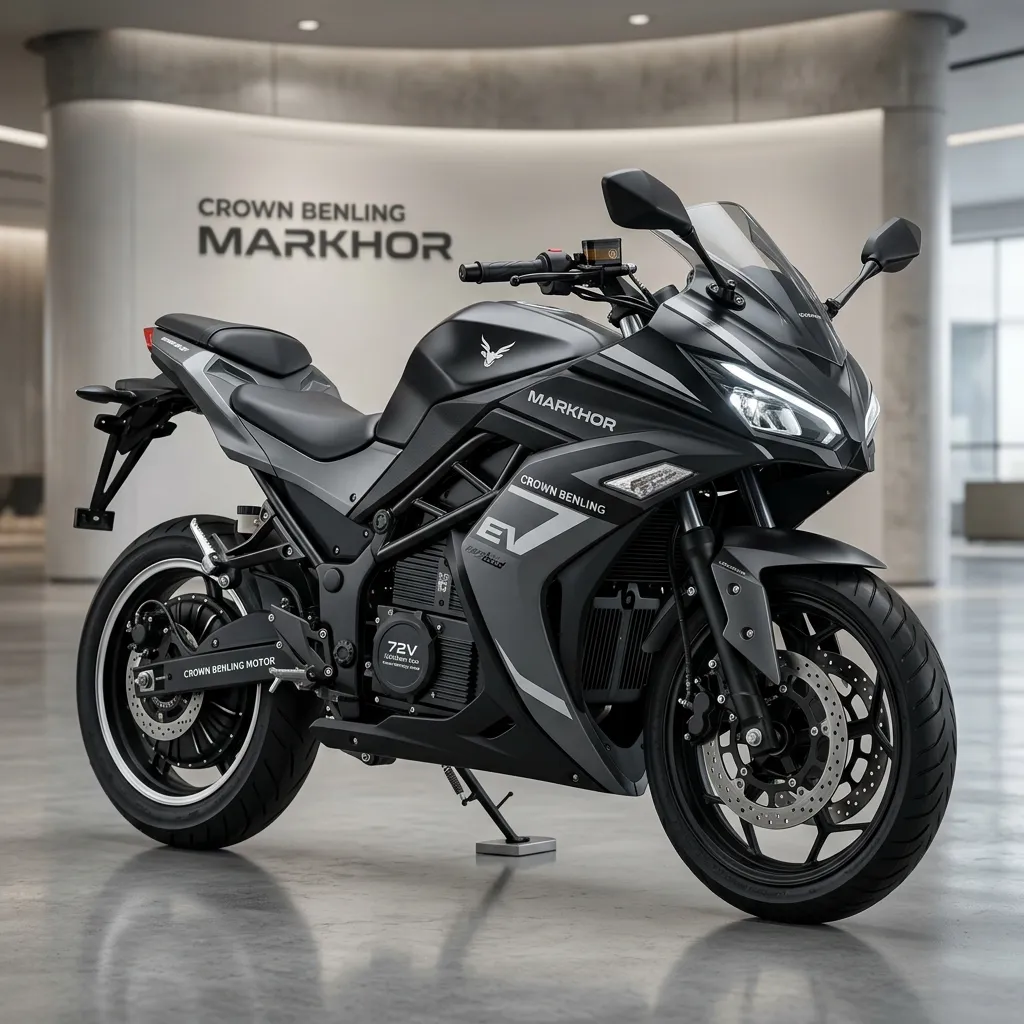
However, the Markhor demands a 100% upfront payment and carries a two-month wait time — and the after-sales service infrastructure outside Karachi, Lahore, and Islamabad remains thin. The Champion at PKR 285,000 makes more financial sense for the average urban commuter covering 30 to 50 km daily. You give up top-speed bragging rights, but you keep your money and your sanity. If you own a petrol bike as a backup, the Markhor becomes an exciting primary option. If it will be your only vehicle, start with the Champion and move up once the service network matures.
Complete Crown EV Lineup Prices in Pakistan 2026
Crown Electric currently offers five primary models in its Performance Series. All of them run on LiFePO4 batteries, which sets the brand apart from many competitors still shipping lead-acid packs at similar price points. Here is where every model lands.
Notice that the Cherry and Markhor share the same price and the same battery, but the Cherry prioritizes range over top speed, making it the better daily commuter between the two flagship models. The Markhor is built for riders who want the highest speed number on the spec sheet.
Crown EV Markhor: Spec Sheet vs. Real-World Reality
A spec sheet is a manufacturer’s best-case scenario. Real-world numbers come from riders navigating Lahore’s signal stops, Karachi’s heat, and Islamabad’s hilly sectors. This table documents both, so you know exactly what you are paying for.
| Specification | Claimed Spec | Real-World Reality | Verdict |
|---|---|---|---|
| Range (single rider) | 90-100 km | 75-85 km | Acceptable — typical EV gap |
| Range (two riders, city) | Not specified | 55-65 km | Concerning for family use |
| Top Speed | 90-100 km/h | 88-95 km/h verified | Matches claims closely |
| Charging Time | 4-5 hours | 4.5-5 hours typical | Accurate |
| Battery Lifespan | 3,000-5,000 cycles | Consistent with LiFePO4 data | Scientifically verified chemistry |
| Motor Noise | Brushless = quiet | Minimal road noise confirmed | Genuine advantage over petrol |
| Braking System | CBS front and rear | Effective but feels soft at 90 km/h | Adequate, not confidence-inspiring |
| Suspension | Standard telescopic | Struggles on broken urban roads | Weak point for Pakistani roads |
| Build Quality (plastics) | Not specified | Mid-grade finish, flex on panels | Below expectation at PKR 380k |
| Monthly running cost | PKR 900-1,200 | PKR 950-1,300 confirmed | Massive saving vs petrol |
Why the LiFePO4 Battery Is the Markhor’s Strongest Argument
LiFePO4 chemistry (Lithium Iron Phosphate) is chemically incapable of the thermal runaway that has caused fires in standard lithium-ion packs. For a country where bikes sit in direct summer heat reaching 45°C and many parking areas lack shade, this is not a marketing claim — it is a genuine engineering advantage. Crown standardizing their entire Performance Series on LiFePO4 is the right decision, and buyers should weight this heavily when comparing against competitors using cheaper lead-acid or standard Li-ion cells.
The Crown Markhor and Champion both carry the 72V to 73.6V / 40Ah LiFePO4 battery. That pack stores roughly 2.88 kWh of energy. At PKR 900 to 1,200 per month in electricity costs versus PKR 5,000 to 6,000 for a petrol bike covering the same distance, the economics are difficult to argue against. An average commuter switching from petrol to the Champion recovers the price difference in approximately 4 to 5 years purely in fuel savings.
The 3,000 to 5,000 charge cycle lifespan of a LiFePO4 cell also means the battery outlasts the bike in most commuter use cases. Charging once daily adds up to roughly 365 cycles per year, putting the battery’s usable life at 8 to 13 years before meaningful capacity degradation. That is not a spec you find on most competitors in this price range.
Crown Champion at PKR 285,000: The Smarter Buy for Most Riders
The Champion runs a 1,500W to 2,200W brushless motor on a 73.6V/40Ah LiFePO4 pack. Top speed sits at 60 to 70 km/h, and the claimed eco-mode range stretches to 100 to 120 km. That range number is higher than the Markhor’s because the Champion’s lower motor output draws less current per kilometer.
For the daily commuter in Karachi, Lahore, or Multan covering 30 to 50 km, 60 to 70 km/h is sufficient for all urban roads without becoming a liability on expressways. Consistent owner reports indicate that the Champion handles stop-start city traffic well, with regenerative braking contributing meaningfully to battery recovery in heavy congestion.
The Champion’s 60 to 70 km/h top speed creates a real safety hazard on fast ring roads and GT road stretches where minimum traffic speeds exceed 80 km/h. If your daily commute includes any high-speed corridor, the Markhor or Raftaar is not an upgrade — it is a safety requirement. Do not buy the Champion for mixed city-highway use.
Crown EV Markhor: Honest Pros and Cons
What Works
- LiFePO4 battery is genuinely safer, longer-lasting, and heat-resistant than lead-acid competitors
- 3,000W brushless motor delivers strong acceleration from 0 to 60 km/h for urban riding
- CBS front and rear braking system adds meaningful safety over drum-only setups
- Monthly running costs of PKR 950 to 1,300 represent over 80% savings versus petrol
- Angular LED headlights provide strong night visibility — a real safety improvement
- Five color options give buyers personalization at no extra cost
What Hurts
- PKR 380,000 upfront with zero installment option is a hard barrier for middle-income buyers
- Two-month delivery wait means you cannot buy it on impulse for an urgent commuting need
- Suspension calibration underperforms on broken roads — pothole impacts are felt sharply
- Plastic panel quality feels mid-grade relative to the price point
- Two-up range drops to roughly 55 to 65 km — limits utility for family households
- Service centers remain concentrated in major cities; rural buyers face long support distances
This Bike Is Not For You If…
- You need your only vehicle available immediately — the two-month wait makes it impractical for urgent replacement needs
- You commute beyond 80 km daily — even under ideal conditions, you would need a mid-day charge
- Your commute includes any expressway or motorway section above 100 km/h where a 90 km/h bike creates real risk
- You live more than 50 km from a Crown service center and expect warranty work or parts support
- You carry two passengers regularly — two-up range drops below 65 km, which may not cover your round trip
- You want installment financing — Crown currently requires full payment upfront with no EMI structure for the Markhor
Where Crown EV Sits Against Pakistan’s Electric Bike Market
At PKR 380,000, the Markhor competes with Jolta Electric’s JE 70 Pro, Road Prince Storm series, and several Chinese-assembled scooters entering the market in 2025 and 2026. Most competitors at this price still ship lead-acid or standard Li-ion batteries — Crown’s LiFePO4 standardization is the clearest differentiator.
However, Jolta’s dealer network is significantly more developed nationwide, and some competitors offer installment plans through bank financing. Crown’s pricing strategy treats the Markhor as a premium device, but the after-sales infrastructure has not caught up to that premium positioning yet. Buyers outside the three major cities are essentially beta testers for the service network.
The Raftaar at PKR 309,900 may be the actual sweet spot in Crown’s lineup for performance buyers. Its 3,000W to 4,000W motor range and 85 to 90 km/h top speed get you within 5 km/h of the Markhor’s top end for PKR 70,000 less. That gap narrows the Markhor’s value proposition significantly unless the specific styling or feature set matters to you.
Frequently Asked Questions
What is the price of the Crown EV Markhor in Pakistan in 2026?
What is the real-world range of the Crown Markhor on a single charge?
Is the Crown Champion worth buying over the Markhor for daily city commuting?
How long does it take to fully charge the Crown EV Markhor and Champion?
Final Recommendation: Which Crown EV to Buy in 2026
The Crown EV lineup in 2026 offers something genuinely valuable to Pakistani commuters: a manufacturer standardizing on LiFePO4 chemistry across all models rather than upselling it as a premium option. That decision alone separates Crown from most of its domestic competition.
Buy the Champion (PKR 285,000) if your daily commute stays under 50 km and you stay within city roads. It delivers 80% of the Markhor’s capability at 75% of the price, and its eco-mode range of 100 to 120 km means most riders never approach the limit.
Buy the Markhor (PKR 380,000) if you need speeds above 80 km/h, you have a petrol backup for range-anxiety scenarios, and you live within reasonable distance of a Crown service center. You are paying a premium for motor power and styling, and those are legitimate reasons as long as you go in with clear eyes about the delivery wait and service network gaps.
Consider the Raftaar (PKR 309,900) before finalizing your Markhor decision. It offers comparable performance at a meaningfully lower price and may represent the best value in the entire Crown lineup right now.
