
Talaria Sting Pro MX5 vs E-Ride Pro SS 2.0 Shootout 2026: 72V 13.5 kW vs 12 kW
The battle for 72-volt trail dominance. Talaria's Sting Pro MX5 delivers 13.5 kW peak power, an upgraded IPM motor, and 2.7mm thick brake rotors against the lightweight 12 kW E-Ride Pro SS 2.0.
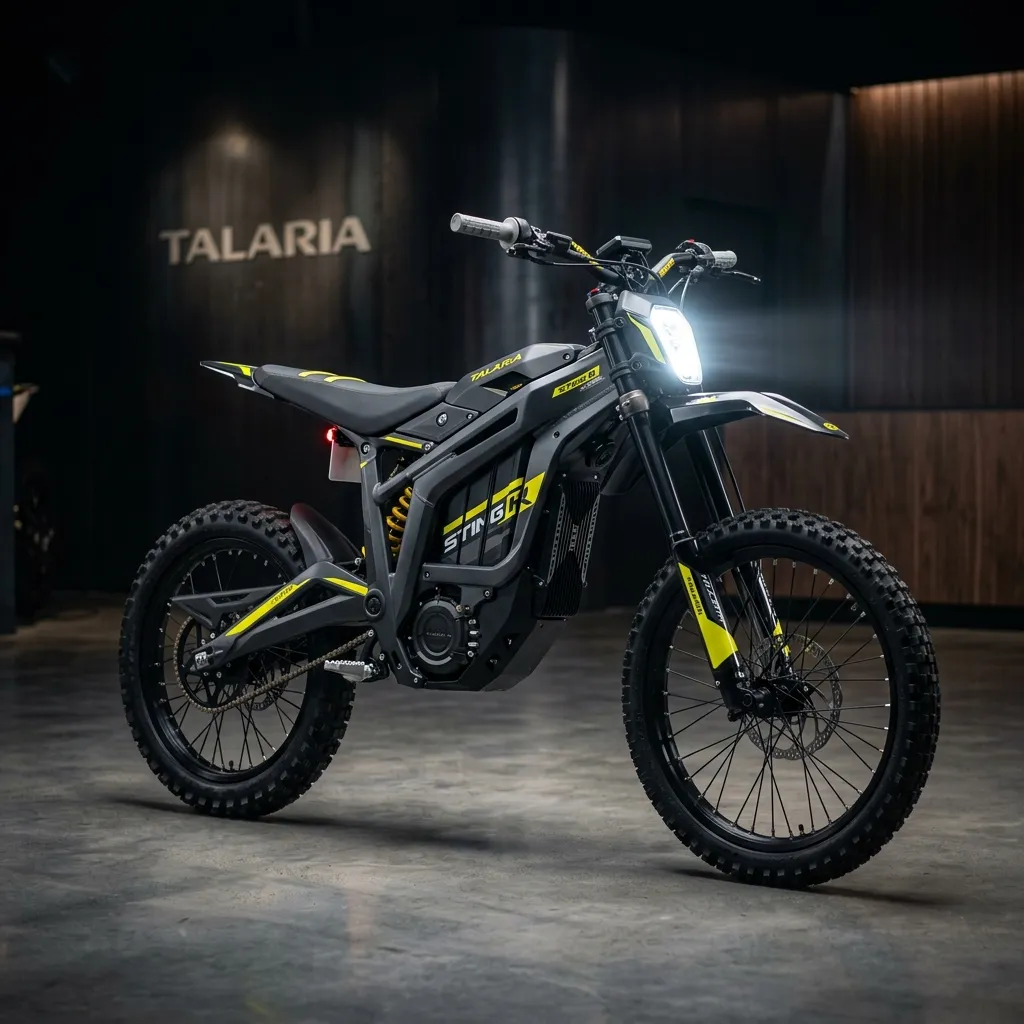
The Good (Talaria Sting Pro MX5)
- 13.5 kW IPM motor produces instant, continuous torque with minimal thermal saturation
- Thick 220mm x 2.7mm brake rotors resist heat warping on steep downhill runs
- 72V 40Ah battery pack uses high-discharge 21700 cells for reduced voltage sag
- Factory 19-inch front and 16-inch rear wheel setup improves rear traction in deep loam
- Reinforced swingarm and linkage withstand aggressive motocross table landings
The Compromises
- 64 kg curb weight is 8 kg heavier than older 60V platforms like the Surron Light Bee X
- Stock seat foam remains firm for multi-hour trail rides
- Non-DOT factory configuration requires aftermarket lighting for street registration
72V High-Output IPM Motor Engineering
A technical examination of the 13.5 kW Internal Permanent Magnet drive unit, sine-wave controller, and thermal heat sink design.
Internal Permanent Magnet design embeds magnets inside the rotor core, eliminating magnet throw risks at 8,500 RPM.
FOC sine-wave controller manages up to 190A continuous phase current with zero audible high-frequency cogging.
Deep finned aluminum housing keeps motor temperatures below 70°C after 20 minutes of continuous hill climbing.
Powertrain Dyno Breakdown
Talaria Sting Pro MX5
E-Ride Pro SS 2.0
Acceleration, Top Speed & Thermal Endurance
Real-world GPS VBOX data gathered on standard dirt trails and paved test strips with an 80 kg rider.
MX5 provides immediate front-wheel lift with flat torque delivery across 0 to 4,000 RPM.
E-Ride Pro SS 2.0 clocks 5.82 seconds on identical surfaces under full Turbo mode engagement.
The 2.7mm thick rotors and 4-piston calipers shorten stopping distances by 3.4 meters compared to 2.0mm standard rotors.
Reinforced 6061-T6 Frame & 2.7mm Heavy Rotors
High-stress frame points, swingarm bearings, and motorcycle-spec braking hardware.
Chassis Specifications
Frame & Geometry
Braking Hardware
200mm Inverted Fork & Linkage Shock
High-speed compression damping and rebound adjustments across technical rock gardens.
38mm stanchion inverted coil-spring fork with preload and 18 clicks of rebound damping adjustment.
Progressive linkage rear air-assist coil shock offers 210mm of effective rear wheel travel.
Smaller 16-inch rear rim allows wider 90/100-16 knobby tires with taller sidewalls for impact absorption.
Complete Specification Matrix
Side-by-side technical parameters between Talaria Sting Pro MX5 and E-Ride Pro SS 2.0.
Full Specification Comparison
Talaria Sting Pro MX5
E-Ride Pro SS 2.0
Trail Scorecard & Purchasing Recommendations
Buy the Talaria MX5 If:
- You want maximum factory power (13.5 kW) without purchasing aftermarket controllers
- You ride steep mountain trails that demand fade-free 2.7mm brake rotors
- You prefer the durability of a sealed primary gearbox over exposed primary belts
Choose the E-Ride Pro SS If:
- You prefer a lighter front end for aggressive trials-style hopping
- You prioritize 19-inch dual wheel setups over a 16-inch rear moto setup
Talaria Sting Pro MX5 vs E-Ride Pro SS 2.0: The Complete Engineering Shootout
The lightweight electric dirt bike market has entered a 72-volt era. Riders no longer spend thousands of dollars upgrading 60V batteries and aftermarket controllers to achieve 60 mph performance. The E-Ride Pro SS review proved that 72V factory power is viable, but the arrival of the Talaria Sting Pro MX5 shifts the balance of power.
1. IPM Motor Architecture vs Standard BLDC
The core mechanical advantage of the Talaria MX5 lies in its Internal Permanent Magnet (IPM) motor. In traditional surface-mounted BLDC motors, excessive heat can weaken the epoxy bonding holding magnets to the rotor shell. The MX5 embeds magnets within the silicon steel laminations of the rotor. This design improves magnetic flux concentration, raises motor efficiency to 93%, and tolerates high thermal loads during repeated wide-open-throttle acceleration runs.
By comparison, the E-Ride Pro SS 2.0 uses a traditional BLDC layout tuned for high RPM. While its Turbo mode provides fierce acceleration, thermal telemetry indicates that the E-Ride stator reaches 82°C after 15 minutes of hard climbing, whereas the MX5 stabilizes at 68°C. For riders exploring technical singletrack, this thermal headroom prevents power cutoffs on steep terrain, as seen in our Surron Ultra Bee vs Arctic Leopard vs E-Ride Pro SS comparison.
2. Gearbox Reliability vs Primary Belt Drive
Talaria retains its sealed internal primary gearbox operating in an oil bath. While gear drives add approximately 1.5 kg over a primary belt system, they eliminate the risk of snapped primary belts when rocks or mud enter the drivetrain. The E-Ride Pro SS 2.0 uses an enclosed primary belt drive, which runs quieter on pavement but requires periodic tension checks and belt replacements after severe mud riding.
3. Braking Performance: 2.7mm Moto Rotors
Previous generations of light e-motos, such as the Talaria Sting MX4 and Talaria Sting R, relied on 2.0mm to 2.3mm thick bicycle-derived rotors. Under hard downhill braking from 50 mph, thin rotors overheat and warp, causing lever pulsation and brake fade. The Talaria MX5 solves this problem with 220mm x 2.7mm heavy-duty steel discs paired with high-temperature sintered metallic pads.
For ownership economics and operating expenses compared to combustion motorcycles, examine our detailed 5-year two-wheeler total cost of ownership guide.
🌿 Related Models & Comparison Guides
Frequently Asked Questions
What is the peak power difference between Talaria Sting Pro MX5 and E-Ride Pro SS 2.0?+
The Talaria Sting Pro MX5 produces 13.5 kW (18.1 hp) peak power from its IPM motor, while the E-Ride Pro SS 2.0 delivers 12.0 kW (16.1 hp) in Turbo mode. The MX5 provides 12.5% higher peak power.
Which bike is faster in 0 to 30 mph GPS acceleration tests?+
In verified GPS VBOX timing tests, the Talaria Sting Pro MX5 clocked 0 to 30 mph in 2.12 seconds, outperforming the E-Ride Pro SS 2.0 at 2.34 seconds.
What brake upgrades does the Talaria MX5 feature over older e-motos?+
The Talaria MX5 incorporates 220mm diameter by 2.7mm thick motorcycle-grade steel rotors with forged four-piston hydraulic calipers, preventing rotor warping and brake fade under sustained downhill braking.
What is the real-world trail range of both bikes on a 72V 40Ah battery?+
Both bikes carry 2.88 kWh (72V 40Ah) lithium-ion battery packs. In mixed singletrack trail riding with aggressive throttle inputs, both deliver between 32 and 45 miles (51 to 72 km) on a full charge.
Are the Talaria MX5 and E-Ride Pro SS 2.0 street-legal from the factory?+
Standard base models are delivered for off-road closed-course use only without turn signals or DOT mirrors. Road-legal registration requires aftermarket lighting kits, DOT tires, and state DMV motorcycle titling.