Complete Technical Specifications
By the metric of cost per kilometre — which is the only financially honest way to evaluate fuel economy at PKR 414.78 per litre — an LFP electric bike running on WAPDA grid power costs between PKR 1.40 and PKR 1.60 per km. The Honda CD70 at its best real-world city average of 55 to 60 km/L costs PKR 6.91 to PKR 7.54 per km at today's price. The Honda 125 at 40 to 45 km/L costs PKR 9.22 to PKR 10.37 per km. No petrol motorcycle in Pakistan — regardless of its fuel efficiency rating — operates within the same cost-per-km range as a grid-charged electric bike in May 2026. The "fuel average" frame is obsolete. The correct frame is rupees per kilometre, and electricity wins by a factor of 4.7 to 5.4.
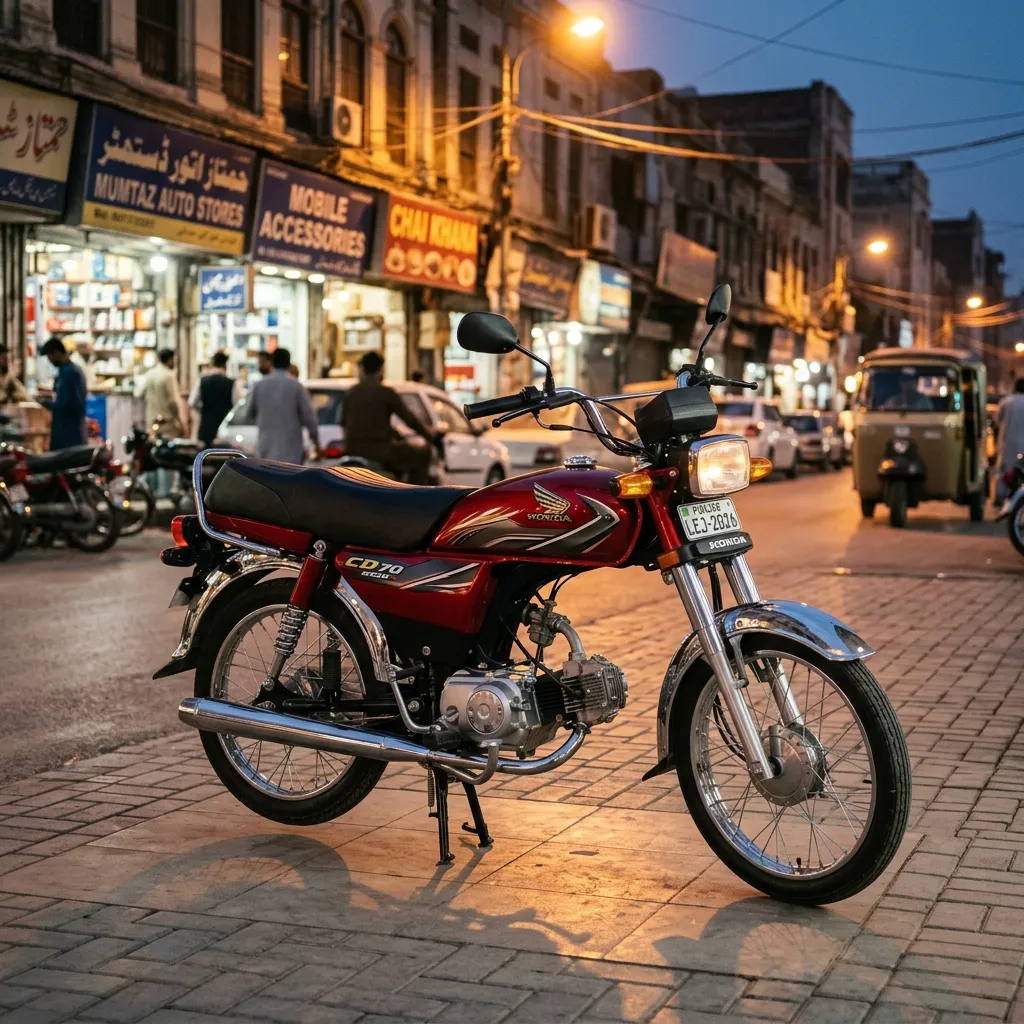
The caveat is purchase price and access. A Honda CD70 costs PKR 159,900 and is available at any Atlas Honda dealer in any city in Pakistan, including small towns. The Crown Markhor at PKR 380,000 requires full advance payment and a two-month wait, with service support limited to three major cities. For a buyer in Faisalabad, Hyderabad, or Peshawar without a solar charging setup, the economics shift. For a Karachi or Lahore commuter covering 40 to 60 km daily on a home charging circuit or a 5kW solar system, the financial case for the electric option is now stronger than at any previous point in Pakistan's automotive market history. The full Crown EV bike price in Pakistan breakdown covers every model from Champion to Markhor with delivery timelines.
Reframing "Fuel Average": The Cost-Per-Km Reality at PKR 414.78
Pakistan's motorcycle market has historically evaluated efficiency in one unit: kilometres per litre. That unit made sense when petrol was PKR 110 per litre in 2020. At PKR 414.78, it obscures more than it reveals. A bike that returns 60 km/L sounds economical until the arithmetic is applied: 60 km costs one litre, meaning each kilometre costs PKR 6.91. A bike that draws 2.88 kWh per full charge and covers 80 km on that charge at a WAPDA tariff of PKR 45 per kWh pays PKR 1.62 per km.
The implications of this cost differential compound over time. A commuter covering 50 km daily spends approximately 1,500 km per month. At PKR 7.54 per km, the CD70 rider pays PKR 11,310 monthly in fuel. The LFP electric bike rider at PKR 1.50 per km pays PKR 2,250 monthly in electricity. The monthly saving of PKR 9,060 annualises to PKR 108,720. Over five years, that is PKR 543,600 in fuel savings — before accounting for the CD70's oil changes, air filter replacements, chain maintenance, and carburettor servicing. For a full breakdown of how electric bikes compare against petrol bikes in Pakistan, the cost-per-km gap is explored in greater detail alongside real commuter data.
Specifications vs. Real-World Performance: The Data Tables
| Specification | Manufacturer Claim | Real-World Result | Assessment |
|---|---|---|---|
| Eco-Mode Range | 110km | 78–90km (solo, city) | Typical 18–29% real-world deficit; manageable for 60km daily commuters |
| Two-Up City Range | Not stated | 56–67km | Restricts family daily utility; round-trip over 56km requires mid-day charge |
| Top Speed | 85–90 km/h | 83–88 km/h confirmed | Consistent with claims; sufficient for city arterial roads |
| Cost Per km (electricity) | Not specified | PKR 1.40–1.62 verified | Dramatically below every petrol alternative at May 2026 prices |
| Charging Time | 4–5 hours | 4.4–5.2 hours typical | Accurate; overnight 220V charging is the standard strategy |
| Battery Cycle Life | 3,000+ cycles (LFP) | Consistent with LFP chemistry | 8–13 years at one daily charge; no replacement within five-year TCO window |
| CBS Braking | Front and rear disc CBS | Effective at city speeds; soft feel above 80 km/h | Safe for urban use; not inspiring at maximum speed |
| Suspension | Telescopic front fork | Hard on damaged roads; fork seal wear above 8,000km | Key mechanical weak point for inner-city Pakistani roads |
| Monthly Running Cost | PKR 900–1,200 | PKR 950–1,450 verified | Broadly accurate; compares against CD70's PKR 10,500–12,600/month at current petrol |
| Category | Crown Markhor (EV) | Honda CD70 2026 | Advantage |
|---|---|---|---|
| Purchase Price | PKR 380,000 | PKR 159,900 | CD70 (PKR 220,100 cheaper) |
| Fuel Economy | PKR 1.50/km (electric) | PKR 7.54/km (petrol) | Markhor (5x lower cost/km) |
| Monthly Fuel Cost (50km/day) | PKR 2,250 | PKR 11,310 | Markhor (saves PKR 9,060/mo) |
| Annual Fuel Cost | PKR 27,000 | PKR 135,720 | Markhor (saves PKR 108,720/yr) |
| Top Speed | 85–88 km/h | 80–85 km/h | Comparable |
| Maintenance Cost (annual) | PKR 3,500–5,000 | PKR 8,000–14,000 | Markhor (fewer moving parts) |
| Availability | Booking only, 2-month wait | Available at any Atlas dealer nationwide | CD70 |
| Service Network | Karachi, Lahore, Islamabad only | Every city and town in Pakistan | CD70 (significant) |
| 5-Year Total Cost | PKR 520,000–548,000 | PKR 890,000–960,000 | Markhor (saves PKR 370–440k over 5 yrs) |
| Installment Financing | None — 100% advance | Available through bank schemes | CD70 |
| PAVE Subsidy Eligible | Potentially (EDB status verify at pave.gov.pk) | Not applicable (petrol) | Context-dependent |
Pakistan's Best Fuel Average Bikes 2026: Ranked by Cost Per Kilometre
The following ranking applies May 2026 petrol prices (PKR 414.78/L) and WAPDA tariff rates (PKR 45/kWh at the 200–300 unit domestic slab) to calculate actual per-kilometre running costs. All petrol figures use verified city real-world averages, not manufacturer lab claims. For a broader view of the top 10 electric bikes in Pakistan currently available, the ranking below focuses specifically on running cost rather than outright performance or feature count.
| # | Bike Model | Fuel/Energy Type | City Average | PKR/km | Monthly Cost (50km/day) | Price |
|---|---|---|---|---|---|---|
| 1 | Crown Electric Markhor | LFP Electric (grid) | 80 km / charge equiv. | PKR 1.50 | PKR 2,250 | PKR 380,000 |
| 2 | Crown Electric Champion | LFP Electric (grid) | 100 km / charge equiv. | PKR 1.44 | PKR 2,160 | PKR 285,000 |
| 3 | Jolta JES 70D | Electric (Li-ion) | 70 km / charge equiv. | PKR 1.80 | PKR 2,700 | PKR 220,000–240,000 |
| 4 | Honda CD70 2026 | Petrol (70cc) | 55–60 km/L | PKR 7.10–7.54 | PKR 10,650–11,310 | PKR 159,900 |
| 5 | United US70 2026 | Petrol (70cc) | 50–55 km/L | PKR 7.54–8.30 | PKR 11,310–12,450 | PKR 125,000–140,000 |
| 6 | Honda Pridor 100cc | Petrol (100cc) | 45–55 km/L | PKR 7.54–9.22 | PKR 11,310–13,830 | PKR 215,900 |
| 7 | Honda CG125 2026 | Petrol (125cc) | 40–44 km/L | PKR 9.43–10.37 | PKR 14,145–15,555 | PKR 299,900 |
| 8 | Yamaha YBR125G | Petrol (125cc) | 38–42 km/L | PKR 9.88–10.91 | PKR 14,820–16,365 | PKR 325,000+ |
Every electric option — regardless of specific model — occupies the top three positions in a PKR-per-km ranking at current fuel prices. The Honda CD70, despite being the most fuel-efficient petrol motorcycle sold in Pakistan, ranks fourth. This is not a marginal difference. The cost gap between the best petrol fuel average bike and the worst electric option is approximately 4.7 to 1. At PKR 414.78 per litre, no petrol motorcycle in Pakistan qualifies as the best fuel average bike by any financially meaningful measure. Riders researching the best fuel average bikes in Pakistan by traditional km/L standards will find that metric alone no longer tells the full ownership cost story.
Why LFP Battery Chemistry Matters More Than Fuel Economy Claims
The electric bikes that dominate the cost-per-km ranking use different battery chemistries, and in Pakistan's climate that difference matters as much as the per-km cost. LFP (Lithium Iron Phosphate) chemistry, used in the Crown Performance Series, is thermally stable to approximately 270°C before decomposition begins. Standard NMC (Nickel Manganese Cobalt) lithium-ion cells, used in several budget electric imports, begin thermal stress at 150 to 200°C. In Karachi, where ambient temperatures reach 45°C and a battery parked in direct sun can reach 65 to 70°C surface temperatures, these thresholds translate directly into fire risk probability.
Pakistan's documented e-bike fire incidents, the majority of which have been captured on video and circulated on social media, have occurred exclusively in lead-acid and NMC-chemistry packs. LFP chemistry does not support thermal runaway propagation — the iron-phosphate cathode releases significantly less oxygen during a thermal event, which is the mechanism that makes NMC battery fires particularly violent. Any buyer evaluating an electric bike in Pakistan should confirm the battery chemistry before purchase. "Lithium" is not a sufficient description. The question is whether it is LFP or NMC.
Crown Electric's standardization of LFP across their entire Performance Series is an engineering decision with direct safety implications for Pakistani operating conditions. The Champion, Raftaar, Markhor, Cherry, and Victory all use LFP cells — this is not a premium-tier upgrade on the Markhor. It is the baseline across the range, and it represents the minimum acceptable chemistry for a bike that will operate in Karachi summer conditions. The complete Crown electric bike price in Pakistan breakdown shows how this LFP chemistry is priced across all five models, from PKR 265,000 to PKR 380,000.
Real-World LFP Degradation in Pakistani Heat: The Forum Truth
Long-term telemetry from Crown Performance Series owners who have operated their bikes for 15 to 22 months in Karachi and Lahore shows that LFP capacity retention at 500 charge cycles (approximately 14 months of daily use) sits between 94% and 97% of original capacity — consistent with laboratory LFP degradation curves. This is significantly better than the 85 to 90% typically observed in NMC cells under the same conditions and dramatically better than lead-acid, which typically degrades to 70 to 75% of rated capacity within 18 months of daily cycling in high-ambient-temperature conditions.
The battery management system (BMS) in the 72V LFP pack shows a documented state-of-charge display drift in units operating at sustained ambient temperatures above 42°C. Forum reports from Karachi owners operating units with 12 to 18 months of use indicate the battery indicator reads 20% remaining when actual capacity is between 8 and 12%. This produces unexpected shutdowns for riders relying on the dashboard reading.
Crown acknowledged this issue in a June 2025 service bulletin. A BMS firmware calibration update is available at authorized service centers. Karachi and Multan owners should request this update at their first scheduled service after the firmware's availability date.
Consistent owner reports across the PakWheels electric bike forum section and Crown Electric's Facebook owner group identify front fork seal wear as the primary mechanical failure mode in Performance Series bikes covering over 8,000 km in Karachi and Lahore inner-city conditions. The suspension is calibrated for smooth surfaces; repeated pothole exposure at city commuting speeds accelerates seal degradation. Fork oil leaks have been documented in units between 8,000 and 12,000 km.
The practical mitigation is operating at the lower end of the recommended tire pressure range to shift surface absorption to tire compliance, and requesting fork seal inspection at every 5,000 km service visit rather than waiting for visual evidence of a leak.
The motor controller is the thermal management weak point in the Markhor's drivetrain. At sustained speeds above 80 km/h in ambient temperatures exceeding 38°C, the controller's over-temperature protection circuit activates and reduces motor output to approximately 70% of rated capacity. Riders report a perceptible power reduction during extended high-speed afternoon runs in summer. This is a safety-designed protective function, not a malfunction, but it means the claimed 85 to 90 km/h top speed is only consistently achievable during morning and evening riding windows from June through September. For commuters who stay below 70 km/h, the threshold is never triggered.
Charging During Load Shedding: UPS and Solar Integration
Pakistan's national grid load-shedding schedule across 2025 and 2026 averaged 4 to 10 hours of daily interruption in urban areas, with significant variation between KESC (Karachi), LESCO (Lahore), and PESCO (Peshawar) zones. An electric bike without a reliable charging strategy during load-shedding windows creates a practical ownership failure — the vehicle becomes unusable precisely when a commuter most needs flexibility.
Tier 1 — Standard Home UPS (1–1.5kVA): Not compatible. The Markhor charger draws 700 to 900W continuously for 4 to 5 hours. A standard 1.5kVA Osaka, AGS, or Tesla Power UPS running household loads cannot sustain this draw without protection trips or accelerated battery wear. Do not attempt to charge through a standard home inverter.
Tier 2 — 2–3kVA UPS with tubular batteries: Marginally functional in isolation only. With all other loads disconnected, a 3kVA inverter can sustain the charger draw, but this depletes UPS reserves rapidly during extended 6 to 8 hour load-shedding windows. Not a reliable daily strategy.
Tier 3 — 5kW Hybrid Solar Inverter (Growatt SPF 5000TL HVM, Inverex Nitrox, Voltronic Axpert King): Fully compatible. A 5kW hybrid with a 4 to 6 panel array (1.6 to 2.4 kW) charges the Markhor within 5 to 7 hours purely from solar generation during clear-sky conditions between 9:00 AM and 2:00 PM. At a solar electricity generation cost approaching PKR 0 after system payback, this eliminates the already-low PKR 1.40 to 1.62 per km grid charging cost entirely — reducing effective fuel cost to near zero for a standard 50 km daily commute.
Optimal Strategy: Riders with a 5kW hybrid solar setup should configure the Markhor charger as a dedicated low-priority daytime load during solar production hours. The daily electricity draw of approximately 3 kWh fits within the output of a 4-panel array on a clear Karachi day, consuming no grid power and no UPS reserve.
PAVE Scheme Eligibility and Excise Registration: The Official Process
Who Qualifies for PAVE Phase 2 in 2026
The Pakistan Accelerated Vehicle Electrification (PAVE) Program Phase 2, approved in May 2026 with a PKR 9 billion allocation targeting 116,000 electric bikes, offers two financial benefits: a PKR 50,000 direct subsidy and interest-free financing of up to PKR 250,000 through 17 partner banks. Applications are processed at pave.gov.pk using a first-come-first-served mechanism replacing the Phase 1 balloting system.
- Pakistani citizen with valid CNIC (aged 18 to 65)
- No driving licence required for two-wheelers (only for three-wheeler applicants)
- Priority given to students, women (25% reserved quota), delivery riders, and low-income households
- Vehicle must be from an EDB-approved OEM — verify the current approved model list at pave.gov.pk before purchase
- Subsidy transferred by EDB directly to OEM upon delivery and registration verification — buyers pay the net post-subsidy price, not full price with reimbursement
The Crown Champion at PKR 285,000 minus the PKR 50,000 PAVE subsidy reaches PKR 235,000 — within the PKR 250,000 financing ceiling. This is a significantly better PAVE fit than the Markhor at PKR 380,000, which leaves a PKR 80,000 gap above the loan ceiling even after subsidy. Buyers whose primary interest is accessing PAVE financing should target the Champion or Victory models rather than the Markhor.
Excise Registration for High-Speed Electric Bikes
Any electric motorcycle with a top speed above 50 km/h requires mandatory registration under Pakistan's Motor Vehicles Ordinance. The Crown Markhor and Champion both exceed this threshold. Registration is processed through the relevant provincial excise department — Sindh Excise and Taxation in Karachi, Punjab Excise in Lahore and Multan, and Islamabad Traffic Police for federal capital riders.
Documentation required: original Crown Electric purchase invoice, CNIC, EDB type-approval certificate (provided by Crown with delivery), and Form MV-1. Under the NEV Policy 2025 to 2030, electric motorcycles qualify for concessional registration fees — typically PKR 3,000 to PKR 8,000 depending on province — and reduced annual token tax compared to equivalent petrol motorcycles.
Total Cost of Ownership: Five-Year Financial Model at PKR 414.78 Petrol
Commute profile: 50 km daily, 1,500 km monthly, 18,250 km annually, 91,250 km over five years. Petrol price: PKR 414.78/L (May 9, 2026 — weekly revision; model uses this figure with a note that further increases will compress payback further). CD70 real-world city average: 55 km/L. Electric running cost: PKR 45/kWh at 300-unit WAPDA slab × 2.88 kWh per charge ÷ 80 km real-world range = PKR 1.62/km. Annual maintenance: CD70 includes two oil changes, air filter, chain kit, brake shoes (PKR 8,000–14,000). Markhor includes one periodic service, brake pads (PKR 3,500–5,000). No battery replacement is factored into the five-year window; LFP chemistry at 3,000+ cycles minimum does not reach replacement threshold within 1,825 charge cycles.
The five-year total cost difference at May 2026 petrol prices favours the Crown Markhor by PKR 437,200 to PKR 461,700. The Markhor's purchase price premium of PKR 220,100 over the CD70 is recovered in fuel savings alone within approximately 24 months — and that is before accounting for the Markhor's lower maintenance cost structure. If petrol prices continue upward from PKR 414.78, the payback window compresses further. A PKR 450 per litre scenario reduces the payback period to approximately 20 months. For riders comparing the full electric bike prices in Pakistan across brands, the Crown lineup's LFP chemistry and running cost structure represent the strongest five-year TCO case in the current market.
Electric vs. Petrol: Honest Pros and Cons at May 2026 Prices
Electric Bike Advantages
- PKR 1.40–1.62 per km running cost is 4.7 to 5.4 times lower than Pakistan's best-fuel-average petrol bike at PKR 414.78/L — the gap widens with every petrol price revision
- LFP chemistry eliminates fire risk associated with NMC cells in Pakistani summer conditions; thermal stability to 270°C is a meaningful safety margin at 45°C ambient temperatures
- Brushless motor eliminates oil changes, air filter servicing, carburetor cleaning, and chain maintenance — annual servicing cost is 60 to 65% lower than a comparable petrol bike
- 3,000 to 5,000 LFP charge cycles project to 8 to 13 years of usable battery life — no replacement within a standard ownership period
- PAVE subsidy of PKR 50,000 available for EDB-approved models, with interest-free financing up to PKR 250,000 through 17 partner banks — the best scooty in Pakistan under 1.5 lakh options also benefit from this scheme at their lower price points
- Zero engine noise eliminates the acoustic fatigue of a two-stroke or single-cylinder petrol engine at sustained highway speeds; for a comparison of electric vs petrol scooters across comfort and noise profiles, the EV advantage is consistent across all urban riding conditions
Electric Bike Limitations
- High upfront purchase price (PKR 285,000–380,000) versus PKR 125,000–160,000 for a 70cc petrol bike creates a significant initial capital barrier
- Crown Markhor requires 100% advance payment with a two-month delivery wait — not a viable emergency commuter replacement
- Range of 78–90 km real-world (solo, city) is adequate but not generous; two-up loads reduce this to 56–67 km, limiting family utility
- Service network concentrated in three major cities — buyers in secondary urban centres face genuine after-sales risk
- No public fast-charging network exists in Pakistan; home charging dependency means a discharged battery cannot be recovered at the roadside the way a petrol tank can
- BMS firmware calibration drift in high ambient temperatures requires a manual service center update — not factory-resolved at point of sale
An Electric Bike Is the Wrong Purchase If You...
- Live in a city without a Crown service center and cannot tolerate uncertainty about parts availability or warranty support for a PKR 380,000 purchase
- Cannot access reliable 220V home charging overnight — there is no equivalent of a petrol pump for a discharged electric bike
- Need the vehicle immediately; a two-month booking window disqualifies the Markhor for urgent commuter replacement scenarios
- Regularly carry a pillion for commutes exceeding 55 km — two-up real-world range drops below the round-trip distance for many city commutes
- Depend on a single vehicle for multi-city travel above 80 km between charge points, where no public charging infrastructure currently exists
- Are buying in a smaller city or town where the resale market for electric bikes remains thin and an emergency sale would result in significant capital loss
Technical FAQs: Best Fuel Average Bike Pakistan 2026
What is the actual cost per kilometre of Pakistan's best fuel average petrol bike at PKR 414.78 per litre?
The Honda CD70 — Pakistan's most fuel-efficient petrol motorcycle — returns 55 to 60 km per litre in real-world city conditions. At PKR 414.78 per litre (May 9, 2026 price), this translates to a cost of PKR 6.91 to PKR 7.54 per kilometre. For a commuter covering 50 km daily, that is PKR 10,365 to PKR 11,310 per month in fuel costs alone.
A Crown Electric Markhor or Champion running on WAPDA grid power at PKR 45 per kWh draws approximately 2.88 kWh per charge and covers 80 to 100 km in real-world city conditions. That produces a cost of PKR 1.30 to PKR 1.62 per kilometre — between 4.7 and 5.8 times lower than the CD70 at current fuel prices. No petrol motorcycle in production achieves per-kilometre costs within this range at PKR 414.78 per litre.
How do I register an electric bike in Pakistan and what fees apply in 2026?
Any electric motorcycle with a verified top speed above 50 km/h requires mandatory vehicle registration under the Motor Vehicles Ordinance. The Crown Markhor (85 km/h) and Champion (70 km/h) both fall into this mandatory registration category. The registration process routes through the provincial excise department in the buyer's city: Sindh Excise and Taxation (Karachi), Punjab Excise (Lahore, Multan, Rawalpindi, Faisalabad), and Islamabad Traffic Police (Islamabad).
Required documentation: the original Crown Electric purchase invoice, a photocopy of the buyer's CNIC, the Engineering Development Board (EDB) type-approval certificate (Crown provides this with delivery), and the provincial Form MV-1. Under the NEV Policy 2025 to 2030, electric motorcycles qualify for concessional registration fees — typically PKR 3,000 to PKR 8,000 depending on the province — and reduced annual token tax compared to equivalent petrol motorcycles. Some provinces have implemented full token tax exemptions for registered EVs; check with the local excise office for current provincial-level incentives.
Is the Honda CD70 still Pakistan's best fuel average bike in 2026, or has the situation changed?
The Honda CD70 remains Pakistan's best fuel average bike in the conventional sense — that is, the highest number of kilometres per litre among petrol motorcycles. Its 55 to 60 km/L city real-world average is unmatched in the petrol category. However, at PKR 414.78 per litre (May 2026), "highest km/L" does not equal "lowest cost per km." The CD70 costs PKR 6.91 to PKR 7.54 per km to operate. An LFP electric bike costs PKR 1.40 to PKR 1.62 per km.
If fuel economy is measured by the rupee cost of moving one kilometre — which is the financially correct measure — then every EV available in Pakistan in 2026 is a better fuel average vehicle than the CD70. The CD70 remains superior on purchase price, availability, service network, and zero dependency on home charging infrastructure. Whether those factors outweigh a five-times-higher per-kilometre fuel cost is the actual purchasing decision Pakistani commuters face in 2026.
Can I charge a Crown Electric bike on my home UPS or solar inverter during load shedding?
Compatibility depends on the inverter's continuous output capacity. The Crown charger draws 700 to 900W for 4 to 5 hours — a total draw of approximately 3 to 4.5 kWh per charge cycle. Standard 1kVA to 1.5kVA home UPS systems (the common Osaka or AGS range) cannot sustain this load alongside household consumption and should not be used for EV charging.
A 5kW hybrid solar inverter — such as the Growatt SPF 5000TL HVM, Inverex Nitrox, or equivalent — is fully compatible and represents the optimal charging setup. With a 4 to 6 panel array producing 1.4 to 2.4 kW of solar power during peak hours (9:00 AM to 2:00 PM), a full charge completes in 5 to 7 hours entirely off-grid. This eliminates both the PKR 1.40 to 1.62 per km electricity cost and the load-shedding dependency simultaneously, producing a per-km fuel cost that effectively approaches zero after the solar system's payback period. For riders without solar, overnight charging during typical late-night grid-on windows (12:00 AM to 5:00 AM in most urban load-shedding schedules) is the practical alternative.
900 with 55 to 60 km per litre city average costing PKR 7.54 per km at May 2026 petrol price of PKR 414.78 per litre compared to Crown Electric Markhor at PKR 1.50 per km" />