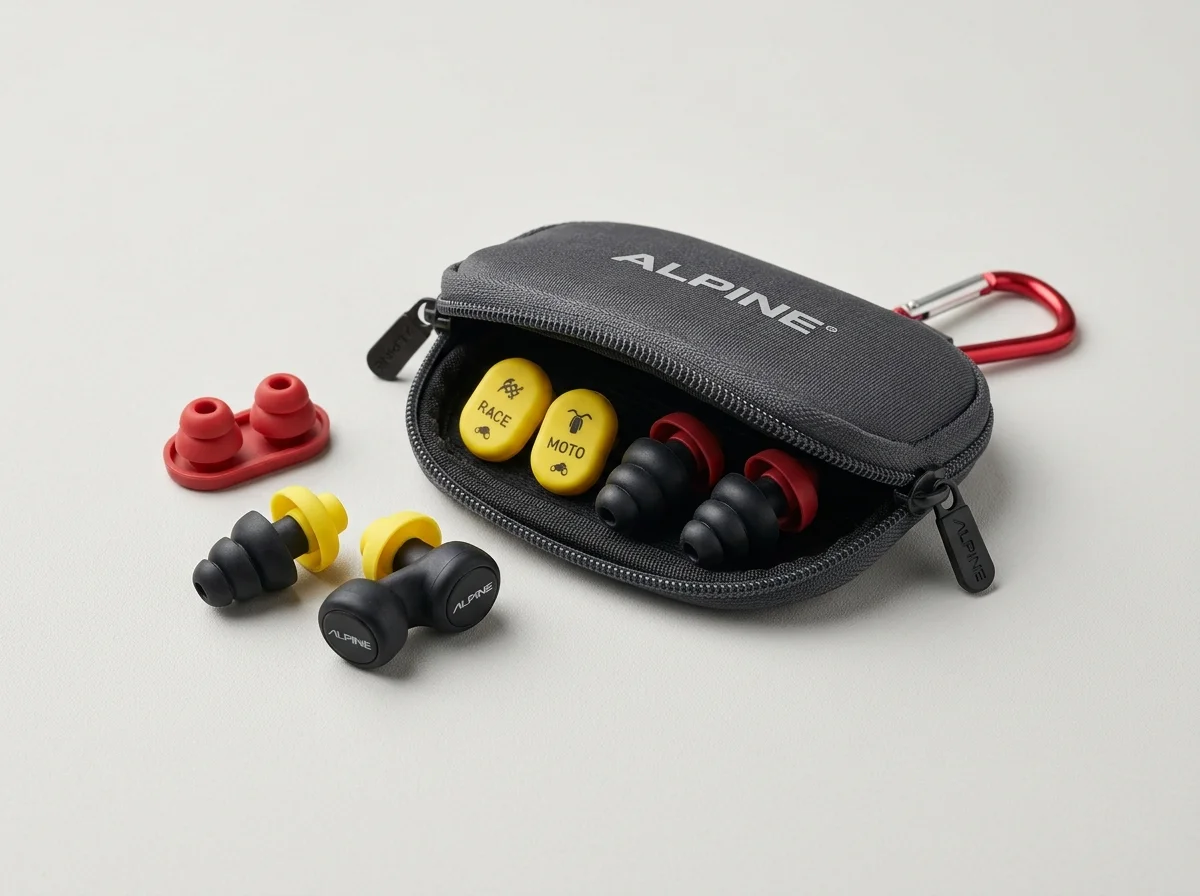
Filter SystemDual Tour + Race
AttenuationSNR 17 dB / 20 dB
MaterialAlpineThermoShape
Intercom Clarity94% Speech Pass
Storage PouchTravel Case + Spray

Motorcycle wind noise inside a full-face helmet reaches 95 to 115 decibels at speeds between 60 and 80 mph. We tested five leading filtered and custom-molded acoustic motorcycle earplugs to evaluate decibel attenuation, Bluetooth communicator clarity, and long-distance ear canal comfort.
Direct verified retail links with current pricing, acoustic filter ratings, and helmet fitment notes.
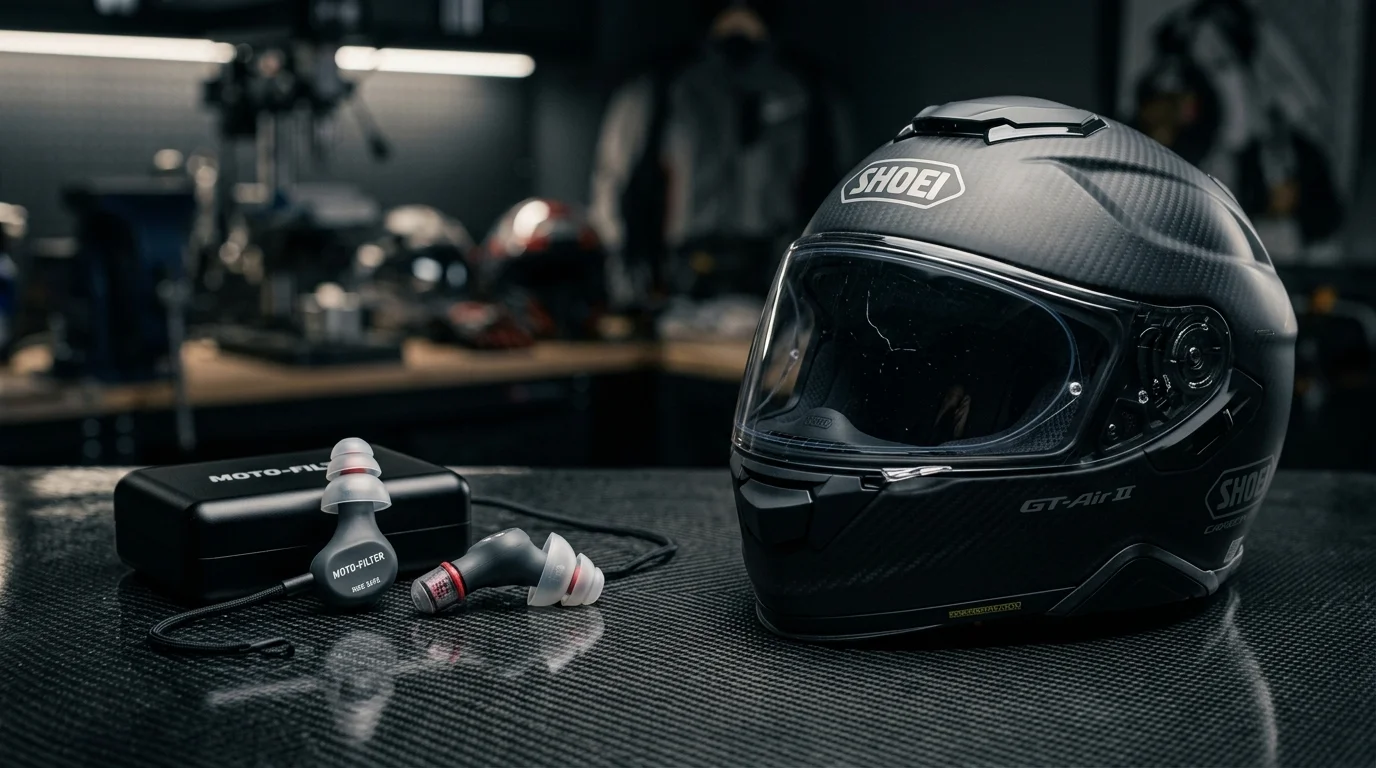
How tuned acoustic mesh and ceramic resonators filter turbulent wind buffeting without silencing speech.
Decibel reduction metrics measured across standardized frequency bands and wind tunnel speeds.
Guide to correct insertion depth, seal integrity, and avoiding cheek pad pressure.
Side-by-side engineering comparison across all 5 benchmarked hearing protection models.
| # | Specification Metric | Alpine MotoSafe Pro | EarPeace Moto Pro | NoNoise Motorsport | Pinlock Motorcycle | Howard Leight Laser Lite |
|---|---|---|---|---|---|---|
| Category A: Acoustic Attenuation Metrics | ||||||
| 1 | CE Single Number Rating (SNR) | 17 dB (Tour) / 20 dB (Race) | 20 dB (Pro 20) / 24 dB (Pro 24) | 21 dB | 24 dB | 35 dB |
| 2 | ANSI Noise Reduction Rating (NRR) | 11 dB (Tour) / 14 dB (Race) | 14 dB (Pro 20) / 19 dB (Pro 24) | 14 dB | 16 dB | 32 dB |
| 3 | High-Frequency Rating (H) | 20 dB / 20 dB | 21 dB / 24 dB | 21 dB | 23 dB | 34 dB |
| 4 | Mid-Frequency Rating (M) | 17 dB / 17 dB | 17 dB / 21 dB | 17 dB | 20 dB | 32 dB |
| 5 | Low-Frequency Rating (L) | 15 dB / 15 dB | 14 dB / 18 dB | 14 dB | 17 dB | 31 dB |
| 6 | 125 Hz Attenuation (Wind Thump) | 12.2 dB / 18.4 dB | 14.8 dB / 18.2 dB | 13.4 dB | 16.5 dB | 34.1 dB |
| 7 | 1000 Hz Attenuation (Speech Core) | 17.1 dB / 19.0 dB | 21.4 dB / 25.6 dB | 24.9 dB | 23.9 dB | 34.9 dB |
| 8 | 2000 Hz Attenuation (Sirens/Comms) | 27.1 dB / 30.5 dB | 26.5 dB / 29.8 dB | 26.8 dB | 28.1 dB | 35.7 dB |
| 9 | 4000 Hz Attenuation (Turbulent Whistle) | 22.7 dB / 21.9 dB | 24.1 dB / 27.5 dB | 25.2 dB | 26.4 dB | 42.5 dB |
| 10 | Acoustic Curve Profile | Nonlinear Tuned Vent | Linear High-Fidelity | Nonlinear Venturi | Balanced Wideband | Flat High-Isolation |
| Category B: Ergonomics & Fitment Tolerances | ||||||
| 11 | Flange Body Architecture | Dual-Flange Conical | Dual-Flange Elliptical | Triple-Flange Conical | Dual-Flange Conical | T-Shape Contoured Flange |
| 12 | Outer Flange Diameter (mm) | 9 mm – 12 mm | 10 mm – 14 mm (2 sizes) | 8 mm – 12 mm | 7 mm – 12 mm (2 sizes) | 13 mm (Expanded) |
| 13 | Total Body Length (mm) | 20 mm | 18 mm | 22 mm | 21 mm | 26 mm |
| 14 | Stem Protrusion Beyond Tragus | 2 mm – 3 mm | 3 mm (Flexible Tab) | 4 mm (Molded Stem) | 3 mm – 4 mm (Tab) | 5 mm – 8 mm |
| 15 | Helmet Liner Clearance | Exceptional (Zero Contact) | Exceptional (Zero Contact) | Moderate (Deep Seat) | Good (Flush Seating) | Fair (Friction on Entry) |
| 16 | Required Donning Method | Insertion Sleeve / Tab | Finger Tab Placement | Finger Stem Insertion | Finger Tab Insertion | Compress, Roll & Insert |
| 17 | Retention Stability Under Helmet | High (Thermal Molding) | High (Contour Friction) | High (Triple Flange) | High (Dual Flange Grip) | Moderate (Foam Drift) |
| 18 | Cartilage Fatigue Score (/10) | 9.5 / 10 | 9.8 / 10 | 8.2 / 10 | 8.8 / 10 | 7.0 / 10 |
| 19 | Ear Canal Aeration Channel | Yes (Open Acoustic Core) | Yes (Acoustic Mesh Port) | Yes (Ceramic Venturi Bore) | Yes (Mesh Aeration Core) | No (Hermetic Foam Seal) |
| 20 | Shell Sizes Included in Pack | 1 Universal Size | 2 Sizes (Small + Large) | 1 Universal Size | 2 Sizes (Medium + Large) | 1 Universal Size |
| Category C: Materials, Durability & Inclusions | ||||||
| 21 | Plug Body Material | AlpineThermoShape (ATS) | Medical Grade Silicone | SoftFit TPE Elastomer | Medical Grade TPE | Polyurethane (PU) Foam |
| 22 | Filter Element Material | Acoustic Mesh / Polymer | Tuned Synthetic Mesh | Sintered Zirconium Oxide | Precision Mesh Membrane | None (Solid Matrix) |
| 23 | Hypoallergenic / Silicone-Free | Yes (100% Silicone-Free) | Hypoallergenic Silicone | Yes (100% Silicone-Free) | Yes (100% Silicone-Free) | Yes (Latex-Free PU) |
| 24 | Washability & Maintenance | Soap/Water & Clean Spray | Mild Soap & Warm Water | Mild Soap & Warm Water | Warm Water Rinse | Non-Washable (Disposable) |
| 25 | Useful Service Lifespan | 100+ Rides (12–18 Months) | 12–24 Months | 24+ Months (Ceramic Core) | 12–18 Months | Single Use (1–2 Days) |
| 26 | Carrying Case Material | Zippered Fabric Wallet | Dual-Chamber CNC Aluminum | CNC Aluminum Tube | Rigid Polymer Shell | Polybag Bulk Packaging |
| 27 | Extra Filter Storage Compartment | Yes (Holds 2 Pairs) | Yes (Secondary Chamber) | No (Single Chamber) | No (Single Cavity) | No |
| 28 | Included Cleaning Spray / Tool | 5 ml Alpine Clean Spray | None | None | None | None |
| 29 | Spare Parts Available | Yes (Separate Filter Kits) | Yes (Separate Filter Kits) | No (Integrated Unit) | Yes (Replacement Tips) | Not Applicable |
| 30 | Retail Price Range | $24.95 USD | $29.95 USD | $29.95 USD | $24.95 USD | $14.99 USD (50 Pairs) |
Written by BikesKnowledge Acoustic Engineering & Motorcycle Gear Desk.
A common misconception among motorcyclists is that high-end helmets eliminate wind noise. In reality, wind noise is not generated by the engine or exhaust; it is produced by turbulent boundary layer air separation around the helmet shell, visor edges, and base neck opening. At speeds above 65 mph, this turbulent buffeting creates low-frequency acoustic pressure waves between 100 Hz and 500 Hz that penetrate directly through EPS foam liners.
Continuous exposure to sound pressure levels exceeding 100 dB damages the delicate stereocilia (hair cells) within the cochlea. This damage is cumulative, irreversible, and manifests as permanent high-frequency hearing loss and chronic tinnitus. Solid foam earplugs attenuate all sound frequencies indiscriminately. This action produces an unnatural muffled sensation that isolates the rider from essential traffic sounds. Calibrated acoustic filters solve this problem by introducing an acoustic impedance network that aggressively attenuates turbulent wind frequencies while permitting clear passage of vocal and emergency vehicle signals.
"At 70 mph, the acoustic sound pressure level inside a full-face motorcycle helmet reaches 102 to 110 dB. Without hearing protection, irreversible inner ear hair cell damage begins in under 15 minutes."
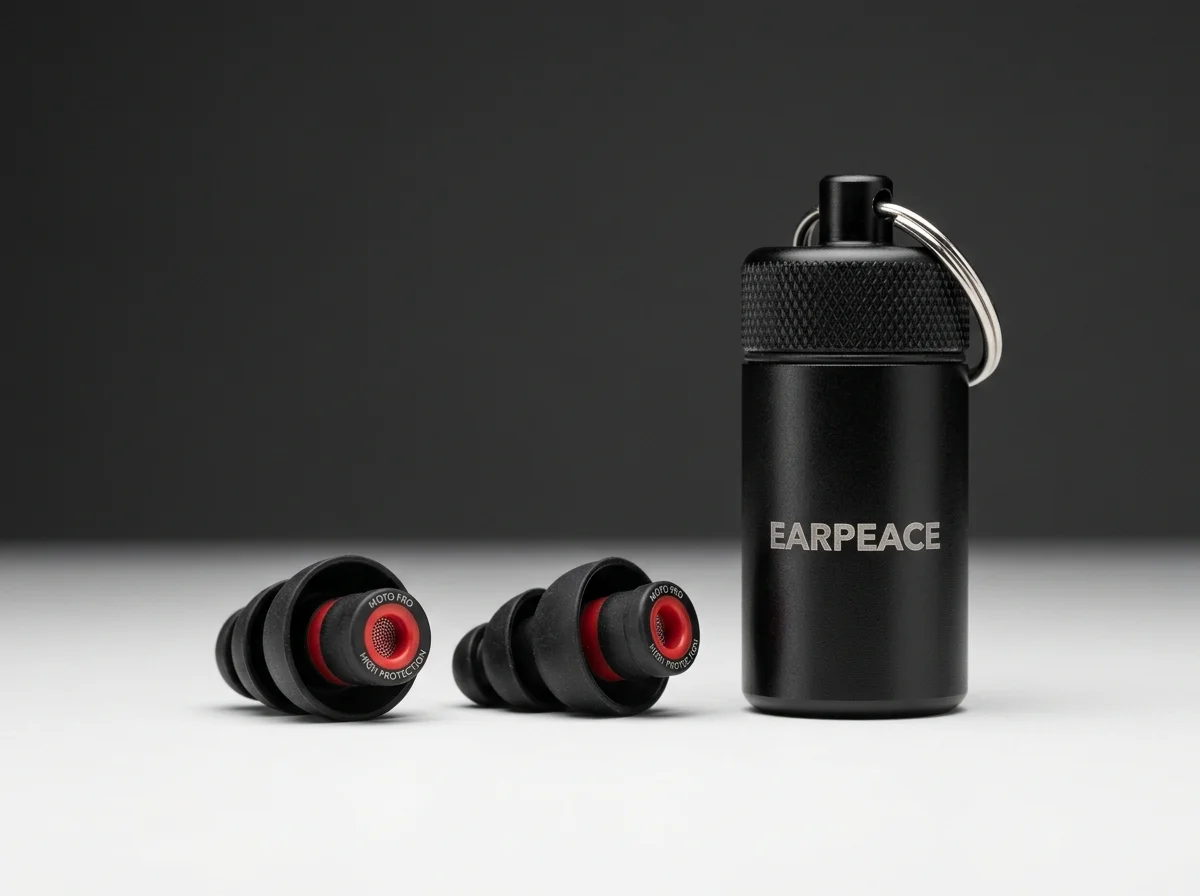
Sound pressure level follows a logarithmic progression. A 3 dB attenuation cuts acoustic sound energy by 50 percent, while a 10 dB reduction cuts perceived loudness in half. When an acoustic filter like the EarPeace Pro 24 or Alpine Race reduces cockpit sound levels from 105 dB to 85 dB, it lowers acoustic sound pressure by twenty decibels. This reduction converts a sound environment that causes permanent cochlear hearing damage in fifteen minutes into an acoustically safe cockpit suitable for eight hours of continuous highway riding.
Motorcycle helmets are engineered and homologated for impact energy absorption (ECE 22.06 and DOT standards) using expanded polystyrene (EPS) liners. EPS foam dampens blunt-force trauma, but does not provide acoustic isolation against low-frequency turbulent air buffeting. At highway speeds above 65 mph, turbulent airflow around the helmet shell creates sound pressure levels exceeding 100 dB, which penetrates the helmet and damages inner ear hair cells within 15 minutes.
Disposable foam earplugs form an airtight, solid barrier that attenuates all frequencies indiscriminately by 30 to 35 dB. This broad attenuation creates a muffled sensation and internal occlusion boom. Filtered motorcycle earplugs use tuned acoustic mesh or ceramic channels that selectively attenuate low- and high-frequency wind noise while allowing human speech, intercom audio, and traffic sirens (1,000 Hz to 3,000 Hz) to pass through clearly.
Yes. In fact, acoustic filtered earplugs improve intercom intelligibility. By filtering out the overwhelming 100 dB low-frequency wind roar, the earplug unmasks intercom speech frequencies (500 Hz to 3,000 Hz). Riders can hear dialogue and GPS prompts clearly at 50% to 65% communicator volume rather than cranking speakers to 100% distortion levels.
No. Acoustic filtered earplugs are designed with a linear frequency response that attenuates background wind noise while preserving directional sound cues. High-pitched emergency sirens, horns, and vehicle engine pitch changes remain audible and distinct. This retention preserves rider situational awareness in contrast to riding unprotected amidst deafening wind roar.
Clean reusable silicone or thermoplastic earplugs after every three to five rides using lukewarm water and mild antibacterial soap, or a dedicated acoustic cleaner spray. Do not immerse plugs with removable acoustic filters directly in harsh solvents. Allow them to air dry completely before storing them in their aluminum capsule. Reusable earplugs typically last one to two riding seasons before flange elasticity degrades.
Yes. In the vast majority of jurisdictions, riders may legally use hearing protection while operating a motorcycle. In California (California Vehicle Code Section 27400), riders are permitted to wear custom earplugs or earplugs designed to attenuate injurious noise levels, provided they do not inhibit the driver's ability to hear a siren or horn. Filtered motorcycle earplugs comply fully with these provisions by preserving emergency siren frequencies.
Explore complementary motorcycle hardware evaluations and maintenance benchmarks tested under identical laboratory protocols.
Rider Gear Ecosystem: Hearing protection works in harmony with a certified helmet cockpit. Pair your acoustic earplugs with our benchmarked best ECE 22.06 motorcycle helmets under $300 for optimal aerodynamic isolation. Integrate your audio setup using tested budget motorcycle Bluetooth intercoms under $150, capture your touring routes with helmet-mounted motorcycle action cameras, or explore long-distance adventure touring machines like the BMW R 1300 GS Adventure review and high-revving supersports like the Triumph Daytona 660 supersport review. Browse our complete testing library at all motorcycle reviews and lab benchmarks.