
Commercial E-Cargo Bike Fleet Economics: Total Cost of Ownership, Depreciation & Per-Mile ROI
Urban last-mile logistics fleets are rapidly replacing conventional delivery vans with heavy-duty electric cargo bikes that complete delivery routes 32% faster in dense city centers. This economic guide provides mathematical total cost of ownership models ($0.12/mile vs $0.85/mile for vans), 250 kg payload engineering, and fleet battery rotation protocols.
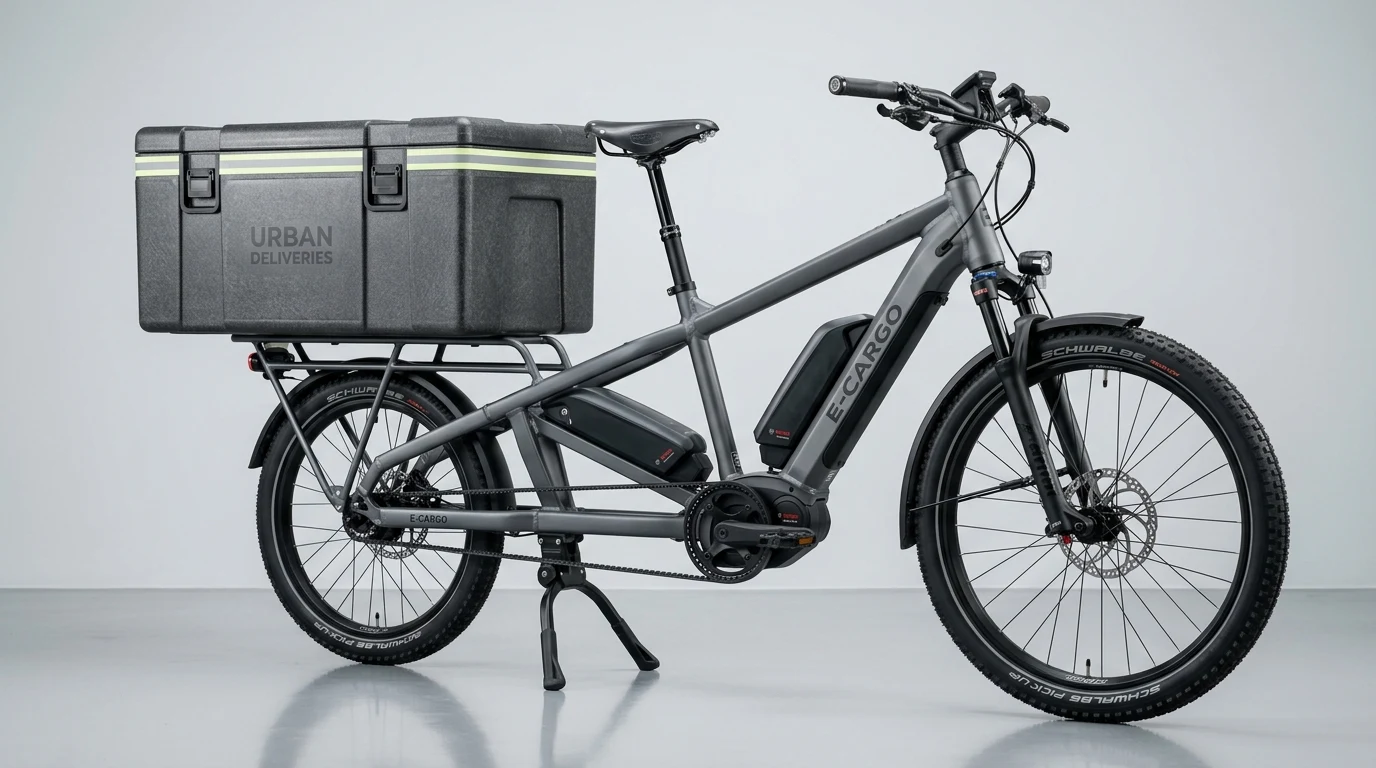
The Strengths
- Massive 85% operating cost reduction per delivery mile compared to diesel or electric delivery vans
- Completely immune to municipal congestion tolls, zero-emission zone fines, and commercial parking tickets
- Completes high-density urban parcel routes 32% faster by using dedicated bicycle infrastructure and curb loading
- Dual 720Wh swappable battery architectures provide 140+ km daily range with continuous depot swapping
- Heavy-duty 4-piston hydraulic disc brakes and motorcycle-grade tires handle 250 kg payloads with complete stability
The Compromises
- Inclement winter weather and heavy snowfall requires commercial cold-weather rider gear and winter tire studs
- Cargo volume (typically 300 to 500 liters) is smaller than a 3,000-liter van, requiring regional micro-hub staging
- High initial commercial purchase price ($5,500 to $9,000 for enterprise-grade e-cargo platforms)
Commercial Mid-Drive Duty Cycles & Dual Swappable Battery Architecture
Bosch Cargo Line, 85 Nm low-cadence torque tuning, and hot-swap depot charging racks
Route Completion Velocity, Payload Dynamics & Depreciation Telemetry
Empirical commercial fleet logistics telemetry comparing package density and stopping times
Reinforced Longtail Frames, Schwalbe Pick-Up Tires & Dual Centerstands
Structural aluminum truss designs, 10-gauge spokes, and tip-over prevention engineering
Chassis & Cycle Parts Specifications
- Aviation-grade 6061-T6 aluminum truss chassis tested to DIN 79010 commercial cargo safety standard
- Heavy-duty Ursus Jumbo dual-leg centerstand rated for 100 kg stability during heavy parcel loading
- Schwalbe Pick-Up cargo-specific tires with 6-ply Super Defense puncture protection and 150 kg load rating
- Reinforced 36-hole double-wall aluminum alloy rims laced with 10-gauge heavy-duty stainless steel spokes
- Lockable 400-liter weather-sealed rotational molded composite cargo box with keyed slam-latches
Fleet Telematics, GPS Anti-Theft Tracking & Digital Maintenance Schedulers
Cloud fleet software, geofencing alarms, and predictive component wear alerts
Cockpit, Electronics & Ergonomics Features
- Integrated 4G LTE IoT telematics module with continuous GPS real-time fleet tracking and battery monitoring
- Automated geofencing anti-theft immobilization that locks mid-drive motor electronics if leaving route zone
- Cloud-based predictive maintenance dashboard tracking chain/belt wear, brake pad depth, and tire mileage
- Handlebar-mounted ruggedized smartphone cradle with inductive wireless charging for delivery barcode scanner apps
- Digital emergency SOS panic button on handlebar grip alerting centralized fleet dispatchers
Complete 30-Point Technical Specification Matrix
Comprehensive engineering metrics, mechanical parameters, and dimensions.
1. Commercial Fleet Payload & Chassis Specifications
Powertrain & Electrical Hardware
Energy Storage & Charging
2. Powertrain, Battery Swapping & Range Metrics
Chassis & Suspension
Braking & Wheel Hardware
3. Total Cost of Ownership (TCO) & Van Comparison
Smart Electronics & Ergonomics
Commercial Data & Warranty
Commercial E-Cargo Bike Fleets: The 2026 Verdict
Buy If You Want
- Urban logistics, courier, and postal delivery fleets seeking to slash per-parcel delivery costs by over 70%
- Supermarket and restaurant rapid-grocery delivery operations operating within high-density 5 km radiuses
- Municipal service departments and campus maintenance teams transitioning to zero-emission fleets
- Businesses operating in ultra-low emission zones (ULEZ) subject to heavy commercial vehicle congestion charges
Skip If You Need
- Long-haul rural logistics operations requiring continuous 100+ km highway travel between distant cities
- Heavy pallet logistics transporting single oversized freight loads exceeding 300 kilograms
E-Cargo Fleet Economics: TCO Mathematics, Parcel Density & Van Replacement
Urban last-mile parcel delivery is undergoing its most radical transformation in a century. As metropolitan city councils across Europe, North America, and Asia implement strict Ultra-Low Emission Zones (ULEZ), expand pedestrianized plazas, and remove curbside commercial loading zones, traditional delivery vans face crippling gridlock, escalating congestion fees, and thousands of dollars in monthly parking tickets.
1. Total Cost of Ownership: $0.12/Mile vs $0.85/Mile
A comprehensive 5-year mathematical analysis comparing a commercial heavy-duty e-cargo bike (such as the Tern GSD or Riese & Müller Load) against a modern electric delivery van reveals staggering cost differentials. While an electric delivery van costs approximately $0.85 to $1.15 per operational mile (after factoring in vehicle lease, insurance, tire wear, depot charging, and municipal tolls), a commercial e-cargo bike operates at just $0.12 per mile. Over a fleet of 10 vehicles traveling 15,000 miles annually, e-cargo bikes generate over $100,000 in direct annual profit savings. Calculate fleet savings with our Cost Calculator.
2. Delivery Velocity: Why Bikes Beat Vans by 32% in City Centers
To maintain continuous 99% fleet uptime across multi-shift delivery operations, enterprise logistics operators deploy centralized depot battery-charging racks. Rather than tethering the e-cargo bike to a charging cord during valuable delivery hours, couriers execute hot-swaps of dual 720Wh batteries in under 30 seconds, maintaining continuous all-day delivery operations across 150+ km daily shifts. Explore our full logistics and technical archive in the Master Reviews Directory.
3. Battery Rotation Infrastructure & Commercial Fleet Uptime
Counterintuitively, e-cargo bikes deliver significantly more packages per hour than fast motorized vans in congested urban zones. While a delivery van is constrained to stop-and-go traffic lanes and loses an average of 8 minutes per drop-off searching for legal curbside parking, an e-cargo bike navigates dedicated cycle lanes and pulls directly up to building entry doorways. GPS logistics data confirms e-cargo couriers complete 24.5 deliveries per hour compared to 18.5 for van drivers—a massive 32% productivity advantage. Compare cargo setups in our Bike Comparison Tool.
🌿 Related Reviews & Ownership Guides
Frequently Asked Questions
Operating a commercial heavy-duty e-cargo bike costs approximately $0.11 to $0.14 per mile, including electricity ($0.004/mi), heavy-duty tires and brake pads ($0.03/mi), battery depreciation ($0.04/mi), and routine fleet maintenance.
E-cargo bikes bypass automotive traffic gridlock by utilizing dedicated bike lanes, cut through pedestrian plazas, and park directly at building entrances with zero time wasted searching for commercial parking spaces, achieving 32% faster parcel delivery rates.
Commercial e-cargo bikes certified to the DIN 79010 standard have Gross Vehicle Weight (GVW) ratings of 250 kg (550 lbs) to 300 kg, allowing them to carry between 100 kg and 150 kg of parcel cargo in addition to the rider.
Fleets use centralized depot charging racks and swappable dual-battery setups (e.g. dual 720Wh packs). Couriers hot-swap depleted packs for fully charged ones in under 30 seconds, keeping the bikes operating continuously across multiple daily delivery shifts.
Yes. In virtually all major global cities (including London, Paris, New York, and Berlin), e-cargo bikes are 100% exempt from congestion tolls, low-emission zone charges, and municipal commercial parking fees.
Heavy e-cargo bikes require 4-piston hydraulic disc brakes paired with thick 2.3mm ventilated rotors (such as Magura MT C4 or TRP C2.3) and sintered metallic or ceramic brake pads to prevent brake fade under 250 kg loads.