
Dual Battery E-Bikes: Parallel Balancing vs Auto-Switch Modules Engineering Guide
Adding a second battery pack to an electric bike is the most effective way to eliminate range anxiety and double touring distance. However, connecting two lithium battery packs requires precise electronic management to prevent cross-charging currents, blown BMS protection circuits, and connector sparks. This engineering guide compares Ideal Diode parallel combiners against automatic relay switches and direct parallel harnesses.
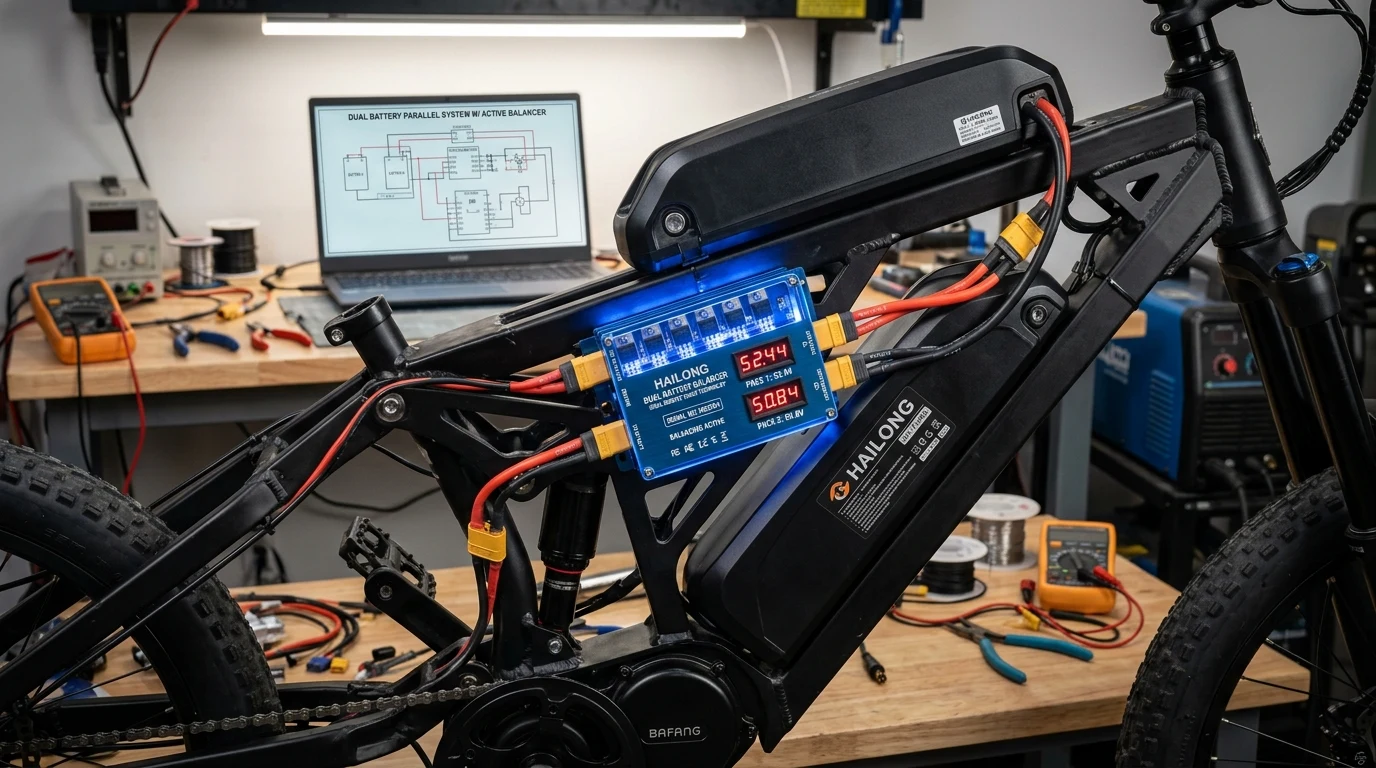
The Strengths
- Active Ideal Diode combiners allow connecting two batteries with different state-of-charge levels safely
- Parallel discharge cuts individual cell current draw in half, reducing internal Joule heating and extending total cycle life
- Significant reduction in voltage sag under heavy hill-climbing throttle maintains higher motor top speeds
- Redundant dual-pack architecture ensures you never get stranded if one battery BMS trips an error cutoff
- Detailed wiring schematics for Hailong, Shark, and custom triangle battery packs with XT90-S anti-spark leads
The Compromises
- Direct Y-cable parallel connection with unmatched pack voltages causes massive cross-charging currents that melt wires
- Auto-switch relay modules switch packs sequentially rather than sharing load, offering zero voltage sag reduction
- Dual battery systems add 7 to 10 lbs of frame weight requiring reinforced water bottle boss mounts
Parallel Discharge Physics, Ideal Diode MOSFETs & Auto-Switch Modules
Active MOSFET gate control, reverse-current blocking, and Peukert capacity recovery kinetics
Voltage Sag Telemetry, Cell Discharge Rates & Usable Energy Comparison
Bench measurements of a 1000W motor load powered by single 14Ah pack vs dual 14Ah parallel packs
Frame Mounting Reinforcement, Dual Shark Bases & XT90-S Wiring
Rivnut frame drilling, CNC bottle cage adapter plates, and heavy-gauge silicone wire routing
Chassis & Cycle Parts Specifications
- Installing reinforced M5 rivnuts into downtube and top-tube to support secondary battery cradle weight
- Using CNC machined aluminum triple-slot adapter plates to distribute battery mass across frame tubes
- Soldering heavy 12 AWG ultra-flexible high-strand silicone wires to Amass XT90-S anti-spark connectors
- Mounting the dual-battery combiner module in a waterproof frame bag or sealed bottom bracket junction
- Fitting inline 30A mini-blade fuses on both battery positive leads before the combiner module
Digital Multimeter Voltage Verification & Charging Protocols
Pre-ride voltage matching checks, independent charging steps, and BMS diagnostic audits
Cockpit, Electronics & Ergonomics Features
- Multimeter Pre-Flight Check: Measuring both pack discharge pins to confirm voltage compatibility
- Dual-Port Independent Charging: Charging each battery pack with its own dedicated GaN smart charger
- Simultaneous Charge Safeguards: Never connecting a single charger to both batteries while connected in parallel
- BMS Balancing Audits: Inspecting individual cell drift across both packs using our cell diagnostic guide
- Current Monitoring: Using a dual-channel digital voltmeter/ammeter display on handlebars for live telemetry
Complete 30-Point Technical Specification Matrix
Comprehensive engineering metrics, mechanical parameters, and dimensions.
1. Dual Battery Combiner & Ideal Diode Electrical Specs
Powertrain & Electrical Hardware
Energy Storage & Charging
2. Performance Gains, Voltage Sag & Cell Longevity
Chassis & Suspension
Braking & Wheel Hardware
3. Wiring Standards, Fusing & Installation Economics
Smart Electronics & Ergonomics
Commercial Data & Warranty
Dual Battery E-Bikes: Parallel vs Auto-Switch Verdict
Buy If You Want
- Cargo e-bike riders and commercial delivery couriers needing all-day range without midday charging stops
- Bikepackers and touring cyclists carrying heavy camping gear across remote mountain routes
- Commuters who want stronger hill-climbing acceleration by eliminating steep voltage sag under throttle
- Riders who want pack redundancy to ensure they never get stranded by a tripped BMS
Skip If You Need
- Weight-conscious urban commuters who only ride 5 to 10 miles per day on flat terrain
- Riders attempting to parallel two battery packs with different nominal voltages (such as mixing 36V with 48V)
Dual Battery Architecture: Ideal Diodes, Voltage Sag Physics & Wiring Safety
Electric bike riders seeking to extend their range typically choose between carrying a spare battery in a backpack or installing a permanent dual-battery system on the frame. While carrying a spare requires stopping to manually swap cables, a properly wired dual-battery system combines both packs on the bike. However, managing two high-energy lithium batteries connected to a single motor controller requires understanding the electrical physics of parallel discharge.
1. Ideal Diode Modules vs Simple Y-Cables vs Auto-Switch Relays
A simple Y-cable directly connects two battery packs together with no active circuitry. If one pack is fully charged at 54.6V and the second pack is at 44.0V, plugging them in causes a violent 60A+ cross-charging current that can melt connectors and damage cell tabs. An Auto-Switch relay module (like Datex) avoids this by running only one battery at a time until it is empty, but provides zero load-sharing benefits. The gold standard is an Ideal Diode parallel combiner: using active N-channel MOSFETs, it prevents cross-charging while allowing both batteries to discharge simultaneously. Learn more about charging safety in our Fast Charging & GaN Charger Guide.
2. The Science of Voltage Sag Reduction & Peukert Gains
When an electric bike draws 25 Amps from a single battery pack, internal cell resistance (IR) causes voltage to drop by 4 to 5 Volts under full throttle. In a dual-battery parallel system, each battery delivers only 12.5 Amps. Because internal heat loss scales with the square of current (I²R), halving the current cuts internal energy dissipation by 75%. This preserves higher operating voltage throughout the discharge curve, delivering faster uphill speeds and extracting up to 18% more usable watt-hours from the cells. Calculate your range gains with our E-Bike Energy & Range Calculator.
3. Safe Installation Protocols: Anti-Spark Connectors & Inline Fuses
When installing a dual battery system, use 12 AWG silicone wiring and genuine Amass XT90-S anti-spark connectors. Install a 30A automotive blade fuse on the positive lead of each battery cradle within 4 inches of the terminal. When charging, charge each pack independently using its own certified charger. For comprehensive controller diagnostics and motor protection, refer to our Controller MOSFET Repair Guide and browse our full library in the Master Reviews Directory.
🌿 Related Reviews & Ownership Guides
Frequently Asked Questions
Yes, provided both battery packs have the exact same nominal voltage (for example, two 48V packs or two 52V packs) and are connected through an Ideal Diode parallel combiner module. The larger capacity pack will naturally supply proportionally more current, and both will discharge smoothly together.
No. Never parallel batteries with different nominal voltages or different series cell counts (such as 13S 48V and 14S 52V). The voltage difference will keep the lower-voltage battery completely disabled or cause severe electronic faults in the combiner circuitry.
If you use a basic Y-cable and plug in two batteries that have a voltage difference of more than 0.5 Volts, the higher-voltage battery will instantly dump massive cross-charging current into the lower-voltage pack. This creates severe connector arcing, blows internal BMS protection fuses, and poses a serious battery fire risk.
A standard silicon or Schottky diode has a forward voltage drop of 0.5V to 0.8V, generating 15+ Watts of waste heat under load that requires large heatsinks. An Ideal Diode uses an active MOSFET with specialized gate control circuitry that has almost zero resistance, dropping less than 0.03V and generating virtually no heat.
No. With an Ideal Diode combiner module, you can charge each battery independently at different times. When you ride, the module draws power from the higher-voltage pack first until both packs equalize, after which it draws power equally from both batteries.
A dual battery system does not increase your motor nominal top speed on flat ground (which is governed by controller RPM limits and battery nominal voltage). However, by cutting voltage sag in half under full throttle, it allows the bike to maintain higher sustained speeds up to steep hills and against head winds.